# Best under-bed shoe organisers for shoes and boots
Canonical HTML: [Best under-bed shoe organisers for shoes and boots](https://spacemadeuseful.co.uk/best-under-bed-shoe-organisers/)
Buying guide · [Bedroom](https://spacemadeuseful.co.uk/under-bed-storage/) ·
Compare shallow, fixed-cell, adjustable and boot-length under-bed shoe organisers. Check real shoe height, cell size and how far each case needs to pull out.
Space Made Useful · Updated November 2026 · 4 options compared ·
Quick answer
## Choose for your tallest pair and the loaded case
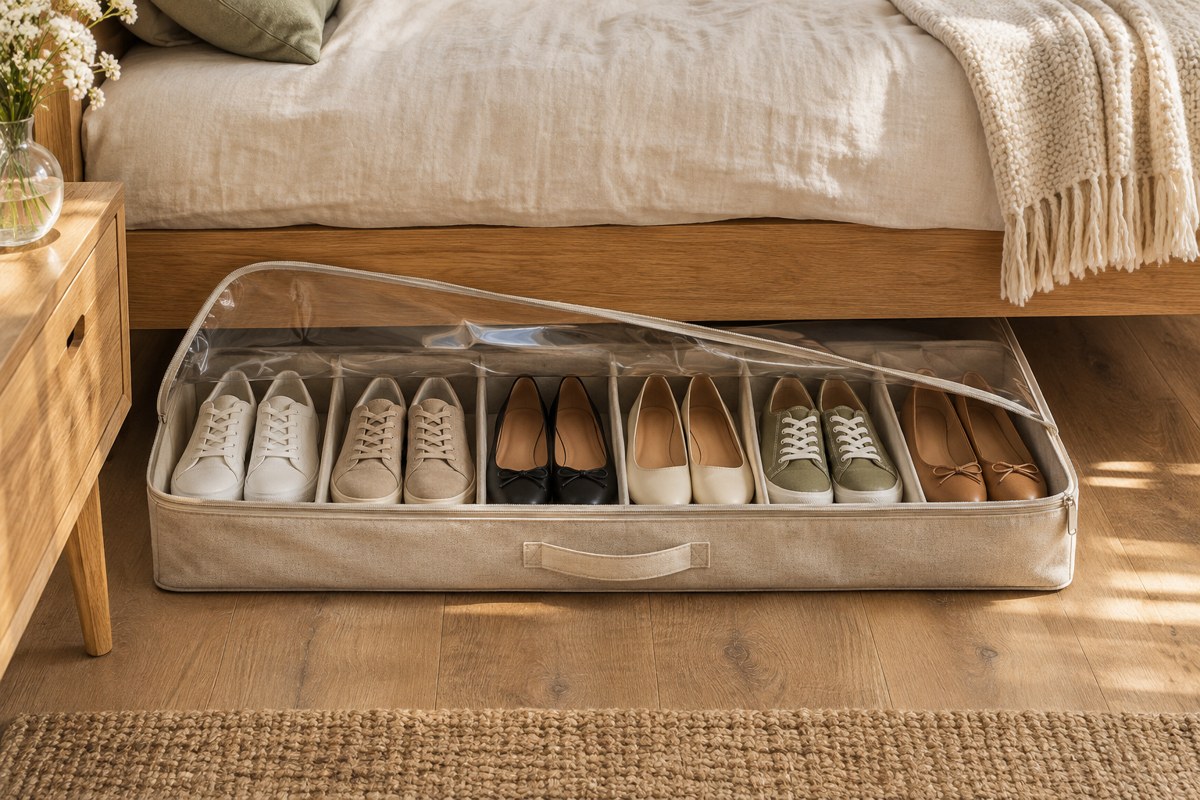
Measure the shoes and the bed’s lowest opening, then check the whole pull-out path. Use low fixed cells for slim shoes, adjustable cells for mixed widths and a separate long layout for boots whose care allows them to lie flat.
## Four under-bed layouts for different footwear
Sizes are nominal and apply to one case. Measure the packed height and count the cells your own pairs need.
For a lower bed
### Lifewit 12-cell under-bed shoe organisers
Two low fabric cases with fixed fabric dividers, a clear top and pulls on two sides. Each case has twelve cells.
**Nominal outside size**: 76.2 × 61 × 11 cm each
**Access**: Clear zipped cover and two grips
**In the pack**: Two 12-cell cases
**What to check** Measure the actual height over soles and tongues. Bulky shoes can need more than one cell or one shoe per cell.
View on Amazon — Lifewit 12-cell under-bed shoe organisers
For a single measured bay
### Compactor Rivoli shoe storage case
One fold-flat fabric case with twelve fixed compartments, a clear zipped cover and a pull handle.
**Nominal outside size**: 76 × 60 × 15 cm
**Access**: Clear zipped cover and pull handle
**In the pack**: One 12-cell case
**What to check** Check the 15 cm outside height and measure shoes against the cells. Leave room to open the cover without bending the case.
View on Amazon — Compactor Rivoli shoe storage case
For pairs of different widths
### VAESIDA adjustable under-bed shoe organisers
Two clear-topped cases with hook-and-loop dividers you can reposition and a supported base.
**Nominal outside size**: 78.5 × 61 × 15 cm each
**Access**: Clear zipped covers and reinforced handles
**In the pack**: Two adjustable cases
**What to check** Widening cells reduces the number of usable compartments. Check actual shoe height and room to pull the whole case into the aisle.
View on Amazon — VAESIDA adjustable under-bed shoe organisers
For shoes and boots in separate cases
### homyfort under-bed shoes and boots set
The two-case set combines a 16-cell shoe case with a separate four-cell layout for laying suitable boots flat.
**Nominal outside size**: 96.5 × 61 × 15.2 cm each
**Access**: Clear zipped covers and front and side grips
**In the pack**: One shoe case and one boot case
**What to check** Check the long case against your bed supports. Store boots flat only where their maker’s care guidance and shaft shape allow it.
View on Amazon — homyfort under-bed shoes and boots set
## Side-by-side dimensions
Scroll sideways to see all columns.
Nominal outside dimensions, length × width × height
| Case | Outside size | Cell layout | Pack |
| --- | --- | --- | --- |
| Lifewit | 76.2 × 61 × 11 cm | 12 fixed cells per case | Two cases |
| Compactor Rivoli | 76 × 60 × 15 cm | 12 fixed cells | One case |
| VAESIDA | 78.5 × 61 × 15 cm | Repositionable dividers | Two cases |
| homyfort | 96.5 × 61 × 15.2 cm | 16 shoe cells and 4 boot cells in separate cases | Two cases |
## Measure a pair in the position it will be stored
Start with the shoes you actually want to put away. Set your longest pair together as it would sit in a cell and measure from the heel to the furthest toe. Then check across the widest part of the pair and from the floor to the highest point on the uppers. Trainers with chunky soles, high tongues or heel loops can need more room than the same UK size in a flat shoe. Include anything you use to help a shoe keep its shape.
Use cell counts as layout information. A fixed twelve-cell case gives you twelve spaces, but a chunky pair can need a cell per shoe, and a high upper can hold up the cover. If a pair sits best heel to toe, try that arrangement before measuring. Leave space to pick up each shoe without tugging it against the next one. When the retailer has published only a maximum shoe length, ask for the usable cell width or check the return terms before committing.
Clean the shoes as directed and let them dry before you store them. Follow the footwear maker’s instructions, particularly for leather and outdoor boots that need airflow. Keep frequently worn wet pairs in a suitable ventilated location until dry. See the [hallway boot storage guide](https://spacemadeuseful.co.uk/best-boot-storage-for-hallways/) for formats intended for regular access.
## Check the filled case and the whole pull-out path
Measure from the floor or rug to the lowest part of the bed along the case’s route. Use the nominal case height as a first filter. A soft cover can rise over a bulky pair, so compare the thickest packed spot against the rail and anything lower behind it. Check the opening width between the legs or centre supports and the unobstructed depth. The [under-bed measuring guide](https://spacemadeuseful.co.uk/measure-under-bed-storage/) walks through each reading.
**Illustrative fit check.** If a 13 cm opening takes an 11 cm empty case, there is 2 cm of nominal height to spare. If a bulky pair lifts the closed cover to 14 cm, that configuration will catch. Try a different orientation, another bay or a container where those shoes can sit without pressure.
A large rectangular case needs space to come clear before you open the top. Sketch the footprint of the case on cardboard and pull it into the normal aisle with the door open. Check the direction of the grips against that route. A short-end handle is useful when the case comes out along its length. A long-side grip can be easier where a wide section of the bed is open. On carpet, check how the intended load behaves across pile and rug edges. The [carpet guide](https://spacemadeuseful.co.uk/under-bed-storage-on-carpet/) gives practical examples of how to check drag.
## Choose fixed cells, adjustable dividers or separate boot storage
For a lower opening, the [Lifewit 12-cell two-pack](https://spacemadeuseful.co.uk/best-under-bed-shoe-organisers/#lifewit-under-bed-shoes-12-two) is listed at 11 cm high. It suits a collection with several flat or slim pairs if the case’s 61 cm side fits the intended entry. Load a taller pair at the edge and see whether the cover can close normally. For one usable bay or a smaller collection, the [single Compactor Rivoli](https://spacemadeuseful.co.uk/best-under-bed-shoe-organisers/#compactor-rivoli-shoes-ran4481) gives you the fixed twelve-cell layout in one case, with a nominal height of 15 cm.
For uneven widths, the [VAESIDA cases](https://spacemadeuseful.co.uk/best-under-bed-shoe-organisers/#vaesida-adjustable-under-bed-shoes-two) let you move the dividers. That is useful if narrow flats and broad trainers share a case. Set up the widest cells first, then use the remaining space for narrower pairs. Expect fewer separate cells when you widen several of them. Check the remaining depth at the sides of each shoe and leave space for fingers.
The [homyfort shoe-and-boot set](https://spacemadeuseful.co.uk/best-under-bed-shoe-organisers/#homyfort-under-bed-shoes-boots-set) separates regular shoe cells from four longer spaces. Those spaces are for boots that can lie flat with their shafts supported and within the loaded height. Check the footwear instructions and the actual outline of the boot. A tall boot whose shaft would crease is better kept upright somewhere suitable. The long homyfort case also needs a continuous bay. Draw the whole 96.5 × 61 cm footprint around the legs before planning where it goes.
## Keep the pairs you want easiest to reach
Put the pairs you will retrieve first nearest the opening edge. A clear cover helps you recognise a group once you have pulled the case out far enough to see it. Put each case where its handle stays within reach and mark the accessible end if two cases look alike. For a spare seasonal rotation, store the rest together and keep regularly worn pairs close to the door or in a [hallway footwear system](https://spacemadeuseful.co.uk/hallway-shoe-storage/).
Use a light loaded case you can support with both hands when you need to carry it. A wider case is easier to work with in a clear aisle than between a bed and a chest of drawers. If only one side of the bed is accessible, the [shared storage guide](https://spacemadeuseful.co.uk/organise-under-bed-storage-for-two/) shows how to use separate bays without putting one case behind another.
## Questions before you choose
### What height do I need under the bed?
Measure the lowest point across the whole path and compare it with the case once loaded. Include the highest upper, the cover and anything that catches as the case crosses the floor.
### Does twelve cells mean twelve pairs?
Twelve cells gives you twelve spaces. A flat pair may fit together while chunky trainers may need one cell per shoe or an adjusted divider.
### Can I store boots on their sides?
Check the boot maker’s guidance and support the shaft if needed. Leave tall or structured boots upright if folding or flattening the upper would damage their shape.
### Which grip should face out?
Use the grip that lines up with your pull-out route. Test the short end and long side against the bed legs and your normal standing position.
### What if my bed has a centre support?
Measure each usable opening and the clear space behind it. Draw the case footprint on cardboard and try the route from the side or foot before buying.
### Can I put wet shoes away under the bed?
Clean and dry them as directed before putting them into a zipped case. Use a suitable ventilated location to dry regularly worn footwear.
## How this shortlist was assembled
We checked four exact Amazon UK variants in November 2026 against the published dimensions and layouts. Lifewit and Compactor publish their own product details. The other dimensions come from the brands’ selected UK listings. Cell counts describe the layouts, and actual capacity depends on the shoes.
[Read our source policy](https://spacemadeuseful.co.uk/source-policy/)
**Space Made Useful**
We compare documented dimensions, opening mechanisms and other details that help you choose storage for the space you have. [How we research our guides](https://spacemadeuseful.co.uk/editorial-policy/).
**Affiliate disclosure.** If you buy through a product link on this page, we may earn a commission at no extra cost to you. As an Amazon Associate we earn from qualifying purchases. [How affiliate links work](https://spacemadeuseful.co.uk/affiliate-disclosure/).