# Shoe cabinet vs shoe rack for a narrow hallway
Canonical HTML: [Shoe cabinet vs shoe rack for a narrow hallway](https://spacemadeuseful.co.uk/shoe-cabinet-vs-shoe-rack/)
Comparison · [Hallway](https://spacemadeuseful.co.uk/hallway-shoe-storage/) ·
Compare closed cabinets and open racks by loaded depth, opening space, shoe fit and everyday access.
Space Made Useful · Updated November 2026 · Two exact product examples ·
The main decision
## Compare the space each option occupies in use
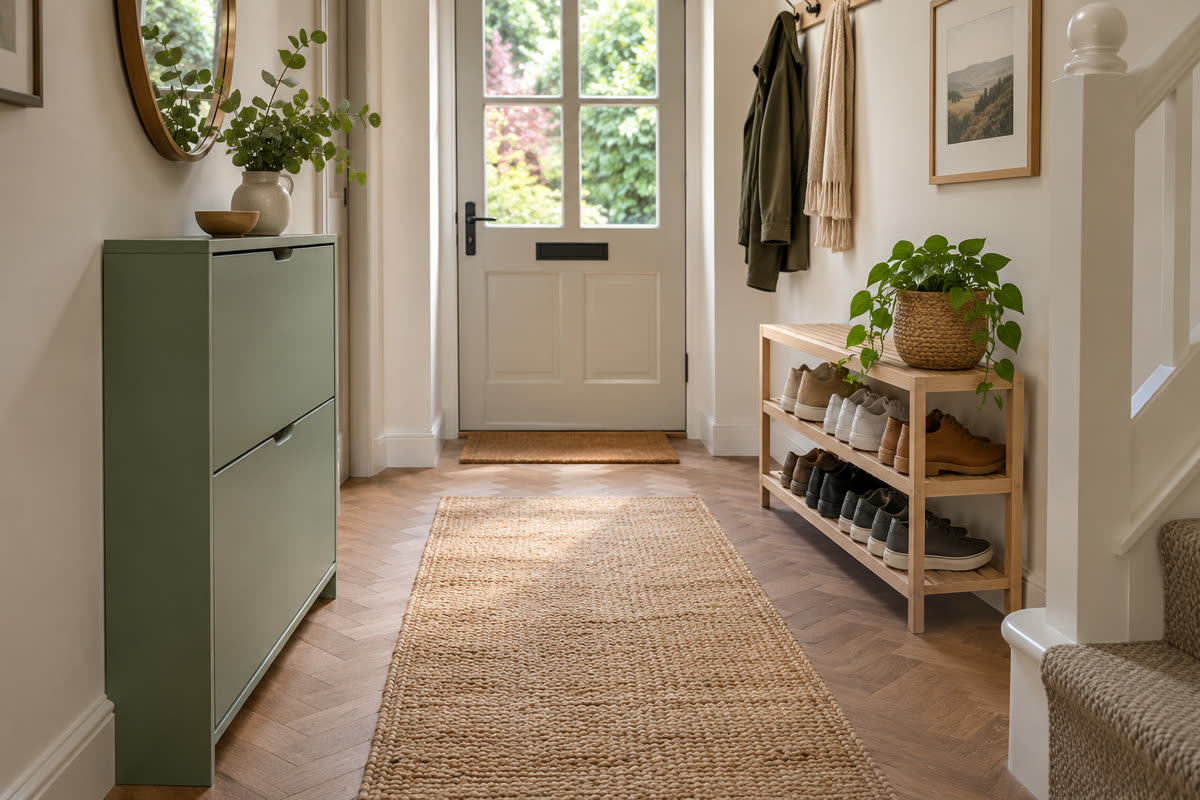
A flip-down cabinet can keep a narrow hall tidy when closed. An open rack gives faster access and accommodates more varied shoe shapes. Measure the cabinet with its flap open and the rack with your longest shoes in place.
## Measure closed, open and loaded footprints
A cabinet and a rack can look like straightforward alternatives until you put them in the same hallway. A slim cabinet hides shoes behind its front. Its moving flap takes up space when someone opens it. A rack has no flap, but the shoes are part of its footprint all day. Compare the two at the point where the entrance is already tightest.
Record the width of the usable wall. Allow for the skirting, a projecting handle and any hinge or valve at the height of the furniture. Take the installed distance from the wall to the farthest front edge. The catalogue depth is a starting figure. A wall projection behind the furniture can increase the space it takes up.
For a cabinet, ask for the maximum open projection of the exact flap. The hinge, front panel and handle can be farther forward than the cabinet body. Check whether opening it crosses the front door's path. For a rack, position your longest pair on the available support and check the farthest toe or heel. Use the full loaded projection when you assess the remaining route.
## Compare the shoes you actually keep near the door
Flat trainers and low shoes are often easier to place in a tilting compartment than a pair with a tall heel or thick sole. A cabinet divider sets the space for each row. Check the usable length, width and height at the narrowest point, and ask whether the maker allows the divider to be moved. Test with the longest and bulkiest pairs separately. The two may be different shoes.
The grey SoBuy below is a 19 cm-deep cabinet before any installation stand-off. That outside measurement tells you about the closed body. The [flip-down shoe fit guide](https://spacemadeuseful.co.uk/check-shoes-fit-a-flip-down-cabinet/) shows how to check the shoe and the compartment as the flap moves.
Narrow wall space
### SoBuy grey two-flap shoe cabinet
A 50 cm-wide cabinet with two tilting compartments and a 19 cm closed body.
**Outside · W × D × H cm**: 50 × 19 × 91
**Access**: Two flip drawers
**In the pack**: One cabinet
**What to check** Fit the supplied wall anti-tip device. Measure the fully open projection and the space inside the bin before choosing.
View on Amazon — SoBuy grey two-flap shoe cabinet
On a rack, shelf spacing determines whether you can pick up a high-top trainer without tipping it through a small opening. A rack's top shelf may have more usable height if there is clear space above it. Measure the gap under the next shelf as well as the height of the shoe. If the shelf is made from rods, check how narrow heels and smaller shoes sit on those supports.
The SONGMICS three-tier rack has a 30 cm frame depth and needs 92 cm of wall length. It can take more wall width than a compact cabinet. Check the width between the uprights and the loaded depth in your actual arrangement before deciding how many pairs it can hold.
For an open stretch of wall
### SONGMICS 3-tier shoe rack
Three open tiers keep everyday shoes within reach. The 30 cm frame depth is useful where a deep cabinet would crowd the hall.
**Outside · cm**: 92 × 30 × 55
**Access**: Open shelves
**In the pack**: One rack
**What to check** Allow 92 cm of wall width and check how far your shoes project past the rails. Follow the supplied instructions for assembly and securing the rack.
View on Amazon — SONGMICS 3-tier shoe rack
## Choose for how your household uses the entrance
A rack can work well for shoes that go on and off several times a day. You can see the pair you want and put it back without opening anything. Its open front also makes it easier to see when footwear has crept into the passage. Keep the pairs you need most within easy reach and move infrequently worn ones somewhere else.
A cabinet is useful when the main reason for changing the hall is visual clutter. It gives dry shoes a defined place and keeps small pairs together. A tall cabinet usually makes better use of height than a wide rack. Check access to switches, use the supplied fixing arrangements and confirm you can take the bulkiest pair out with the flap in its normal open position.
Wet footwear changes the routine. Give it somewhere appropriate to drain and air before putting it away. A [boot tray or stand](https://spacemadeuseful.co.uk/best-boot-storage-for-hallways/) can work as a separate arrival point if it sits clear of doors and feet. Follow the footwear maker's care instructions and use a dry storage place for pairs you will leave there between seasons.
## Work through one layout both ways
**Illustrative comparison.** A hall has 104 cm from wall to wall at the proposed position. A cabinet reaches 21 cm into the hall when installed and closed, leaving 83 cm. With the flap open it reaches 38 cm, leaving 66 cm. A rack with shoes on reaches 34 cm, leaving 70 cm all the time. The figures describe this layout only. Check how your doors and household use the available space.
If the open flap crosses your front door, the closed depth does little to help. Try the cabinet farther from the door, or see whether a shorter rack fits a recess. If a large shoe projects into the route on an open rack, try another orientation that keeps it supported or put that pair elsewhere. The [narrow hallway measuring guide](https://spacemadeuseful.co.uk/measure-narrow-hallway-shoe-storage/) covers the whole route and helps you draw the footprint.
Once you know which format works, compare the [slim cabinets](https://spacemadeuseful.co.uk/best-slim-shoe-cabinets/) or [narrow hallway racks](https://spacemadeuseful.co.uk/best-shoe-racks-for-narrow-hallways/) by their actual dimensions. If you need a seat, check the space for your knees and feet in the [shoe bench guide](https://spacemadeuseful.co.uk/best-hallway-shoe-storage-benches/). That changes the usable footprint again.
## Questions before you choose
### Which takes up less space, a cabinet or a rack?
A shallow cabinet can have a smaller closed footprint. The answer depends on its installed position and flap opening, and on how far shoes project from the rack.
### Is an open rack better for wet shoes?
Open sides let air reach footwear, but a rack alone may drip onto the floor or pairs below. Use a suitable tray in a clear area while footwear dries according to its care instructions.
### Can I use a flip-down cabinet for boots?
Check the exact compartment and the entire movement of the flap. Tall shafts and deep soles often need a different location even when the shoe length fits.
### Can a cabinet stand without its wall fixing?
Use the exact maker’s installation instructions. Where it requires an anchor, include that in the installation or choose a format you can set up as directed.
### Does a rack’s advertised pair count include large shoes?
It is a guide to capacity under the maker’s assumptions. Measure the widths of the pairs you actually store and the usable shelf span.
### Can I mix a rack and cabinet?
Yes, where there is room for both in use. A small drying station and a cabinet for dry shoes can work well, provided the door and route stay clear.
## How we put this guide together
The two examples use the listed dimensions for the exact Amazon UK variants and the corresponding manufacturer information. The hallway calculation is illustrative. The room photograph depicts the formats in a generic setting.
[Read our source policy](https://spacemadeuseful.co.uk/source-policy/)
**Space Made Useful**
We compare documented dimensions, opening mechanisms and other details that help you choose storage for the space you have. [How we research our guides](https://spacemadeuseful.co.uk/editorial-policy/).
**Affiliate disclosure.** If you buy through a product link on this page, we may earn a commission at no extra cost to you. As an Amazon Associate we earn from qualifying purchases. [How affiliate links work](https://spacemadeuseful.co.uk/affiliate-disclosure/).