
Best boot storage for hallways
Compare a boot tray, inverted wellie stand and adjustable rack. Measure wet and dry boot storage to keep a narrow UK hallway usable.
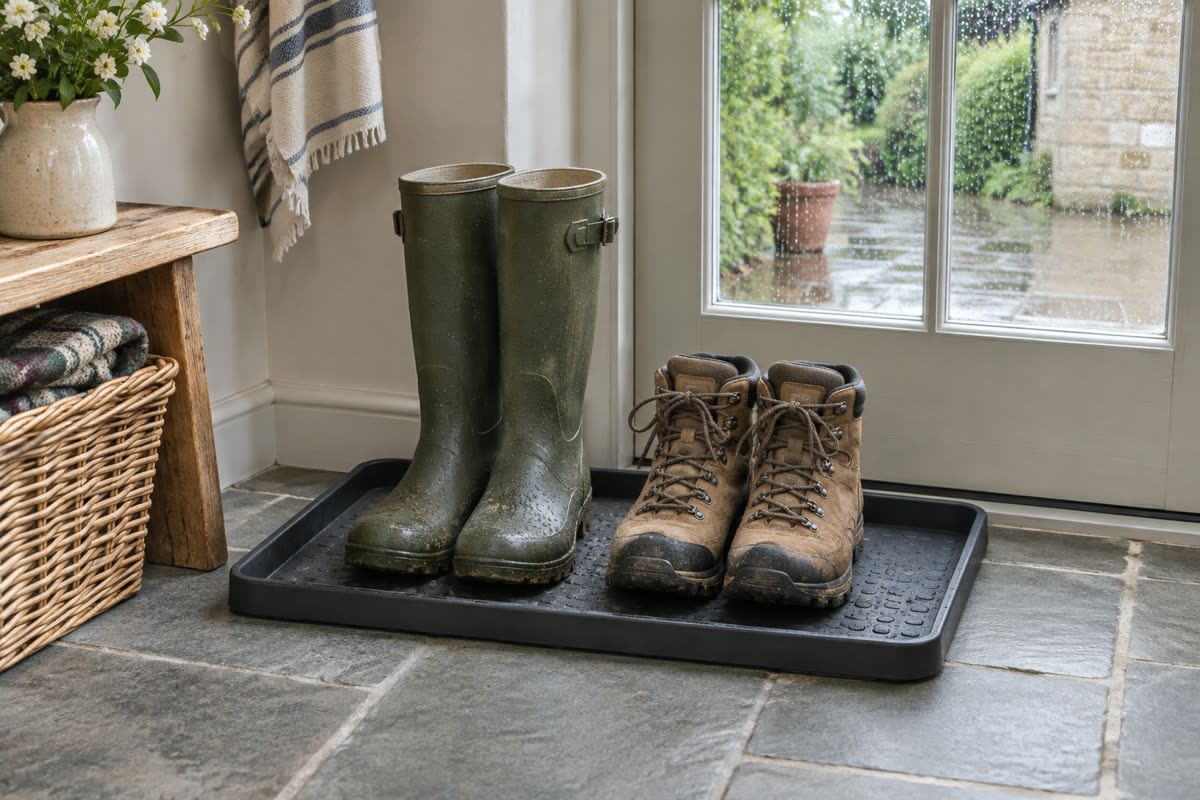
Three formats for different boots
Compare a tray for wet soles, a stand for compatible tall wellies and an adjustable rack for dry footwear. The loaded space varies with the pair.
Flat landing for muddy shoes
Nicoman plain black boot tray
A rigid floor tray with a raised lip for wet soles and grit. Lift it out to rinse and dry it.
- Outside · W × D × H cm
- 75 × 38 × 3
- Access
- Open tray
- In the pack
- One tray
What to check The outside size includes the rim. Check the inner flat space and place the tray clear of door movement and the walking route.
View on Amazon — Nicoman plain black boot trayInverted storage for wellies
Woodside four-pair steel boot rack
The floor stand holds boots upside down on posts of 38 and 45 cm. The 24 cm depth describes the empty frame.
- Outside · W × D × H cm
- 87 × 24 × 45
- Access
- Open boot posts
- In the pack
- One stand
What to check Check shaft fit and the space needed to lift boots over the posts. Allow for loaded projection and use a separate tray if you need to catch drips.
View on Amazon — Woodside four-pair steel boot rackShort wall span
Joseph Joseph Level adjustable shoe rack
This narrow floor footprint holds shoes vertically on adjustable shelves. It can be configured as part of the same system.
- Outside · W × D × H cm
- 26 × 35 × 51.2
- Access
- Adjustable open shelves
- In the pack
- One rack
What to check Allow 35 cm frame depth before shoe projection. The maker lists 1 kg per shelf and requires every rack in a stack to be fixed to the wall.
View on Amazon — Joseph Joseph Level adjustable shoe rackSide-by-side dimensions
Scroll sideways to see all columns.
| Product | W × D × H | Use it for | Measure first |
|---|---|---|---|
| Nicoman plain black tray | 75 × 38 × 3 cm | Wet soles upright | Flat area inside the lip |
| Woodside W604 | 87 × 24 × 45 cm | Compatible inverted wellies | Loaded projection and lifting room |
| Joseph Joseph Level | 26 × 35 × 51.2 cm | Dry shoes or ankle boots that fit | Shelf clearance, stability and load |
Separate wet and dry footwear
List the boots that come through the door in a wet week. A child's wellies, an adult walking boot and a tall riding boot each need a different kind of space. The priority for boots that arrive wet is a place to remove them without crossing the rest of the hall, and a surface you can wipe or lift to clean. Tall dry boots and winter boots that only come out occasionally can live elsewhere.
Put a sheet of cardboard in the proposed landing spot and line up the actual wet-weather pairs. Test it on a busy arrival. Check the way a person steps out of a boot and where they put a hand for balance. If taking boots off means standing in the doorway, move the zone sideways or to a separate room. A shoe bench can help if there is enough space to sit and stand, and the wet boots can still go on a separate tray.
Keep air moving around footwear when its care instructions call for air drying. Check whether the maker allows removable insoles to be taken out. Avoid packing damp soles straight into a closed cabinet. For shared hallways or a space used as an escape route, keep the route clear and check the building's rules before putting anything outside the home.
Measure the whole boot and the movement
Measure the length and width of the outsole at its widest points. For upright storage, stand the pair naturally and measure the tallest shaft. For inverted storage, check the opening and the internal depth of the shaft against the stand's post dimensions. If the seller has only published the height of the post, ask for its diameter or width and check the shape of the top. Don't rely on making a snug boot stretch to fit.
Now record the space used to lift and turn the boot. The top of an inverted sole might clear a shelf while parked and collide with it during removal. Hold the boot in the position needed to clear the post and measure the highest point. Check the toe and heel in their loaded positions. A stand advertised at 24 cm deep can need more floor space once boots and the tray sit in front of the wall.
For a worked tray example, suppose three pairs occupy 68 cm across and 33 cm front to back, including gaps to lift each pair. That group needs a flat interior at least that large. A rim that reduces the depth to 32 cm makes the tray a poor fit, even if the overall tray is 38 cm deep. Position the pair as you really park it, including any thick tread that crosses the rim.
Choose the format that matches the arrival routine
For wet soles at floor level, start with the Nicoman tray. The raised lip helps contain grit and drips. Check the inside dimensions of the plain black 75 × 38 cm variant and leave a clean grip at an edge so you can lift it for rinsing. It can be easier to handle two small trays at separate stations than one large one across the doorway. Measure the actual loaded outline of either arrangement.
For tall wellies with clear space above, the Woodside W604 takes up to four compatible pairs on two post heights. Test where the toes project and whether you can take a back pair off without knocking the front row. Plan a separate tray if you need to catch drips. Check how far that tray projects beyond the frame and whether the feet stand level on it or need to sit directly on the floor.
For dry ankle boots on a short wall, the Joseph Joseph Level lets you change shelf spacing. Check the pair against the 1 kg per shelf limit and confirm that both boots stand securely without hanging into the route. An extra-large walking boot might be better on an open floor tray. Keep the Level out of the wet zone if repeated drips would reach other footwear or make it hard to clean.
Set up a place you can reset easily
Keep a small brush or washable cloth in a sensible place nearby. Empty accumulated water, let the tray dry and return it before the next busy arrival. Check under the tray during wet weeks so grit does not scratch the floor and moisture can be spotted promptly. Store rarely worn pairs away from this spot so there is room for the next wet pair.
Before ordering, walk the route from outside to the main rooms with the door open and the largest boots in place. Include a bag, pushchair or anything else you commonly bring through. If the layout only works with the boots in a particular order, give each pair a repeatable home or try the front-door clearance guide for a better spot. The hallway shoe storage hub covers dry shoe options for the rest of the wall.
Questions before you choose
What is the best way to store wet wellies in a hall?
Use an open landing spot clear of the walking route, with a tray to contain drips. Follow the boots' care directions and let them dry before closed storage.
Will a 75 cm boot tray hold four pairs?
Lay all the soles side by side and measure the rectangle they occupy. Compare with the flat space inside the lip rather than the outside dimensions.
How much space does an inverted boot stand need?
Check width and depth with the boots mounted, plus enough height to raise a boot off its post. Include any tray underneath.
Can tall boots go on an adjustable shoe rack?
Check the open height and each shelf's load limit. A high shaft that folds or catches when you remove the boot needs a taller dedicated spot.
Where can wet boots go in a very narrow hall?
Try a recess beside the route, or a separate area on a wipeable floor. Test the front door and the route with your widest pair in place.
Can I dry boots by a radiator?
Follow the care instructions for the exact boot. Where the maker recommends air drying away from strong heat, choose a ventilated spot away from the radiator.
How this shortlist was assembled
We used exact Amazon UK listings and maker dimensions to compare three different formats. Measurements describe the empty products. We considered boot-care guidance from SCARPA and Le Chameau when discussing drying.