
Best modular drawer trays for mixed-size items
Compare interlocking and independent modular tray sets. Choose sizes for loose items, measure the assembled footprint and leave room to lift trays out.
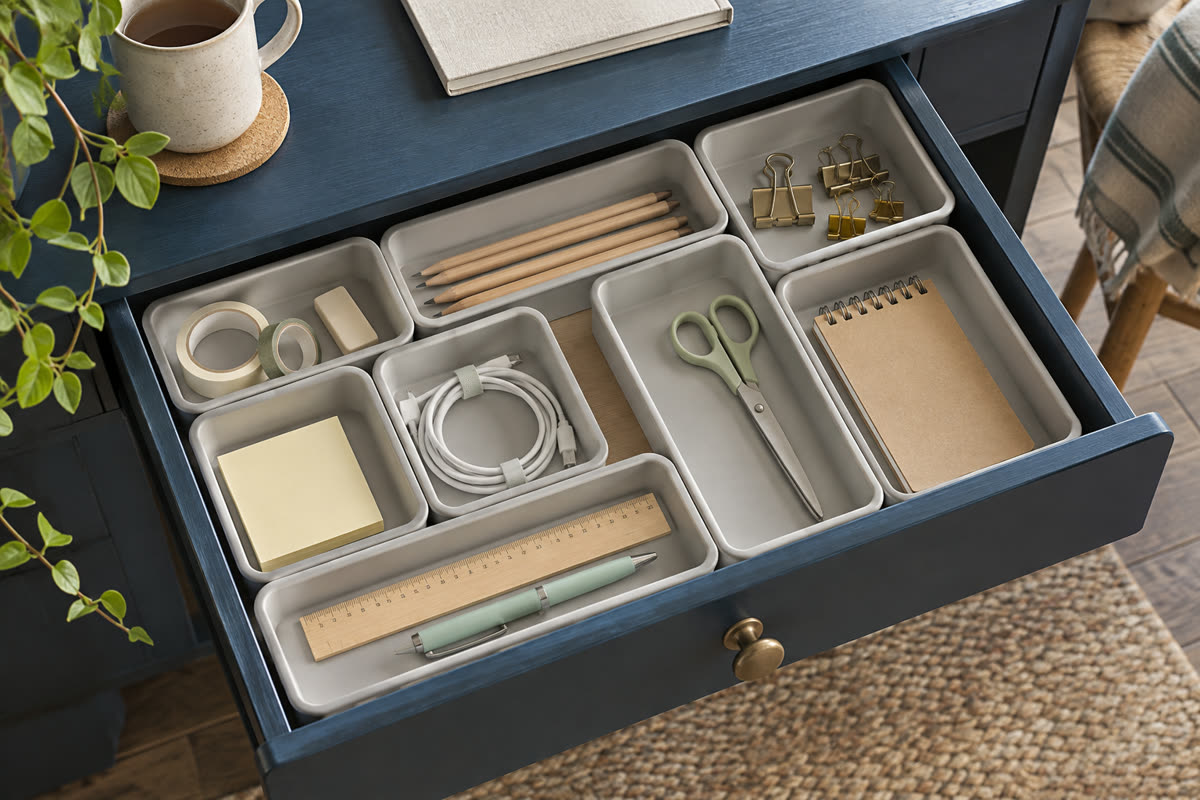
Three sets for different ways of rearranging a drawer
Individual tray sizes and a published example layout describe different things. Check the dimensions of your own arrangement.
Three sizes that connect
Addis white interlocking tray set
Eight interlocking plastic trays give small groups, long items and wider pieces separate places.
- Individual outside sizes
- 7.5 × 7.5, 23.4 × 8 and 23.5 × 16 cm; 4.5 cm high
- Access
- Interlocking trays
- In the pack
- Eight trays
What to check Measure the full connected layout and give removable groups enough grip room. Check the loaded height as well.
View on Amazon — Addis white interlocking tray setFor loose everyday essentials
Joseph Joseph Blox 7-piece organiser
Seven trays clip together in different arrangements, so you can group small accessories without committing to one large fixed insert.
- Example layout · cm
- 43.9 × 26.5 × 5
- Access
- Lift-out trays
- In the pack
- Seven trays
What to check The maker’s example arrangement is 43.9 × 26.5 × 5 cm. Check your chosen layout and the clearance under the drawer’s front rail.
View on Amazon — Joseph Joseph Blox 7-piece organiserLoose trays in four sizes
Vtopmart clear 25-piece drawer trays
Twenty-five independent trays nest when empty. Grip pads are supplied for the intended installation.
- Approx. individual outside sizes
- 22.9 × 15.2, 22.9 × 7.6, 15.2 × 7.6 and 7.6 × 7.6 cm; 5.1 cm high
- Access
- Independent lift-out trays
- In the pack
- Twenty-five trays and 100 pads
What to check Outside figures are approximate and the 5.1 cm height excludes optional pads. Use only the pieces that fit your chosen layout.
View on Amazon — Vtopmart clear 25-piece drawer traysSide-by-side dimensions
Scroll sideways to see all columns.
| Set | Sizes | Height | How pieces sit |
|---|---|---|---|
| Addis 518901 | 7.5 × 7.5, 23.4 × 8 and 23.5 × 16 cm | 4.5 cm | Eight interlocking pieces |
| Joseph Joseph Blox 85199 | 43.9 × 26.5 cm example arrangement | 5 cm in the published example | Seven trays that clip together on all sides |
| Vtopmart DOVM0003 | 22.9 × 15.2, 22.9 × 7.6, 15.2 × 7.6 and 7.6 × 7.6 cm, approximate | 5.1 cm before optional pads | 25 separate pieces |
Plan around the longest or widest group
Empty the drawer and sort what you use together. Use a long tray for pens or a small brush, and a short one for clips or hair ties. A folded cable may need a broad tray to keep its plug flat. Put the largest group on paper first and trace the area it needs, including the part you hold to lift it out.
Check each tray's inside length and width where your items will rest. A tray can have a broad outside rim and a narrow base. Compare the size of a wide plug or bulky handle with the section it will sit in. If you need to pull an item out diagonally, leave room for the movement or choose a larger compartment. Make the busiest group easy to take out rather than using the smallest available pocket.
Look at the level of detail you need. Keeping one compartment for each size of clip may help if you choose a specific one every day. One larger group may work for spare parts you rarely use. Too many small compartments can slow down putting things back.
Check the complete arrangement against the drawer
Measure at the base and mark the narrowest part on paper. Include curves, screws and any raised lip. Arrange templates for the trays on the drawing and account for projecting connectors. When measuring a connected set, use the full assembled footprint. When placing loose trays, leave a grip where you want to lift them. Check your arrangement with the drawer open to its usual position.
Check the lowest point in the closing path. Use the highest edge or item, plus any grip pad or liner under the tray. The shallow tray guide has lower profiles if the drawer cannot clear the chosen set. For an actual-size plan, follow the paper template guide.
Choose whether the pieces connect or lift independently
For an interlocking set with three sizes, the Addis 518901 gives three square trays, three long narrow pieces and two wider pieces, all 4.5 cm high. Match the wider tray to the largest group. Check the dimensions of the whole arrangement when the smaller pieces are alongside it and leave space for any group you will take out.
For joining trays along different sides, the Joseph Joseph Blox set gives seven pieces and supplied grip feet. The manufacturer's 43.9 × 26.5 cm footprint shows one layout. Start with the long tray and clip only the pieces you want to move together. Measure the arrangement you actually use, including the height and clearance for the feet as fitted.
For loose trays you can lift separately, the Vtopmart 25-piece set comes in four footprint sizes. Its stated tray height is about 5.1 cm before the optional grip pads. Use the pieces you need and leave the rest for other spaces. If the layout needs more room to lift a tray, move one piece without disturbing the whole group.
Check the loaded drawer in normal use
Start with a modest number of pieces. Try taking out the busiest tray without pulling the neighbours with it. On a drawer that stops short of full extension, keep frequently removed trays where the cabinet exposes their sides. Put the groups you rarely use farther back only if they can come forward easily.
Close the drawer gently after putting back the tallest item, then after returning everything from a normal day. If the whole insert moves, check its fit and the maker's grip options. The sliding organiser guide distinguishes whole-set movement from individual trays drifting apart. Use dividers instead of trays where a row would keep the group accessible without extra side walls.
For specific contents, compare makeup drawer organisers and cable storage formats. Both guides check the loaded item as well as the empty tray.
For small supplies you carry between rooms, compare divided craft and parts cases with locking outer lids and the actual cell layout.
Questions before you choose
Do modular trays all clip together?
Some do, while others sit independently. Check the exact product and whether you can lift the pieces you need separately.
Can I connect two different tray brands?
Use only the combinations documented by the maker. Lookalike edges may have a different profile or connection.
Does the overall Blox footprint apply to every layout?
The published footprint describes one example. Measure your chosen arrangement around its outer edges.
Can I put grip pads under loose trays?
Use the supplied pads where appropriate and follow the fitting directions. Include them in the closing height.
How do I lay out trays around rounded corners?
Trace the base and move long square pieces in from the corners. Use smaller pieces where they can rest flat and remain easy to grip.
How many pieces should I use?
Use as many as give each daily group a useful place. Extra pieces can stay out until you need a different layout.
How this shortlist was assembled
We checked three exact UK listings and the makers' size information. The Blox dimensions are for one arrangement and Vtopmart's metric figures are rounded conversions of the maker's tray sizes.