
Best shelving for storage boxes of different sizes
Compare adjustable wire, fixed plastic and deep solid shelving for storage boxes. Check supported depth, upright spacing and loaded shelf limits.
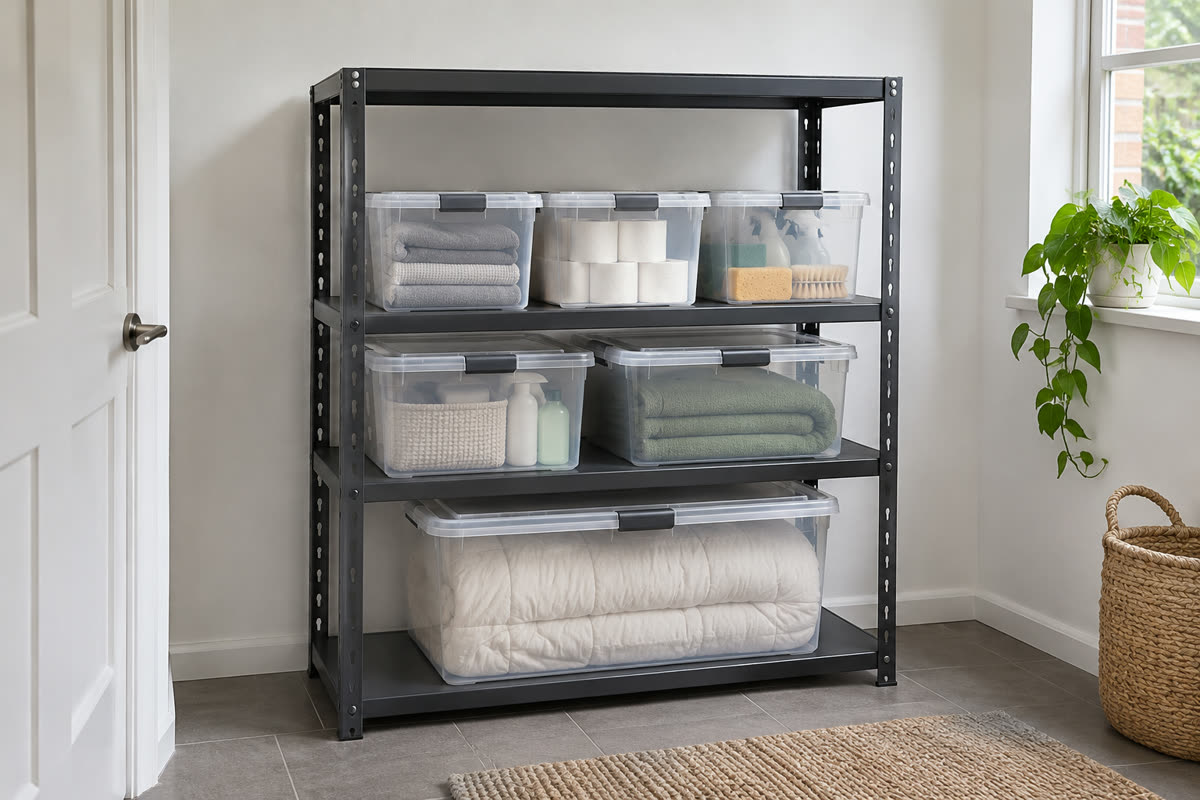
Four units for different box footprints and shelf surfaces
The dimensions describe the outside frame. Check the usable deck, shelf opening and exact loading and fixing instructions.
Adjustable wire with smaller depth
Amazon Basics black four-shelf wire rack
Four wire shelves adjust in 2.54 cm increments for containers of different heights.
- Outside · W × D × H cm
- 91.4 × 35.6 × 137.1
- Access
- Four adjustable wire shelves
- In the pack
- One rack
What to check Check support and clearance around the posts. The manual calls for two adults during assembly and includes a tipping restraint.
View on Amazon — Amazon Basics black four-shelf wire rackFixed moulded shelves
Keter Plus 80/5 moulded shelving
Five moulded plastic shelves with plug-in assembly and fixed spacing.
- Outside · W × D × H cm
- 80 × 40 × 187
- Access
- Five fixed shelves
- In the pack
- One unit
What to check Check the exact bay opening and use the required wall fixing. Follow the stated loading pattern and check the base support of each box.
View on Amazon — Keter Plus 80/5 moulded shelvingDeeper adjustable wire decks
Rhino Racking RRW14 five-tier wire unit
Five adjustable wire decks on a boltless frame. The outside depth is 45 cm.
- Outside · W × D × H cm
- 90 × 45 × 183
- Access
- Five adjustable wire shelves
- In the pack
- One unit
What to check Check the supported deck between posts and the fit of the box base. Use the maker's wall fixing and load instructions.
View on Amazon — Rhino Racking RRW14 five-tier wire unitDeep solid decks for bulky boxes
Rhino Racking RR17 shelving with MDF decks
Five adjustable MDF decks on a boltless steel frame with a 60 cm outside depth.
- Outside · W × D × H cm
- 120 × 60 × 180
- Access
- Five adjustable MDF decks
- In the pack
- One unit
What to check Check the supported deck and withdrawal space before ordering. Follow the maker's assembly, fixing and load distribution instructions.
View on Amazon — Rhino Racking RR17 shelving with MDF decksSide-by-side dimensions
Scroll sideways to see all columns.
| Unit | W × D × H | Shelf surface | Spacing |
|---|---|---|---|
| Amazon Basics SL-SUAM-7 | 91.4 × 35.6 × 137.1 cm | Four wire shelves | Adjustable in 2.54 cm steps |
| Keter Plus 80/5 | 80 × 40 × 187 cm | Five moulded plastic shelves | Fixed spacing |
| Rhino RRW14 | 90 × 45 × 183 cm | Five wire shelves | Adjustable |
| Rhino RR17 | 120 × 60 × 180 cm | Five MDF decks | Adjustable |
Start with the loaded boxes you need to keep
Group the containers by width, depth, height and how often you remove them. Measure the widest point, including clips and handles, and note which side will face the front. Include a bulging lid or loaded fabric side when relevant. The position that looks most efficient can leave you without a usable grip, so test the orientation as well as the numbers.
Measure the base that needs support. A lidded box can be wider at the top than the bottom, while a wide flat box may have feet close to its edges. Mark the positions of any feet and check them against the deck. Measure the loaded weight where it could be close to a limit. Move heavy groups into several manageable boxes if that makes them easier to handle.
Check the usable deck and the opening above
Measure the part of the deck you can use between uprights, braces and raised edges. Find the gap to the underside of the shelf above. A beam may reduce clearance at the front where you need to lift the box. Check the opening at each bay, including the way you operate a clip or lid. Our shelf measuring guide covers the movement step by step.
If the shelves adjust, mark your preferred positions before assembly. Include room for the biggest lift and a lower position for the heavier boxes. Check the adjustment increments and the model's permitted shelf arrangement. For fixed spacing, sort your groups by height first so a tall box does not make a whole shelf unusable.
Compare four shelf formats
For a more compact adjustable wire unit, the Amazon Basics four-shelf rack uses a 35.6 cm outside depth. It offers 2.54 cm shelf increments. Check wire support, the open width between posts and the usable depth. Follow the manual's assembly and restraint instructions.
For fixed moulded shelves, the Keter Plus 80/5 has a 40 cm-deep frame and five shelves. Check the openings before choosing it for a mixed collection. Use the prescribed wall fixing and check the base of each container against the shelf surface.
For more depth with wire shelves, the Rhino RRW14 has a 45 cm outside depth and five adjustable wire decks. Check a representative deep box on the actual support and allow for both posts and the approach. Check the maker's instructions for wall fixing and load distribution.
For bulky boxes with room in front, the Rhino RR17 has a 60 cm-deep frame and five adjustable MDF decks. Its solid surface suits boxes that need continuous support. Check the supported deck dimensions and the floor space to withdraw a deep box fully before choosing it.
Plan the loaded shelves and the working aisle
Check the shelf and unit ratings for the exact setup. Use the load distribution the maker specifies and secure the unit as directed. Keep heavier groups on suitable low shelves and everyday groups within a comfortable reach. Leave room to stand and set down a full box after removing it. See the freestanding shelf measurement guide if assembly or wall space is tight.
Load one shelf first and try the entire routine. Open or withdraw a box, then return it without catching a post or pulling another container forward. If a box is hard to grip from above, use a lower group or front-opening storage. Where depth is the main constraint, compare shallower shelving and match it to smaller boxes.
A utility cupboard also needs clear service and operating space. For leisure storage, check board-game box support and orientation against the actual shelf opening.
Questions before you choose
Should I buy shelves the same depth as my boxes?
Compare the usable supported depth, including posts, rear braces and shelf lips. Keep the base supported as the makers specify.
Which shelf surface is best for small boxes?
A flat solid deck can suit small or narrow feet. On wire, check that the base rests securely and follows the shelf instructions.
How much height do boxes need above them?
Include handles, any lift over a lip and the movement of the lid or clips. Set spacing for the way you actually open the box.
Does a shelf's load rating apply to one heavy box?
Check the maker's loading instructions. A rating for an evenly distributed load does not establish suitability for the same weight concentrated in one place.
What if all my boxes are different heights?
Choose adjustable spacing or put taller and shorter groups on separate shelves. Keep access to the things you need most often.
Can I skip an anti-tip kit if I put the heaviest boxes low?
Use the specified fixing and assembly instructions. Putting heavier items lower is part of the loading plan and does not remove a required restraint.
How this shortlist was assembled
We verified the exact Amazon UK variants and compared maker specifications and assembly information. Outside depth is shown for comparison. Usable deck size and box fit need a separate check.