
Best shoe racks for narrow hallways
Compare shallow and narrow shoe racks for small hallways. Check loaded depth, shelf height and how much floor space you need to take shoes out.
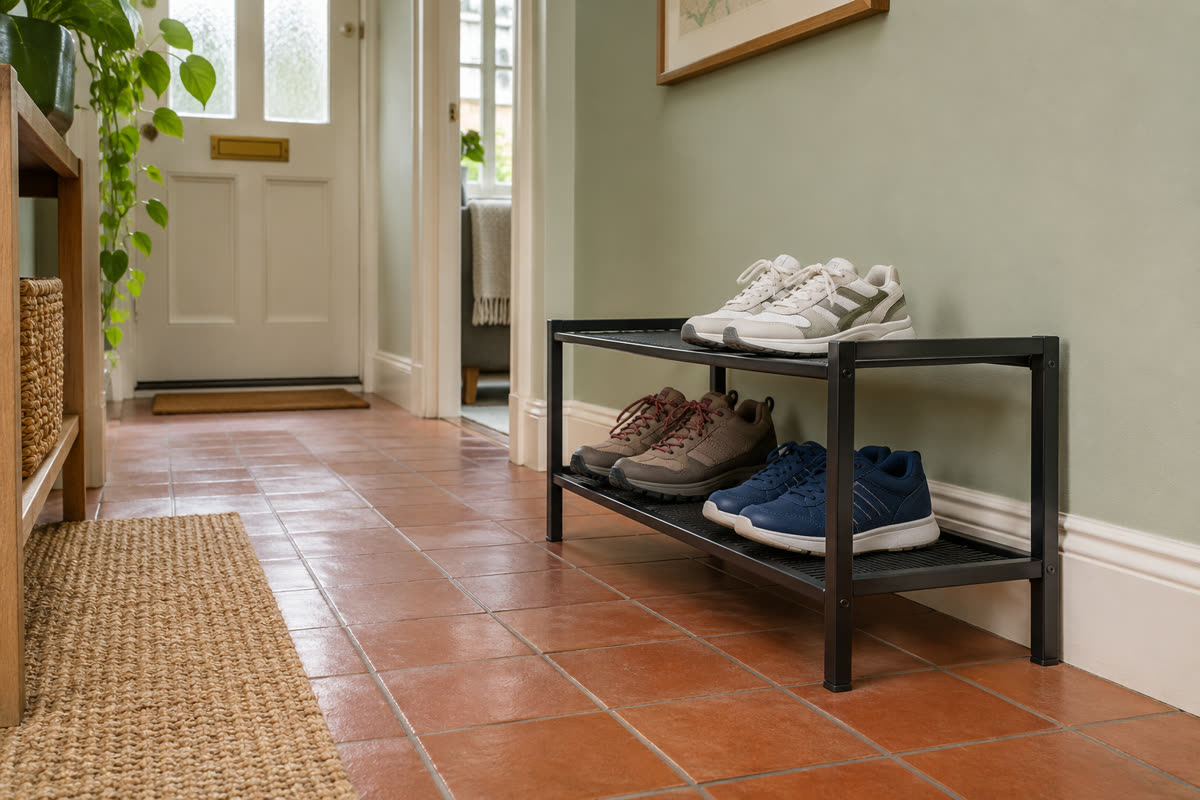
Four open racks for different hallway shapes
A rack can fit the wall while shoes project past its frame. Dimensions below describe the rack itself.
Shallow frame with adjustable width
Yamazaki Frame expandable three-tier rack
Set the frame between 41 and 70 cm wide. The 25 cm frame depth leaves more room to assess how far footwear projects.
- Max width · W × D × H cm
- 70 × 25 × 46
- Access
- Three open tiers
- In the pack
- One rack
What to check Check the shoes on the rails. The maker allows up to two units in its stacking arrangement and lists 3 kg per shelf.
View on Amazon — Yamazaki Frame expandable three-tier rackOpen oak shelves
Hallowood Waverly oak three-tier rack
Three open tiers in a 70 cm-wide frame with room to organise everyday pairs.
- Outside · W × D × H cm
- 70 × 27 × 60
- Access
- Three open tiers
- In the pack
- One rack
What to check Dimensions describe one rack. Check the width between the supports and the usable height between the tiers against your own shoes.
View on Amazon — Hallowood Waverly oak three-tier rackFor an open stretch of wall
SONGMICS 3-tier shoe rack
Three open tiers keep everyday shoes within reach. The 30 cm frame depth is useful where a deep cabinet would crowd the hall.
- Outside · cm
- 92 × 30 × 55
- Access
- Open shelves
- In the pack
- One rack
What to check Allow 92 cm of wall width and check how far your shoes project past the rails. Follow the supplied instructions for assembly and securing the rack.
View on Amazon — SONGMICS 3-tier shoe rackShort wall span
Joseph Joseph Level adjustable shoe rack
This narrow floor footprint holds shoes vertically on adjustable shelves. It can be configured as part of the same system.
- Outside · W × D × H cm
- 26 × 35 × 51.2
- Access
- Adjustable open shelves
- In the pack
- One rack
What to check Allow 35 cm frame depth before shoe projection. The maker lists 1 kg per shelf and requires every rack in a stack to be fixed to the wall.
View on Amazon — Joseph Joseph Level adjustable shoe rackSide-by-side dimensions
Scroll sideways to see all columns.
| Rack | Width | Depth | Height | Where to start |
|---|---|---|---|---|
| Yamazaki Frame | 41–70 | 25 | 46 | Shallow rack with adjustable width |
| Hallowood Waverly | 70 | 27 | 60 | Oak rack with a fixed wall span |
| SONGMICS LSA303B02 | 92 | 30 | 55 | Long wall for several everyday pairs |
| Joseph Joseph Level | 26 | 35 | 51.2 | Short wall with depth to spare |
Measure the rack with shoes in place
Mark the wall space you want to use. In an open stretch of hallway, the tightest point may sit opposite a radiator, a newel post or the corner of the entrance mat. Take your measurement there. Include the skirting behind the rack and check whether its feet can sit in front of the skirting while the top sits closer to the wall. A rack with straight sides may need extra stand-off across its whole height.
Lay out your three largest pairs on paper cut to the rack's stated depth. Set them in the orientation you would use each day. If the heel goes against the wall, mark where the toe sits. If the rack has rails, use rolled card to approximate the rail positions. Confirm the real support spacing with the maker if heel or toe support looks marginal. Check that small shoes cannot slip between the rails and that a flexible sole will rest securely.
Consider a 25 cm frame that stands 2 cm forward of the wall. If a trainer sticks out 4 cm past its front, the loaded depth is 31 cm. Compare that footprint with a 30 cm shelf that fully supports the same trainer. Use the hallway measuring guide for the rest of the plan, especially if a door opens nearby.
Test access and shelf height
Check the usable height from the shelf surface to the underside of the next tier. The spacing between two visible shelf edges may include the thickness of the shelf and any raised lip. Take the height of a shoe while it stands naturally, then add room for the grip and movement you use to remove it. A high-top can sit between shelves and still catch its heel collar every time you pull it forward.
Think about how a second person reaches the rack while someone is coming through the door. Unlike a flip-down cabinet, an open rack leaves the floor clear of a swinging flap, but loading the bottom tier can still put you in the main route. Try placing the most-used pairs at an easy reach and reserve the lowest tier for shoes you reach from the side. Leave enough space to lift the rack or reach the floor underneath when cleaning.
Choose by hallway shape
For a shallow stretch, the Yamazaki Frame offers a 25 cm-deep structure. Expand it only as far as you need, so the extra width remains useful for a door frame or a place to set a bag. Check the smallest shoe against the rails and the longest against the loaded depth. If you want to add a second tier of furniture later, read the stackable rack guide before buying.
For a straight 70 cm span, the Hallowood Waverly provides three oak tiers in a 27 cm-deep frame. Measure usable width between the supports and check shoe clearance under the top shelf. Allow the entire height of the rack under a coat rail. Sleeves can hang below the rail and make the top shelf inconvenient even where the furniture fits.
For a longer wall, the 92 cm SONGMICS rack gives multiple people room to set pairs side by side. Check obstructions along all 92 cm. If the door stop or doorway interrupts the first tier, the nominal extra width may yield very little usable space. A shorter rack in a clear recess can work better than spreading footwear across the main route.
For a short return, the Joseph Joseph Level uses 26 cm of wall width and goes 35 cm deep. It makes sense at the end of a wall or inside a suitable recess where you can reach from the front. Adjustable heights help separate low shoes from higher ones. Place the largest pair on your paper footprint to see how much extra depth and side clearance it needs.
Set up the daily pairs before filling every tier
Count shoes at the time the hallway gets busiest, including a spare pair for a visitor if that regularly happens. Assign positions that match when and where people take shoes off. Put shoes used for the morning rush on a shelf that is easy to load with one hand. A little unoccupied room between pairs gives you somewhere to put the wet pair when two people return at once.
Keep tall or dripping boots on a suitable tray in a separate area if the rack is hard to wipe underneath. Check the shelf material and care instructions for wet footwear. Closed storage is another option if the shoes are dry and the visual clutter bothers you. Use the cabinet versus rack comparison to see what you gain and lose in the same hallway. Explore the hallway shoe storage hub for benches and other layouts.
A vertical shoe tower suits a short wall with height to spare. If the usable span changes between rooms or seasons, compare extendable racks by their full width range.
Questions before you choose
Which rack takes the least width?
Joseph Joseph Level is 26 cm wide. Check its 35 cm depth and the width and projection of the loaded shoes.
What makes a rack shallow?
Compare the frame depth, stand-off from the wall and shoe projection as a single loaded footprint. The shallowest frame can take more room if shoes overhang.
Are angled shelves shallower?
They can reduce the floor space needed for the shelf itself. Check the heel support and how far the shoe projects in its actual resting position.
Can I put boots on the lowest shelf?
Only if the boots stand naturally with clearance to lift them out. Measure from the support surface to the underside of the next shelf, then allow extra room to remove them.
How many pairs fit side by side?
Use the width occupied by your pairs, plus gaps to grab them. Inside width, rails and posts affect capacity.
Do these racks need wall fixing?
Check each model's supplied instructions for the planned configuration. Joseph Joseph requires each Level unit in a stack to be fixed to the wall.
How this shortlist was assembled
We selected exact UK listings and compared published dimensions and shelf designs. Pair counts and loaded depths depend on your shoes. Hallowood dimensions refer to the single unit.