
Best extendable shoe racks for adjustable widths
Compare extendable shoe racks by minimum and maximum width, frame height and rail support. Check how your pairs sit at the width you need.
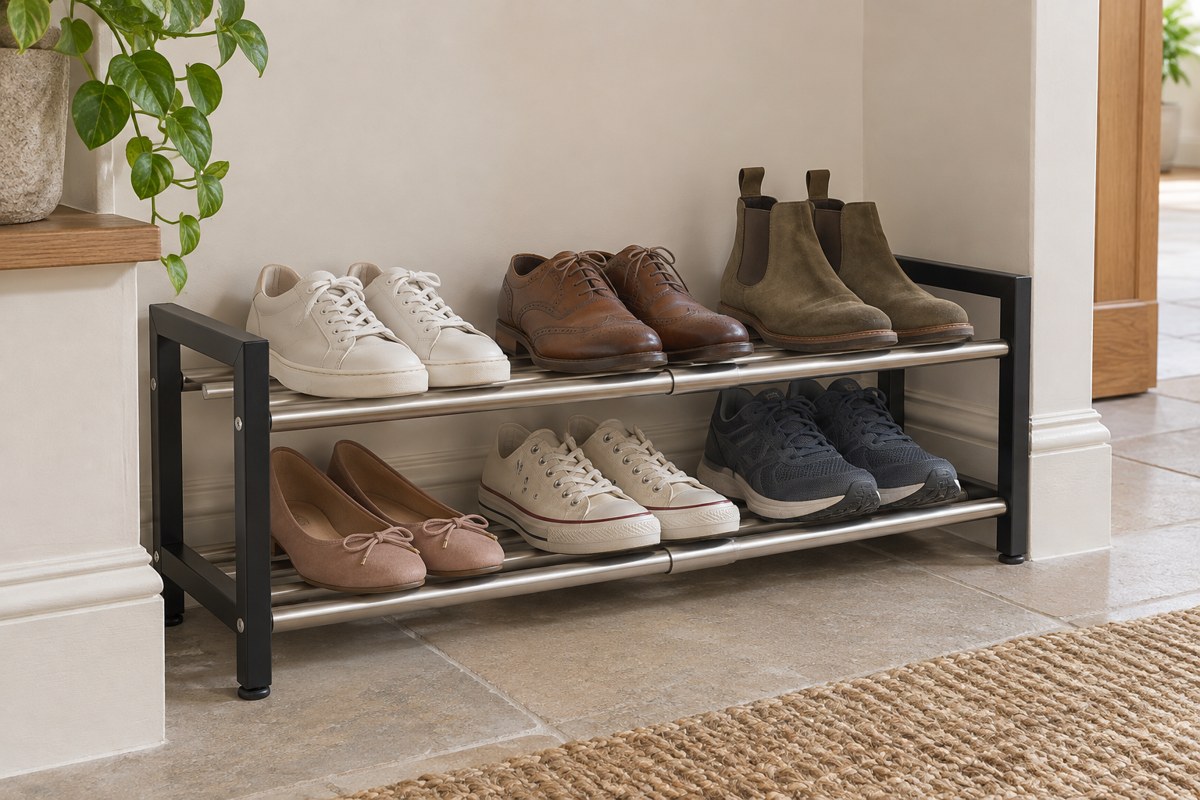
Four adjustable ranges for different wall spans
Widths are outside measurements. Compare the space between the end frames and the room needed to remove each pair.
Shallow frame with adjustable width
Yamazaki Frame expandable three-tier rack
Set the frame between 41 and 70 cm wide. The 25 cm frame depth leaves more room to assess how far footwear projects.
- Max width · W × D × H cm
- 70 × 25 × 46
- Access
- Three open tiers
- In the pack
- One rack
What to check Check the shoes on the rails. The maker allows up to two units in its stacking arrangement and lists 3 kg per shelf.
View on Amazon — Yamazaki Frame expandable three-tier rackLow rack below a fixed shelf
ENJOYBASICS two-tier extendable shoe rack
Two open metal rail tiers with a published width range from about 45 to 83 cm.
- Outside · W × D × H
- Approx. 45–83 × 22.6 × 34.2 cm
- Access
- Two open rail tiers
- In the pack
- One rack
What to check Try the smallest soles on the rails and check usable span and toe projection at the setting you plan to use.
View on Amazon — ENJOYBASICS two-tier extendable shoe rackThree angled tiers
SONGMICS DAVIAN extendable shoe rack
The frame extends from around 58 to 83 cm and uses angled metal tiers with arched ends.
- Outside · W × D × H
- Approx. 58–83 × 22.9 × 57.9 cm
- Access
- Three angled tiers
- In the pack
- One rack
What to check Measure the full height under coats or shelving. Try a representative pair on the angled supports before counting how many will fit.
View on Amazon — SONGMICS DAVIAN extendable shoe rackA wider wall span
Tajsoon two-tier extendable shoe rack
Two open rail tiers with a wider starting span and extension to about 106 cm.
- Outside · W × D × H
- Approx. 73–106 × 22.1 × 34.5 cm
- Access
- Two open rail tiers
- In the pack
- One rack
What to check Check the overall width at the chosen setting and count the span between end frames. Check sole support and use the maker’s adjustment limits.
View on Amazon — Tajsoon two-tier extendable shoe rackSide-by-side dimensions
Scroll sideways to see all columns.
| Rack | Width range | Depth × height | Tier layout |
|---|---|---|---|
| Yamazaki Frame | 41–70 | 25 × 46 | Three open tiers |
| ENJOYBASICS | Approx. 45–83 | 22.6 × 34.2 | Two low rail tiers |
| SONGMICS DAVIAN | Approx. 58–83 | 22.9 × 57.9 | Three angled tiers |
| Tajsoon | Approx. 73–106 | 22.1 × 34.5 | Two wide rail tiers |
Start with the span you want to fill
Measure between the obstacles at floor level and at each intended shelf height. A short alcove can be wider above the skirting than where the rack feet stand. A nearby door frame, pipe or radiator valve can interrupt an otherwise useful span. Check the end frames and use the narrowest relevant reading. Leave room to set the rack down, adjust it and grip shoes at the ends.
Write down two widths if you expect to use the rack in more than one place. The first might be the width under a coat shelf and the second might be a longer wall you use when visitors arrive. Check both against the same model’s range. A rack that starts wider than the first location cannot fill both jobs. When it is fully extended, check the support and amount of floor it takes in the second location.
Count the space between the end frames
Extendable width usually describes the outside frame. Compare the actual span between the end supports with the width of your pairs. Measure several together in their intended orientation and leave room to lift a pair without pushing the next one sideways. On rails, check where the heel and forefoot make contact. A telescoping joint can change the rail profile in the middle, and a pair that sits well near the end may sit differently over that joint.
Check shoe depth and height at the width you will use. An angled rail can change where the toe rests and how far the heel sticks out. On a level rack, a deep trainer may still project beyond the front. Try the largest shoe on a paper layout of the floor and use the hallway measuring guide to check the route. Smaller soles may need a surface with closer support. Check any insert against the rack instructions and available height before using it.
Choose by starting width, tier height and shelf angle
The Yamazaki Frame starts at 41 cm and extends to 70 cm. Its three tiers suit a shorter section of wall where you can use the height. The maker lists 3 kg per shelf. Confirm how your pairs sit on its rails and how far each projects. Use the width range for a single unit as listed.
The ENJOYBASICS two-tier rack covers about 45–83 cm with a lower overall height of about 34.2 cm. It can be a candidate beneath existing storage if there is room for shoes on its top level. The SONGMICS DAVIAN offers a similar maximum width but a taller three-tier layout. Its angled tiers make the shoe support and retrieval check especially important.
For a longer run, the Tajsoon two-tier rack starts around 73 cm and extends to about 106 cm. It is a useful comparison when a shorter rack cannot cover the wall you intend to use. Set it to the width you actually need. Check the available rail span and the floor contact at that setting. A vertical tower is a separate option for a short wall return with usable height.
Set the width before loading shoes
Set the rack on a suitable floor and follow the maker’s instructions for assembly, adjustment and limits. Work with it empty when you change the width, following any steps to keep the two sides even and the rails engaged. Keep fingers clear of sliding joints and stop at the documented extension limit. Once it is set, make sure both ends sit level and check the support points before filling the shelves.
If the rack will move into a cupboard between uses, measure the door opening as well as its internal width. A rack can contract enough to fit inside and still catch on a hinge during the turn. Check the path with the rack empty and allow room to hold both end frames.
Put a representative pair at each end and near the centre. Check that a shoe does not slide or rock and that you can lift it without bumping an end frame. Add the remaining daily pairs and repeat the door and passage checks. If the widest setting makes the hall crowded, reduce the width or move a seldom-used group elsewhere. Use the shared hallway guide to work out how much space each person’s real pairs need.
Questions before you choose
How do I measure for an extendable shoe rack?
Measure the narrowest width at the feet and shelf heights. Check the rack’s minimum and maximum settings and leave room to adjust it.
Does the listed width describe usable shelf space?
It usually describes the outside frame. Measure between the end supports for the width your shoes can actually use.
Does a wider setting hold more shoes?
It can add usable space. Check rail support at the extension joint, leave grip gaps and use the published limits.
Can I fit one beneath a coat shelf?
Compare the assembled height and the top-row footwear with the space below the shelf or hanging coats. Leave room to lift out a pair.
Will small shoes sit on a rail rack?
Try a small sole over the gaps and joints. Choose a surface that supports it securely or use a suitable insert where the maker permits it.
Can I adjust it with shoes still on it?
Empty the rack and follow the maker’s adjustment instructions. Check both ends and the rail engagement before putting shoes back.
How this shortlist was assembled
We checked four exact Amazon UK offers and compared the assembled ranges in the maker specifications or the selected listing’s dimension drawing. The approximate figures reflect rounded conversions. The comparison covers one rack at each stated width.