
Best clothes drawer organisers for socks and folded clothes
Compare shallow open bins, a mixed-size set, divided fabric cells and tall jeans organisers. Check folded size and loaded closing height.
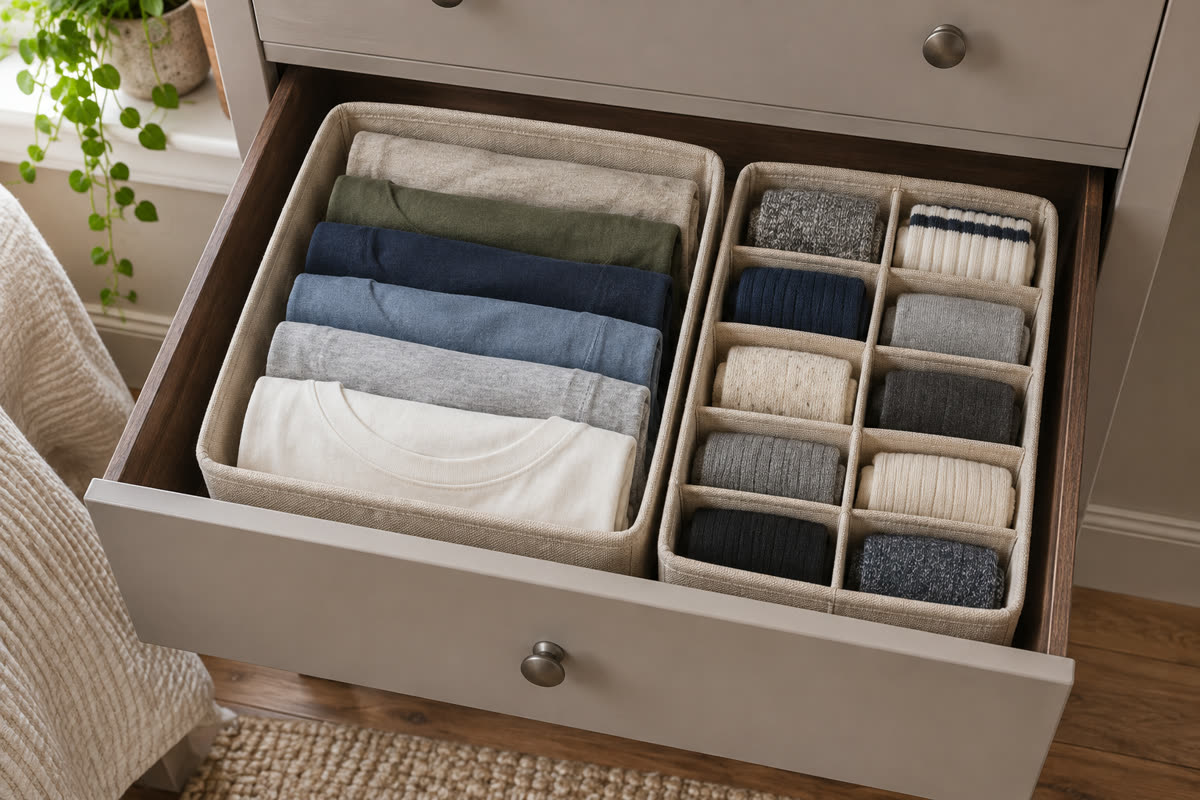
Four fabric formats for different folded groups
Compare each outside footprint with your base and each compartment with the clothes. Height figures describe the empty organiser.
Lower drawers and flexible groups
DIMJ grey open clothes organisers
Two long fabric bins and two square ones, with open interiors for items you want to group.
- Outside sizes
- 30 × 15 and 15 × 15 cm; 9 cm high
- Access
- Open top
- In the pack
- Four bins
What to check Check the 9 cm height with clothes loaded. Set up the zipped bases as directed and leave room to grip the bins.
View on Amazon — DIMJ grey open clothes organisersThree sizes for different folds
IKEA SKUBB white set of six boxes
Two boxes of each footprint give larger groups and smaller accessories a separate place.
- Outside sizes
- 14 × 14, 28 × 14 and 28 × 28 cm; 13 cm high
- Access
- Open top with zipped base
- In the pack
- Six boxes
What to check Check the full 13 cm height and the space needed to lift the widest box with clothes in it.
View on Amazon — IKEA SKUBB white set of six boxesSmall groups in separate cells
SONGMICS Summer Sand divided clothes organisers
Eight fabric organisers in two footprints, with several layouts for pairs and small folded pieces.
- Outside sizes
- 32 × 32 and 32 × 16 cm; 10 cm high
- Access
- 5-, 6-, 8- and 24-cell layouts
- In the pack
- Eight organisers
What to check Compare the usable cell opening with your usual folds and check the height of any contents above the rim.
View on Amazon — SONGMICS Summer Sand divided clothes organisersJeans in a deep drawer
SONGMICS tall six-cell jeans organisers
Two reinforced fabric organisers, each with six slots and handles at both ends.
- Outside per unit · cm
- 42 × 30 × 17
- Access
- Six slots per unit
- In the pack
- Two organisers
What to check Check the slot with a folded waistband. The 17 cm empty height and any protruding fold or handle need to clear the cabinet.
View on Amazon — SONGMICS tall six-cell jeans organisersSide-by-side dimensions
Scroll sideways to see all columns.
| Organiser | Footprint and height | Format | Use it for |
|---|---|---|---|
| DIMJ grey four-pack | 30 × 15 and 15 × 15 cm; 9 cm high | Undivided bins | Low drawers and loose groups |
| IKEA SKUBB white six-pack | 14 × 14, 28 × 14 and 28 × 28 cm; 13 cm high | Mixed open boxes | Combining several larger and smaller folds |
| SONGMICS RUS008M01 | 32 × 32 and 32 × 16 cm; 10 cm high | Divided fabric cells | Pairs and small folded items |
| SONGMICS RUS009G02 | 42 × 30 cm; 17 cm high | Six slots in each unit | Folded jeans in a tall drawer |
Measure the clothes in their usual fold
Sort a normal week's laundry into groups. Fold the items you intend to store as you would on a busy day. Measure their widest point, including the way a thick seam or waistband springs back. Put your biggest pair of socks next to the smallest and see if they really need the same compartment. Groups that fit the same layout are easier to keep together than a mix with very different sizes.
Try standing folded T-shirts upright and check whether you can see the top of each one. If they slump sideways, adjust the width of the row or choose a bin that gives them support. Put a finger between the folds and remove one. If the whole row comes out, give it more room. Clothes you leave flat need enough space above the stack to grip a piece from the middle.
For socks and underwear, choose cells where you want each pair visible. An undivided square or narrow rectangle can work better if you keep a loose group together and rarely need one particular item. A taller narrow slot can work for jeans where the fold fits and the drawer has enough height.
Check the height with the fabric bins filled
Take the base measurements at the height the organiser will rest. A fabric bin can change shape when filled, especially if clothes push the sides outward. Measure the complete outside shape and compare it with the usable opening, including the corners and any screws. Give yourself room to lift a bin by its sides or handles.
Measure the lowest point the drawer passes beneath during closing. Include the height of the biggest folded garment above the bin floor and any base insert or liner. Check the tallest waistband in the position it normally sits. A tray body that clears the rail can still carry clothes high enough to catch it.
Choose open bins, cells or tall slots
For low undivided groups, the DIMJ grey four-pack gives two longer bins and two smaller squares, all 9 cm high. Use the longer bin for folded underwear or tees whose fold fits the base, and the small bins for socks. Leave room to remove them and check the gap above the tallest item.
For several different folds, the IKEA SKUBB set has two boxes in each of three footprints. Their 13 cm height suits a drawer that can clear them when loaded. Try one of each size in your layout before deciding how many to use. Keep some room beside the larger square for your fingers or a loose accessory.
For small groups in individual cells, the SONGMICS eight-piece set combines several counts of fabric compartments in two outside footprints. The 10 cm height is useful where deep boxes would crowd the space. Check the usable cell size for your actual folds, and use the least divided piece for anything too bulky for small cells.
For folded jeans in a deeper drawer, the SONGMICS tall pair uses six slots per organiser with a listed 17 cm height. Lay out the widest waistband and check it against a slot. Leave room to grasp the top of a pair without lifting the whole bin and keep its handles clear of the closing path.
Make the layout easy to refill
Load one drawer with a realistic batch of clean clothes. Put the items you use most at the front. Use the rear for a group you can bring forward safely, especially where the drawer only opens partway. Keep a little empty space in each group so you can put clothes back without pushing them down.
Check the drawer layout guide if several footprints need to share a tapered base. For longer rows that sit directly on the drawer base, compare adjustable dividers. Where bulky folded pieces are easier to reach from above, the wardrobe storage bin guide compares open and lidded options for shelves.
Questions before you choose
Do clothes drawer organisers work in shallow drawers?
Use the shortest loaded setup that still contains your clothes. Measure beneath the lowest rail and include the base panel and any liner.
Are divided cells better for socks?
They can keep pairs distinct if the socks fit without bulging. An open bin suits a group you want to reach into quickly.
Can I use a deep jeans organiser for T-shirts?
Check the folded width and use a tall unit only where you can see and reach the contents. A lower open bin may be easier for small folds.
How do I stop fabric sides collapsing?
Fit the supplied base or support panels as directed. Avoid forcing large folds into cells and check whether a low open bin would hold the group more comfortably.
Will these fit my chest of drawers?
Measure the real base and closing path and compare each intended arrangement. Furniture names and nominal drawer sizes alone cannot establish a fit.
Can I wash a fabric organiser?
Follow the exact care instructions, including whether it has removable or fixed stiffeners. Let it dry fully before returning it to the drawer.
How this shortlist was assembled
We compared four exact Amazon UK sets. The table gives empty outside sizes and groups the different formats by the kind of folded item. Filled height and usable cell capacity depend on the clothes.