
How to measure shelves for storage boxes
Compare box orientation, supported shelf depth, lifting height and withdrawal space with worked calculations before choosing storage boxes.
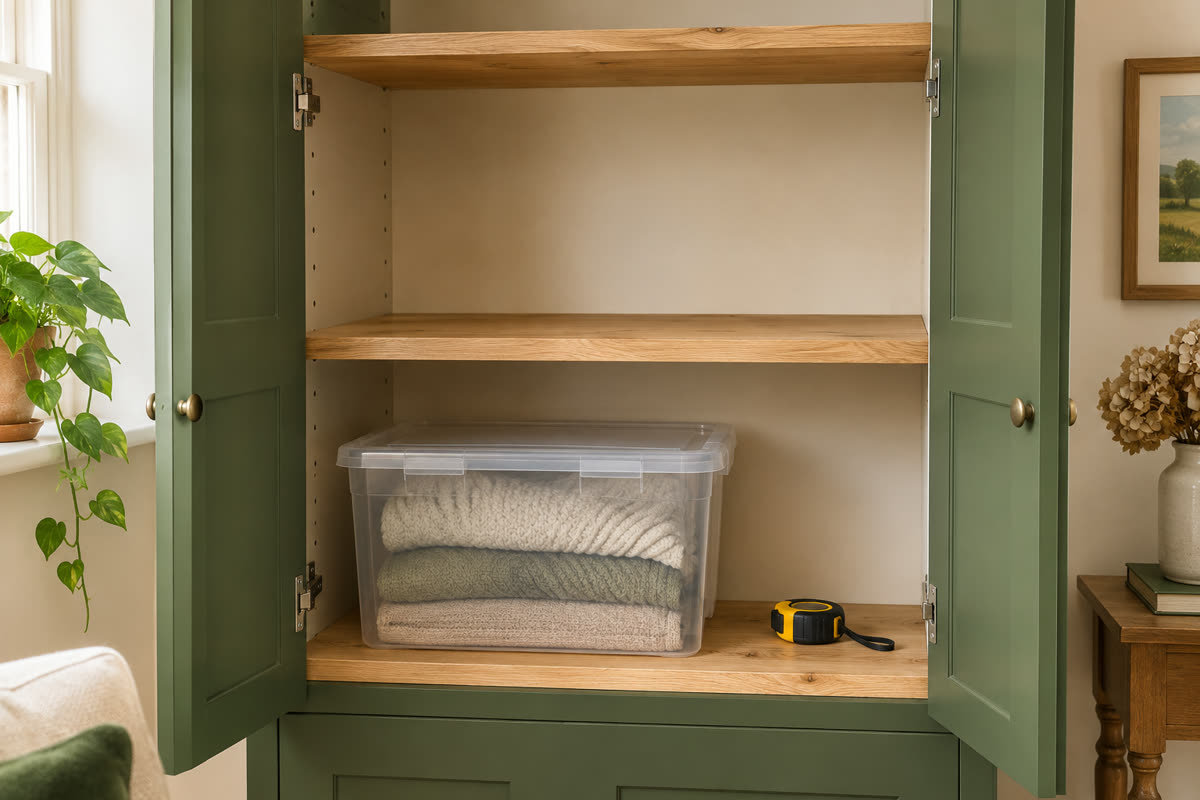
Fit is only half the check
Measure the box’s route off the shelf
Record the smallest usable bay, compare it with the complete outside box dimensions and leave room for the way you will grip, lift or open it. Litres tell you capacity, not whether a container will fit the shelf.
A shelf can look wide enough for several boxes and still be awkward to use. Uprights reduce the opening, a cupboard hinge can catch a lid, and a shelf lip can require you to lift before pulling forward. The most useful measurement is the available space along that whole retrieval route.
Start with the shelf already assembled and installed according to its instructions. Empty the intended bay so you can see brackets, supports and edges. Keep separate notes for the shelf opening, the box exterior and the usable space inside the box.
Measure the bay at the box’s actual position
Measure the clear width between uprights or side panels where the box will sit. Repeat at the front edge and further back. Shelf supports, a bowed panel or a cupboard door can make the narrowest point smaller than the obvious opening.
For depth, measure the usable supported surface from front to back. Include a back panel, pipe boxing or another obstruction. Do not use the furniture’s advertised overall depth: that may include doors, trims and a rear gap rather than usable shelf space.
For height, measure from the shelf surface to the lowest obstruction above. Look at support brackets and the underside of a shelf lip, not only the central opening. If a box needs to be raised to pass over the front edge, record that movement separately.
Cupboards need a door check as well. Open the door to its real usable position and note the local opening around hinges and catches. A container that sits comfortably behind a hinge may not come back out without being turned.
Compare outside dimensions first, then the interior
Outside measurements determine shelf fit. Check that they include the lid, clips and handles in the position used for storage. A base that sits within the shelf can have a wider lid overhanging it. For a fold-out handle, consider both the stored and carrying positions.
Inside measurements answer a different question: whether the contents fit. Tapered walls, rounded corners and a moulded base can reduce the usable footprint. A folded sheet stack that matches the outside width may be too wide for the interior.
The shallow Really Useful 10L illustrates the difference. Its outside dimensions are 52 × 34 × 8.5 cm, while the listed usable interior is 46 × 29.8 × 7 cm. The 8.5 cm outside height helps it fit a low bay; the 7 cm inside height limits the stack you can pack.
For very low beds
Really Useful Box 10L Clear
An 8.5 cm high box for flat puzzles, spare pillowcases or craft supplies. Its shorter footprint can work in the bay between a bed leg and a centre support.
- Outside · cm
- 52 × 34 × 8.5
- Inside · cm
- 46 × 29.8 × 7
- Capacity
- 10 litres
- Access
- Removable clip lid
What to check The 7 cm internal height limits what you can put in it. Plan to pull the box far enough out to unclip and lift the whole lid.
View on Amazon — Really Useful Box 10L ClearDo not use litre capacity to infer any of these spans. Two containers with the same stated capacity can have completely different shapes. Our boxes and shelving hub explains how access and contents affect the format you choose.
What changes when you turn a box?
We compared two published box sizes against the same illustrative 73 × 35 × 22 cm bay. The figures below use each box’s complete outside dimensions, including lid and handles. A non-negative difference puts the rectangular bounds within the static bay; zero means no spare dimension, and it does not establish suitable handling or support.
Swipe the table to see each dimensional check.
| Box / upright orientation | Across × front-to-back | Width difference | Depth difference | Height difference | Static bounds |
|---|---|---|---|---|---|
| Really Useful 10L, long side across | 52 × 34 | 21 | 1 | 13.5 | Within bay; retrieval still to check |
| Really Useful 10L, short side across | 34 × 52 | 39 | -17 | 13.5 | Exceeds at least one dimension |
| Really Useful 33L, long side across | 71 × 44 | 2 | -9 | 5.5 | Exceeds at least one dimension |
| Really Useful 33L, short side across | 44 × 71 | 29 | -36 | 5.5 | Exceeds at least one dimension |
A deeper bay changes the choice, and the withdrawal distance
In a separate 73 × 55 × 22 cm bay, both upright orientations of the 10L are within the static bounds. With the front of the box flush with the shelf edge, full straight withdrawal needs a nominal 34 cm of travel in the first layout and 52 cm in the second: 18 cm more. This is a translation distance for the complete rectangular box, not a total standing-space allowance. A recessed starting position, grip, lip or door changes the route.
Plan view · 73 × 55 cm bay
Long side across
Outside footprint: 52 cm across × 34 cm deep. The depth difference is 21 cm; the width difference is 21 cm.
Nominal full withdrawal: 34 cm. Add a suitable place to hold or set down the loaded box; do not treat the travel line as hand clearance.
Plan view · 73 × 55 cm bay
Short side across
Outside footprint: 34 cm across × 52 cm deep. The depth difference is 3 cm; the width difference is 39 cm.
Nominal full withdrawal: 52 cm. Add a suitable place to hold or set down the loaded box; do not treat the travel line as hand clearance.
Count lifting height and side access explicitly
A different low bay, 10 cm high, leaves 1.5 cm above the 8.5 cm box while it rests on the shelf. If a lip requires an illustrative 2 cm level lift before withdrawal, the box’s top reaches 10.5 cm: 0.5 cm beyond the opening. That assumed route is excluded even though the closed box fits. Do not infer that tilting will solve it; the diagonal, contents and entire opening would need checking.
There is a similar trap in packing two boxes across a shelf. In the deeper bay, two 34 cm-wide boxes occupy 68 cm of a 73 cm width. That leaves 5 cm before handling allocations. Choosing an illustrative 2 cm at each outer side and 2 cm between them needs 6 cm, so the allocation is 1 cm too wide. Those gaps are an example of a calculation, not a universal hand-space recommendation.
Choose the orientation only after comparing the supported footprint, the narrowest opening, your grip and the space outside the shelf. Opening the lid after removal separates the carrying route from the lid-removal space; opening it in the bay needs its own measured movement.
The 33L remains outside the shallow bay in both orientations. More capacity cannot make up for excessive depth; compare its possible use in an appropriate under-bed bay instead.
For folded linen
Really Useful Box 33L Clear
The 33 litre box has room for folded sheets and keeps the contents visible through its clear sides. The firm lid clips on when you put the box away.
- Outside · cm
- 71 × 44 × 16.5
- Inside · cm
- 60.5 × 37 × 14.5
- Capacity
- 33 litres
- Access
- Removable clip lid
What to check At 71 cm long it needs a good-sized bay. Allow room to reach both clips and take the lid off once the box is out.
View on Amazon — Really Useful Box 33L ClearCheck loaded retrieval and the shelf’s documented load
Plan where your hands will go. Side handles need access at the sides; a front grip may need room above or below it. If the box has to be lifted over a lip, include the loaded box height during that movement. A container that is easy to slide empty can be awkward when full.
Decide whether you will open it on the shelf or take it down. A removable lid usually needs more working room than the box’s closed height. If you choose front-opening storage later, check that the door opens without hitting a shelf edge and that the maker permits the proposed stacked arrangement.
Compare the weight of boxes and contents with the documented limit for the exact shelving. Check whether a figure is per shelf or for the whole unit, and whether it assumes an evenly distributed load. Do not transfer a rating from another width, shelf material or assembly.
Keep frequently handled or heavier items where you can retrieve them comfortably, within the furniture’s instructions. Do not change required anchoring or add unsupported stacks to gain capacity.
Make a shelf map you can reuse
Record each bay’s smallest width, supported depth and lowest height. Add notes for hinges, lips and the direction a box must move. Then list the exact candidate box and its outside and inside dimensions alongside the intended contents.
A cardboard footprint is useful for checking width and depth, but add a height mock-up if the opening is close. Once the container arrives, try the empty retrieval route first and then a manageable representative load. Keep access practical rather than packing every remaining gap.
Use your shelf map to compare clear boxes, stackable boxes and front-opening boxes. If you need a new unit as well, check the room and assembly route with the freestanding shelving measuring guide.
Questions before you choose
Do box dimensions include lids and handles?
Check the exact maker’s convention. Really Useful lists its outside dimensions including lid and handles. Other brands or marketplace listings may use a different convention.
Why are internal dimensions smaller?
Walls, taper, mouldings and the lid take up space. Use outside dimensions to check the shelf fit and usable inside dimensions to check what the box can hold.
How much room do I need above a box?
It depends on how you grip, lift or open that box. Check the actual movement, including any shelf lip. There is no single clearance figure that works for every handle and lid.
Can a box overhang a shelf?
Do not assume it is supported safely because it stays in place when empty. Follow the shelf and container instructions and choose a footprint the shelf can support appropriately.
Can I stack boxes that fit below the next shelf?
Height arithmetic alone is insufficient. Check the exact boxes and lids support the proposed stack, any limits and the retrieval route. Compare the shelf rating with boxes plus contents, including whether it applies per shelf, to the whole unit or to a particular load distribution.
Where the measurements come from
Really Useful’s product sheets give approximate outside dimensions including lids and handles, and minimum internal dimensions. The 73 × 35 × 22 cm shelf bay is an illustrative example. Shelf loads, stacking and installation depend on the exact products.
Our comparison uses the inputs below and the stated formulas. Room dimensions and handling allowances are illustrative; named product dimensions are kept separate from them. Analysis prepared November 2026.
- Width difference = clear bay width − box dimension across the shelf.
- Depth difference = supported depth − box dimension front to back.
- Raised-height difference = clear height − complete box height − illustrative vertical lift.
- Straight withdrawal distance = the box dimension front to back, assuming its front begins flush with the shelf edge.
Calculations use unrounded inputs; displayed results are rounded to two decimal places where necessary.
- External dimensions include the lid and handles; maker describes dimensions as approximate maxima and internal dimensions as minima.
- Rotation is in plan only: the box remains upright and height is unchanged.
- Rectangular bounds do not describe the exact base contact area. Shelf support and load limits require separate product instructions.
- The 2 cm lift case is a chosen movement example, not a recommended allowance. It assumes the box stays level beneath an obstruction across the route.
- Withdrawal distances model full straight removal from a flush-front position; grip, door, hinge, lip, lid and set-down space are additional checks.
Sources: Really Useful 10L dimensions and measuring convention; Really Useful 33L dimensions and measuring convention.