
Best hallway shoe storage benches
Compare shallow flip-drawer and open-cubby shoe benches. Check seat height, opening clearance, usable cubby size and hallway space before buying.
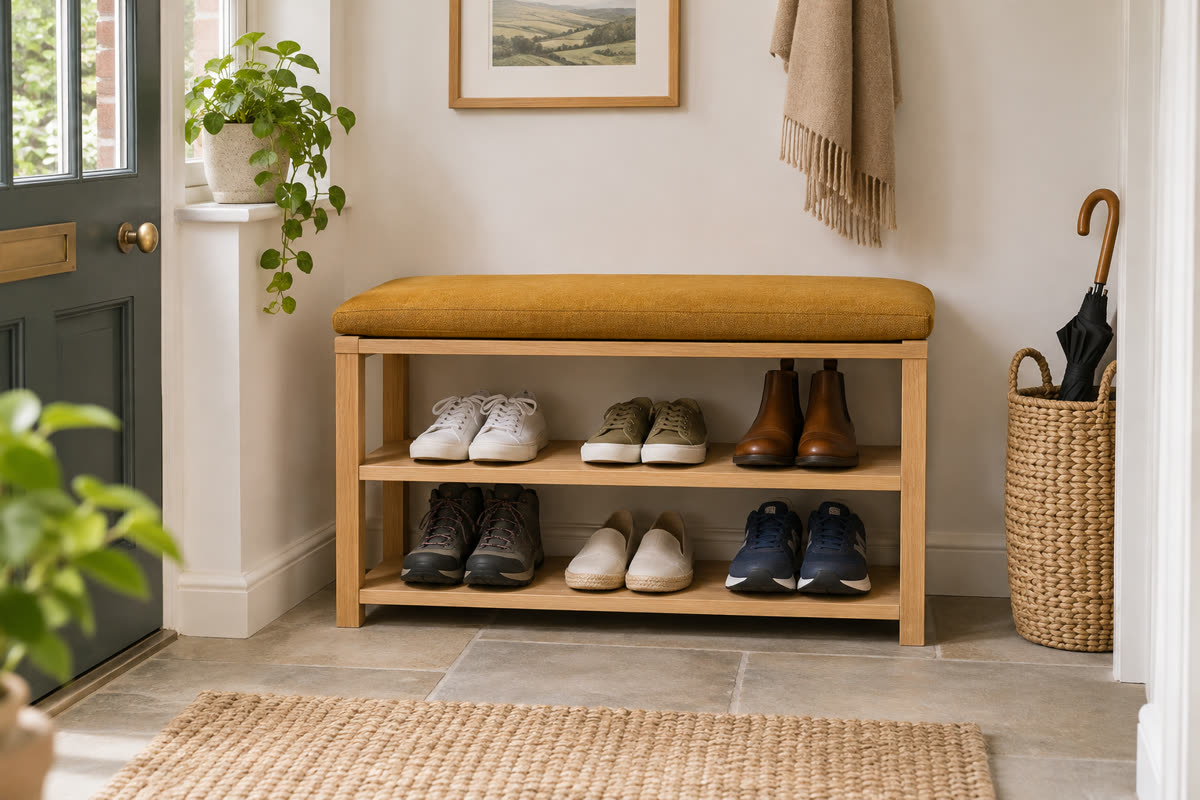
Three benches for different hallway layouts
The usable seat, opening and foot space matter as much as the body dimensions. Compare each in the place you expect to sit.
Shallow seat with hidden shoes
SoBuy white flip-drawer shoe bench
A removable cushion sits above one flip drawer. The 24 cm closed body suits a recess with space in front for the flap.
- Outside · W × D × H cm
- 61 × 24 × 51
- Access
- One flip drawer
- In the pack
- One bench
What to check Check the seat rating in the supplied instructions and measure both seated and open footprints. Published load figures refer to different parts of the unit.
View on Amazon — SoBuy white flip-drawer shoe benchLong wall and individual cubbies
VASAGLE ten-cubby shoe bench
The cushioned bench separates shoes into cubbies, with adjustable shelves at the sides.
- Outside · W × D × H cm
- 104 × 30 × 48
- Access
- Open cubbies
- In the pack
- One bench
What to check Use the maker’s dimensions. Check internal openings and the supplied seat and shelf ratings for this exact variant.
View on Amazon — VASAGLE ten-cubby shoe benchDeeper open compartments
VonHaus Ash Hall grey shoe bench
Four cubbies have a documented internal depth of 32.8 cm and width of 37.7 cm. Confirm usable compartment height for the supplied revision.
- Outside · W × D × H cm
- 80 × 38 × 45
- Access
- Four open cubbies
- In the pack
- One bench
What to check The body is 38 cm deep before any stand-off. Check the supplied revision: the selected offer is 3000218.1, while the current maker page describes 3000218.2 with different compartment heights.
View on Amazon — VonHaus Ash Hall grey shoe benchSide-by-side dimensions
Scroll sideways to see all columns.
| Bench | W × D × H | Shoe access | Where it works |
|---|---|---|---|
| SoBuy FSR82-K-W | 61 × 24 × 51 cm | Flip drawer | Short recess with room in front |
| VASAGLE LHS10NL | 104 × 30 × 48 cm | Ten open cubbies | Long wall with room for side access |
| VonHaus Ash Hall | 80 × 38 × 45 cm | Four open cubbies | Deeper space for larger dry pairs |
Measure the seated footprint
Look for a place where a person can use both hands to put on shoes and leave space for other people to pass. Tape out the bench width and depth on the floor. Use a stable existing seat of a similar height if you have one, and test the approach from the front door. Sit, lean forward as you normally would, then stand. Mark the farthest position of your feet, knees and shoulders during the movement. Repeat with anyone else who regularly needs the seat.
The person who uses the bench may need somewhere to set a shopping bag or school bag within reach. Place those items where they would actually sit. Make sure a handrail or door handle remains accessible. A bench 24 cm deep with a person using it can occupy more practical space than a 30 cm open rack. If the occupied area leaves little space at the narrowest point, try a different recess or keep seating in an adjoining room.
Height matters alongside depth. Check whether the person can rest their feet securely and stand comfortably from the seat. The overall height may include a cushion. Compare the usable seat depth and the position of its front edge with a seat you already know. If the bench is intended to help someone with specific support needs, check that the actual seat and surrounding space work for that person's routine.
Check the storage openings, then count pairs
Open cubbies suit footwear you want to see quickly. The clear space inside a compartment can be wider than its opening once you account for panels, trim and shelf edges. Measure the longest and tallest pair. Compare the soles side by side with the opening width. Test whether you can pull the shoes out by their heels without pinching your fingers between the shoes and the top of the cubby.
For example, a trainer with a 31 cm outsole can fit inside a 32.8 cm-deep cubby by length alone. A handle, back panel lip or the position where you grip the shoe can still stop you from using the full depth. Leave room to remove the pair. If shoes need to stand proud, mark the extra floor projection and check the route with someone sitting.
A flip drawer gives you a clear front when closed. Measure the maximum opening and plan where you will stand while using it. Some people will prefer to take their shoes out before sitting. Rehearse that sequence if the bench will sit by a doorway. The flip-down cabinet fit test explains how to check the tilted shoe envelope.
Choose by seating space and storage style
For a shallow body on a short wall, try the SoBuy FSR82-K-W. The 61 cm body and removable cushion give it a small closed footprint. Leave space to pull the drawer open while standing in front, and check seat instructions for the exact unit. The format suits a few regular pairs if they fit the tilted compartments. Keep bulky shoes elsewhere if they catch as it closes.
For a long wall with several regular users, the VASAGLE ten-cubby bench makes it easier to give each person an identifiable place. Check the intended height of each side shelf before assembly. Reserve the taller openings for the pairs that need them. Measure the 104 cm span near switches, skirting and door trim. The cubbies at both ends need room to reach from the front.
For larger dry shoes in a deeper recess, consider the VonHaus Ash Hall. Its four cubbies have a published internal depth of 32.8 cm and width of 37.7 cm. Confirm usable compartment height for the supplied model; current sources describe different revisions. Measure your actual shoes against the matching specification. Its 38 cm body suits a deeper recess where it can sit fully out of the main path.
Set up for daily use
Follow the instructions for assembly, fixing and seat and shelf loads. Make sure the furniture sits level and that drawers move freely after assembly. Keep the storage under the seat for regular dry pairs. Use a separate tray or stand for dripping boots, where someone can reach it easily after taking their boots off.
Before ordering, run through the most crowded time of day with the taped layout. If people need to wait at the front door while someone uses the bench, see whether changing its orientation or location creates a route around it. If everyone puts shoes on standing up, an open rack or slim cabinet may give you more storage in the same space. The hallway measuring guide covers door and skirting checks.
If you already have a seat, check how to organise the bench you have before replacing it.
Questions before you choose
Can I use a shallow shoe bench in a narrow hallway?
Only where there is room to sit, reach your shoes and stand without blocking the door or route. Mock up the bench and test the seating movement.
Which bench in the shortlist has the shallowest closed depth?
The SoBuy FSR82-K-W is 24 cm deep with its drawer closed. Check the full flap and standing space before choosing it.
Will a cubby fit a large trainer?
Measure the longest sole, widest point and tallest upper. Check the opening as well as depth inside and space to grip the heel.
Can two adults sit on one bench?
Check the instructions for the exact model, including permitted seat loading and distribution. Make sure the usable seating width suits both people.
Does a bench need to be fixed to the wall?
Follow the assembly instructions for the exact model and use every required fixing. Check this before buying if you cannot drill.
Can I store wet shoes in bench cubbies?
Use a separate wipeable landing spot for dripping shoes. Follow the footwear and bench care instructions before storing the shoes.
How this shortlist was assembled
We compared three exact Amazon UK listings with manufacturer dimensions. We used published internal cubby measurements where available and omitted seat ratings where product information for the variant or the loaded part was unclear. The current VonHaus maker page and selected Amazon offer describe different revisions, so we omit an unconfirmed compartment-height split.