Skip to content

Drawers

Drawer organisers

Plan drawer organisers around the base, closing height and contents. Compare dividers and trays, with practical guides for kitchen and clothes drawers.

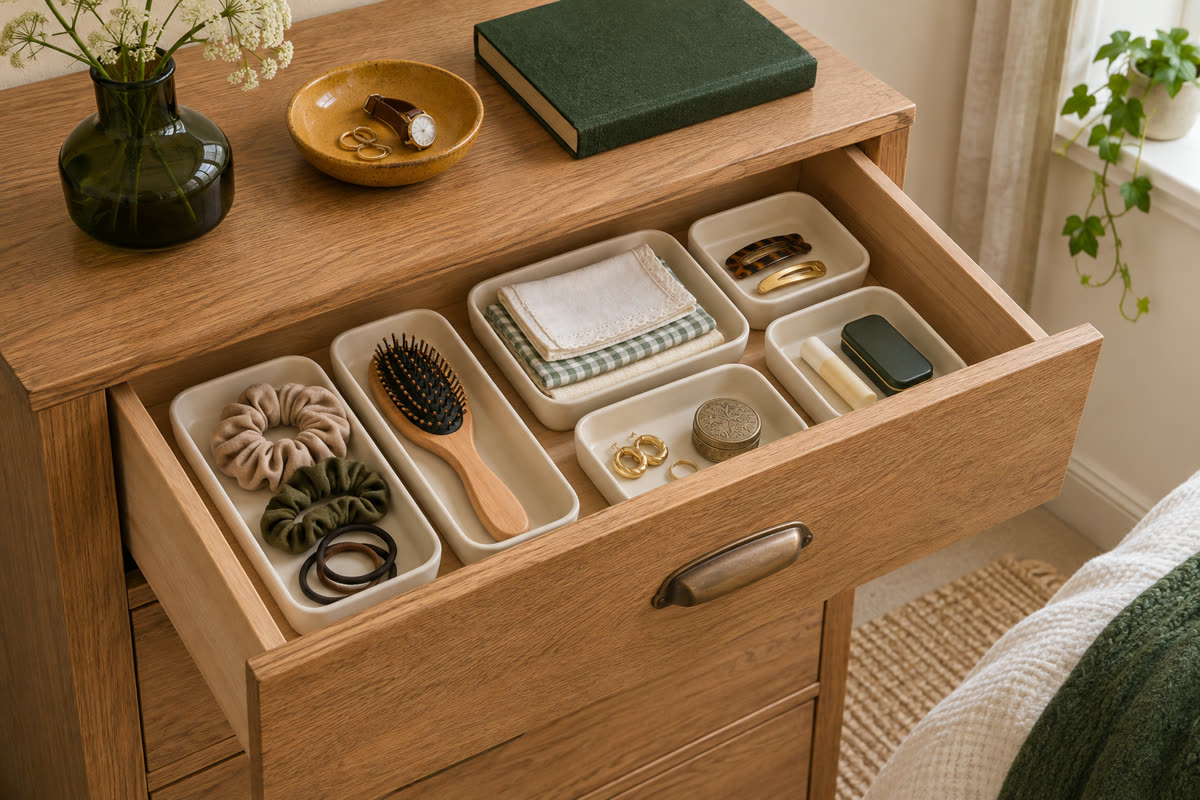
An open oak drawer with small ivory trays holding a brush, hair ties and folded handkerchiefs

A useful first step

Measure the base and the closing height

Check the narrowest resting footprint, loaded height and how far the drawer opens.

Open the measuring guide

Explore the whole topic

All drawer organisation guides

Compare products when you need something new, or find a layout for what you already own.

Use dividers for rows and trays for loose pieces

Adjustable dividers suit rows of folded clothes when their stated range matches the inside of the drawer. Check the end fittings and the surfaces they press against. Smaller lift-out trays help when you want to take hair ties, buttons or other little items out together.

A modular set for mixed contents

Blox trays clip together in different arrangements. Lay out the pieces you need for the drawer, then measure the entire arrangement. The dimensions below describe one example layout rather than the size of each individual tray.

For loose everyday essentials

Joseph Joseph Blox 7-piece organiser

Seven trays clip together in different arrangements, so you can group small accessories without committing to one large fixed insert.

Example layout · cm
43.9 × 26.5 × 5
Access
Lift-out trays
In the pack
Seven trays

What to check The maker’s example arrangement is 43.9 × 26.5 × 5 cm. Check your chosen layout and the clearance under the drawer’s front rail.

View on Amazon — Joseph Joseph Blox 7-piece organiser

Arrange for the things you use most

Put daily essentials near the front. In a drawer that opens partway, keep spares at the back or use a tray you can lift out without tipping. Compare the outside width of all the trays you intend to put side by side. Rounded corners and thick walls can make the actual compartments smaller.

Check the base

Use the inside width and depth where the organiser sits. Allow for rounded corners and any fixings.

Check the closing height

A tall divider can clear the drawer side yet catch on the rail or shelf above it.

Check your hand space

Leave enough room to pick up small things without lifting out the whole insert.

If the drawer is already full to the top, look at wardrobe organisers for bulkier clothes, or boxes and shelving for occasional items.

Check the inside base and closing route

Follow the drawer organiser measuring guide for base width and depth, closing clearance and usable travel. The modular-tray example explains why spare space in a calculation is not a guarantee that a filled drawer will close.

Back to all drawer organisation guides

Questions before you choose

Do I measure a drawer at the top or the base?

Use the inside footprint where the organiser rests, checking front, middle and back. Sloping walls and rounded corners can make the top measurement misleading.

Why can a tray stop a drawer closing?

The tray or its contents can hit a front rail or another obstruction above. Measure the lowest closing clearance and include liners and feet.

Are dividers or small trays more useful?

Dividers suit rows of folded items; lift-out trays suit loose pieces you want to keep together. Check adjustment range, compartment shape and access before choosing.

How do I organise a drawer that only opens partway?

Put the things you use most in the exposed area. Keep spares at the back only where you can retrieve them, or choose a tray that lifts through the opening without tipping. Test the loaded route as well as the tray footprint.

Should I buy an organiser set before planning the layout?

Map the inside base and group the contents first. Paper footprints help show whether the pieces you need will fit around corners and fittings. Include liners, feet and the tallest loaded item when checking whether the drawer will close.

How this guide is put together

We group the guides around the space, the contents and the way you need to reach them. Product examples use published specifications for the linked model, with limitations explained beside each recommendation.

The checklist is a planning aid. Confirm the exact variant, installation requirements and loaded access before buying. Our editorial policy and source policy explain how we compare products and handle incomplete or conflicting details.

Explore another storage area