
Best jewellery drawer trays for rings, earrings and bangles
Compare low lined jewellery trays, removable earring grids, an expanding drawer insert and a lidded tray. Check slot fit and loaded height.
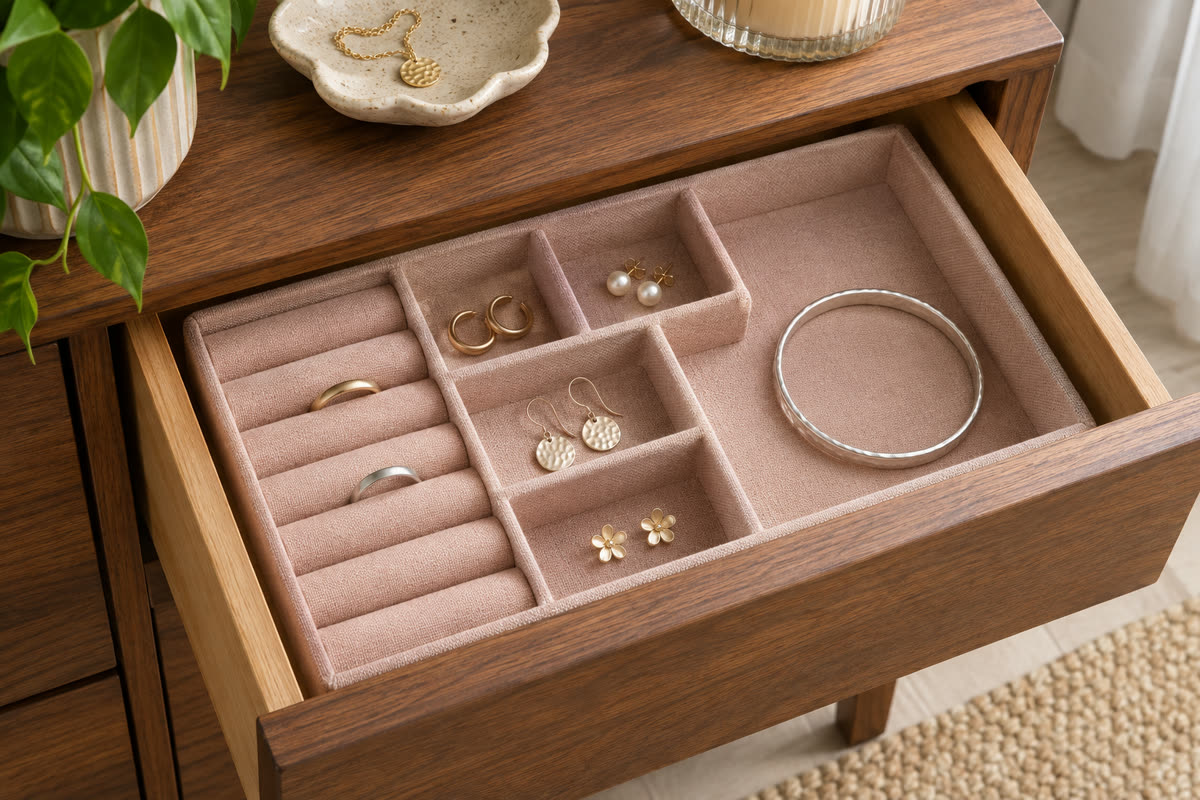
Four lined layouts for different jewellery groups
The dimensions describe empty products. Rings, earrings and watch straps can stand above a tray's rim and change the clearance it needs.
Lift-out trays for mixed jewellery
ProCase grey velvet jewellery trays
Four lined trays with a mix of layouts and removable dividers where fitted.
- Outside per tray · W × D × H cm
- 23.9 × 15 × 2.8
- Access
- Open mixed compartments
- In the pack
- Four trays
What to check Use the trays side by side where height is tight. Check the fit of rings and the complete height of any loaded stack.
View on Amazon — ProCase grey velvet jewellery traysMany small pairs in separate cells
Catime grey 24-grid jewellery tray
A velvet-covered tray with a removable grid for pairs and small accessories.
- Outside · W × D × H cm
- 35 × 24 × 3
- Access
- Open grid
- In the pack
- One tray
What to check Check the actual cell opening against the widest pair and leave room to grip it. Check how high any item sits above the rim.
View on Amazon — Catime grey 24-grid jewellery trayExpands to fit a wider drawer
Stackers Medium Jewellery Slider
A lined expanding insert with sections for rings, necklaces, earrings and bracelets.
- Outside · W × D × H
- 30.5–47.5 × 26 × 3.5 cm
- Access
- Expanding lined insert
- In the pack
- One tray
What to check Check the smallest drawer width and the compartments exposed at the chosen setting. Measure the loaded height.
View on Amazon — Stackers Medium Jewellery SliderCovered storage with adjustable sections
Frebeauty black glass-lid jewellery tray
A velvet-lined tray with a removable divider arrangement, a glass lid and two clasps.
- Closed · W × D × H cm
- 35.1 × 24.1 × 5.1
- Access
- Hinged glass lid
- In the pack
- One tray
What to check Measure the closed tray and the space needed to open it. Plan to lift it out first if the lid would strike the cabinet.
View on Amazon — Frebeauty black glass-lid jewellery traySide-by-side dimensions
Scroll sideways to see all columns.
| Tray | W × D × H | Layout | Check first |
|---|---|---|---|
| ProCase four-pack | 23.9 × 15 × 2.8 cm each | Four mixed layouts | Loaded height of any stack |
| Catime 24-grid | 35 × 24 × 3 cm | Removable 24-cell grid | Usable cell size and grip for small pairs |
| Stackers Medium Slider | 30.5–47.5 × 26 × 3.5 cm | Expanding insert | Full width and the compartments exposed at your setting |
| Frebeauty glass-lid tray | 35.1 × 24.1 × 5.1 cm closed | Twelve adjustable compartments and a lid | Closed height, clasps and room to open |
Sort jewellery by shape before counting sections
Start with the pieces you wear most. Separate rings, pairs of earrings, long chains, bangles and watches. Measure the largest piece in each group. A rigid bangle needs its full outside diameter when laid flat. A pair of earrings may take more space if posts project, and a thick watch strap can sit high when the clasp is fastened. Group pieces by the way they rest rather than by how many the tray can hold.
Check the ring holders with the widest band and the tallest stone or setting. A slot can hold a ring while part of it projects well above the rim. For earrings, try whether you can pick up each pair without disturbing the neighbouring one. If the smallest sections are hard to reach, use fewer and reserve a broad area for pieces that need more handling room.
Give delicate chains separate space to avoid tangling during normal use. Work from the way you can put them back after taking them off. A larger open section can suit a chain laid in a gentle curve. Use a suitable separate pouch for an item that should be kept apart or protected according to its care guidance.
Measure the loaded arrangement and closing route
Measure the usable drawer base and the lowest point it closes under. Note any hinges, screws or a rail above it. Place a folded paper strip at the highest point of the loaded tray to help judge where an item might catch. Include the base of the tray and any liner in the overall measurement. Our drawer measuring guide covers the closing path and how to check a tray at the back.
For a stack, measure all the trays together in their actual fitting position with the contents loaded. Some trays sit partially inside a compatible rim. Check that the underside of the upper tray leaves room for the ring or clasp below it. Use the stack only as the maker describes and keep the pieces you need daily where you can reach them directly.
Choose by the access you need
For small groups you want to lift individually, the ProCase grey four-pack gives four velvet trays, each 23.9 × 15 cm and 2.8 cm high. Choose the layouts that fit the pieces and use them side by side when height is tight. Check the fit of the removable dividers where fitted.
For lots of small pairs, the Catime 24-grid tray has a removable grid and a 35 × 24 cm footprint. The listed cells are about 6 × 5 cm. Check the clear space inside the grid against your earrings and keep broader pieces together in an appropriate open section.
For an adjustable width, the Stackers Medium Slider expands from 30.5 to 47.5 cm and is 3.5 cm high. Compare the expanded position with your drawer base and see which compartments open up at that setting. Use the paper layout guide if it needs to share space with another organiser.
For covered storage, the Frebeauty lidded tray has twelve compartments, removable dividers and two clasps. Its 5.1 cm height is for the closed tray. Check the lid swing and where you can lift the whole tray with both hands. Keep it where the glass lid can be handled without striking the cabinet or another item.
Give daily pieces the clearest reach
Put the pieces you wear most in the front part of the drawer. Check that you can lift a ring or earring with one hand while the tray stays level. Use the back for occasional pieces only if you can bring the tray forward without catching it. Keep space around anything you need to lift out.
Return a full day's pieces and check the loaded height again. If the tray moves, use the sliding organiser guide for layout and grip checks. If only a low flat watch or bangle needs a place, the shallow tray guide covers lower undivided options. Follow the tray and jewellery makers' care directions when cleaning or choosing a surface for delicate pieces.
Questions before you choose
How shallow can a jewellery tray be?
The ProCase trays here are 2.8 cm high empty. Check whether rings, earring posts or clasps stand above the rim.
Can I stack trays in a drawer?
Use the maker's compatible arrangement and measure the complete loaded stack. Side by side can be easier to reach where height is limited.
What kind of tray works for large bangles?
Choose a wide section or removable grid that fits the outer diameter. Lay the bangle in its actual resting position before measuring.
How do I store necklaces in a drawer?
Give each delicate chain room to lie separately, or use a suitable individual pouch for occasional pieces. Check the clasp and pendant fit the chosen section.
Can a lidded tray stay in the drawer while I open it?
Check the lid's full opening movement and the cupboard above. If it would catch, lift the tray out before opening.
Which insert works in a variable-width drawer?
The Stackers Medium Slider expands from 30.5 to 47.5 cm. Check the smallest width at the base and room to lift the pieces out.
How this shortlist was assembled
We compared the published dimensions and layouts of four exact Amazon UK variants. Loaded or stacked height and the fit of individual jewellery pieces depend on your arrangement.