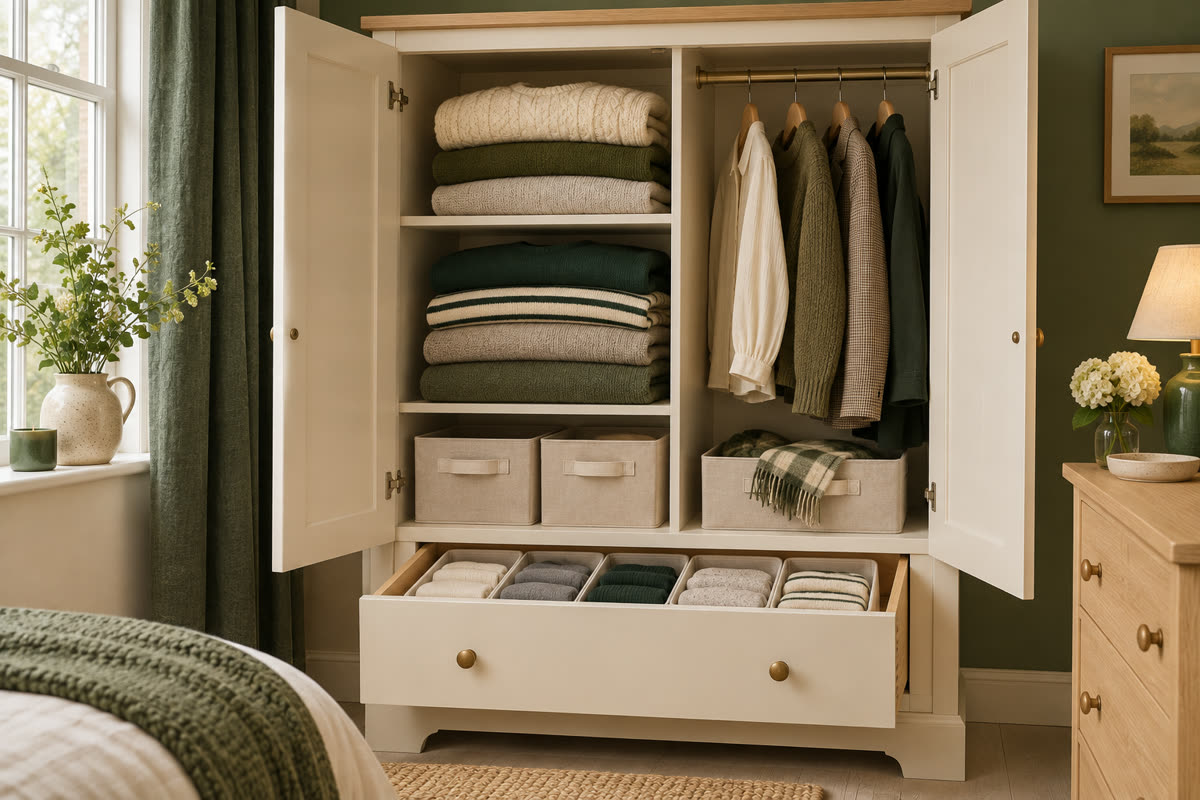
Match the organiser to the spare space
A shelf insert splits a tall bay into two shorter ones. A hanging organiser adds compartments to a rail-only wardrobe. Lift-out bins keep a deep shelf in usable groups. Pick the type that solves the awkward part of your wardrobe before comparing individual products.
Unused height
Shelf insert
Check the width between its legs and the space above it for your folded stack.
Spare rail width
Hanging shelves
Allow for the organiser’s drop and the hanging clothes alongside it.
Deep shelf
Lift-out bins
Group items so you can pull them forward together and reach the back.
Add compartments to a rail-only bay
The SONGMICS two-pack gives you separate five-shelf organisers, so you can use one in each wardrobe if that suits the space. Each takes 30 cm of rail width. Check the rail, hooks and drop before loading it.
For a wardrobe with spare rail space
SONGMICS hanging organisers, set of 2
Each five-shelf organiser uses a 30 × 30 cm footprint beneath the rail. Open compartments put folded clothes at different levels.
- Outside · cm
- 30 × 30 × 90
- Access
- Open compartments
- In the pack
- Two organisers
What to check Confirm the complete assembled hook-to-bottom drop against your bay. Each shelf is rated for up to 2 kg, with 10 kg total per organiser. Check the wardrobe rail’s capacity.
View on Amazon — SONGMICS hanging organisers, set of 2
Check the opening before adding a pull-out
A basket may fit between the wardrobe sides and still catch on a hinge or sliding door. Measure the clear opening at the point where the basket needs to pass. Frame-specific runners also need the correct width, depth and mounting points for that system.
For socks and underwear, compare drawer organisers. For seasonal clothes used less often, see under-bed storage.
Record the usable wardrobe bay
Our wardrobe measuring guide covers the smallest opening, shelf dimensions, complete hanging drop and hinge intrusion. Check those before choosing an insert or comparing frame-specific baskets.