
Best shallow drawer organisers for small items
Compare low open and compartment trays from 1.5 to 3.8 cm high. Measure the tray and its contents under the drawer's lowest closing point.
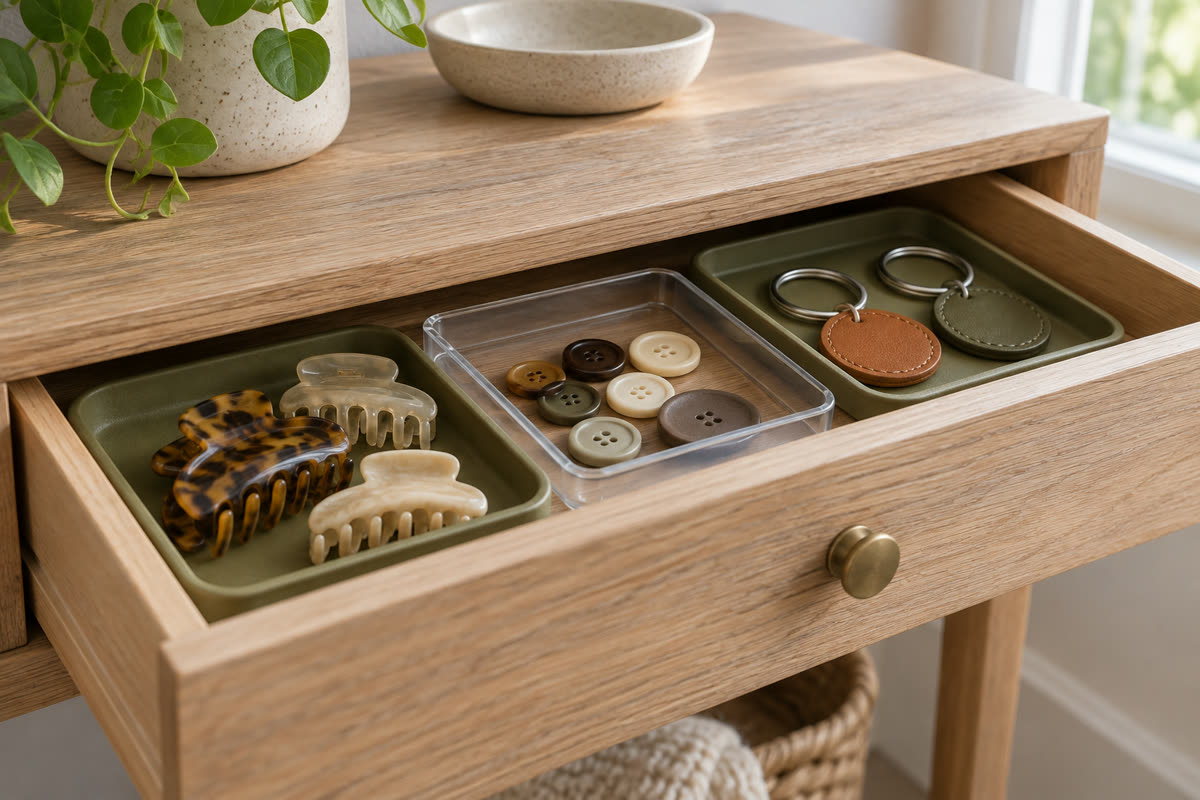
Three low trays with different uses
These figures describe the empty tray. A brush handle, key fob or bangle can make the loaded arrangement taller.
Very low lined surface
Oirlv beige low microfibre tray
A shallow undivided tray gives flat accessories and watches a soft resting surface.
- Outside · W × D × H cm
- 20 × 18 × 1.5
- Access
- Single open tray
- In the pack
- One tray
What to check Check how high a clasp or bangle sits and leave room to lift the item. The rim gives little separation between pieces.
View on Amazon — Oirlv beige low microfibre trayOne open group of loose items
WooDeeDoo small square pine tray
An open square tray with a raised rim and the full usable base available to one group.
- Outside · W × D × H cm
- 20 × 20 × 3
- Inside · cm
- 18 × 18 × 2.7
- Access
- Single open tray
- In the pack
- One tray
What to check Compare the inner footprint with your widest item and leave room to grip the tray when it is full.
View on Amazon — WooDeeDoo small square pine trayMany small groups in a wide drawer
Ernst red ten-compartment tray
Ten fixed ABS compartments keep small craft pieces, fasteners or tools apart.
- Outside · W × D × H cm
- 40.6 × 27.9 × 3.8
- Access
- Ten fixed sections
- In the pack
- One tray
What to check Check the broad footprint and your reach to the back. Use a single layer where closing height is tight.
View on Amazon — Ernst red ten-compartment traySide-by-side dimensions
Scroll sideways to see all columns.
| Tray | Footprint | Empty height | Useful for |
|---|---|---|---|
| Oirlv P19903 | 20 × 18 cm | 1.5 cm | Lined surface for flat accessories |
| WooDeeDoo EUW20 | 20 × 20 cm | 3 cm | One open group of loose items |
| Ernst 5010 | 40.6 × 27.9 cm | 3.8 cm | Ten fixed sections for craft supplies or small parts |
Find the lowest point the drawer closes under
Start with the empty drawer in its normal position. Look for the rail beneath the worktop or the bottom of the next drawer. Check both sides, the middle and the area around exposed screw heads. Measure from the tray's intended resting surface to the lowest part of the cabinet that the drawer passes beneath. Record the reading where the highest item will sit, as well as the smallest overall reading.
Measure width and depth at the base. The inside of the drawer may get wider towards the top, and a low square tray can meet a rounded corner before it reaches the bottom. Cut a paper outline if a fit is close. Keep room to take the tray out for cleaning and check the space under the cabinet when the drawer is open. The drawer measuring guide covers these as separate checks.
A tray that leaves room above the rim still needs enough height for you to pick up the contents. Put your hand over the planned position and try lifting a small clip. If the front rail blocks your hand in the last part of the drawer, use the low tray near the front or give the rear space to an occasional group you can pull forward.
Measure each group in its intended position
Lay the items on a flat surface. Place a watch, hair clip or key fob as you intend to store it. A clasp or thick end can sit higher than the rest. Keep each item in the orientation that makes it easy to grip. If a tall piece needs to go on its side, check whether it will stay that way when the drawer opens and closes.
Where the items can overlap or pile up, measure that loaded condition as well. Give hair bands or clips enough space that they can be returned without forming a mound. For a drawer with several different shapes, compare modular trays and check their generally taller walls against the available height.
Compare the tray style with your daily items
For flat accessories, the Oirlv microfibre tray has a 1.5 cm empty height and one undivided surface. Lay watches or rigid bangles flat and check the tallest clasp. The low rim makes it easy to lift a piece but gives less separation than individual jewellery cells.
For one group of loose items, the WooDeeDoo pine tray is 20 × 20 cm outside and 3 cm high. The maker gives approximately 18 × 18 × 2.7 cm inside. Compare the interior against the broadest piece you want to keep there. Leave room to grip the tray if you plan to take it out with the contents.
For several small parts in one wide tray, the Ernst 5010 uses ten fixed compartments in a 40.6 × 27.9 cm footprint. Its 3.8 cm height can suit a wide shallow drawer. Map the usable opening so you can reach the rear compartments, and check the intended compartment for the biggest part.
Test the loaded layout before you fill every space
Put the tray in the empty drawer and close it gently. Load the highest item, repeat the check and then add the rest of the group. Try taking an everyday piece out and returning it. If you need to push it down to close the drawer, give it a separate place. Recheck with the drawer fully loaded, when items are more likely to sit on top of one another.
Use the paper layout guide to compare several footprints. If one tray fits but moves around, try a more deliberate position or a compatible grip option from the sliding organiser guide. For forks, spoons and knives, compare flat cutlery layouts that hold the longer pieces in place.
Questions before you choose
How shallow are the trays in this guide?
The listed empty heights are 1.5, 3 and 3.8 cm. Compare the loaded height with the lowest cabinet obstruction.
Why won't my drawer close over a shallow tray?
Check the tallest item in the tray, raised feet and any liner. Look for a rail or screw head that sits below the rest of the cabinet.
How do I measure a tray with a sloping rim?
Use the highest outside point for closing clearance and the widest outside point for footprint. Check the narrower usable area inside.
Can I stack low trays in a shallow drawer?
Use a compatible stack only if its complete loaded height clears the drawer and you can reach the contents. A single layer usually preserves easier access.
What works for tiny items in a wide drawer?
Choose fixed compartments or a group of small trays if you can reach and remove each item. Check the grip space around loose trays.
Do I need a liner under a shallow organiser?
Use a compatible liner only if the tray needs grip and still clears the closing path. A flat liner adds height.
How this shortlist was assembled
We selected three exact Amazon UK products with empty heights below 4 cm and different layouts. We checked published outside sizes and use maker interior dimensions where available. Loaded examples are illustrative.