
Best pull-out baskets for existing wardrobes
Compare a narrow base-mounted wire basket with a wide side-mounted pull-out. Check runner fit, door opening, load and clearance before buying.
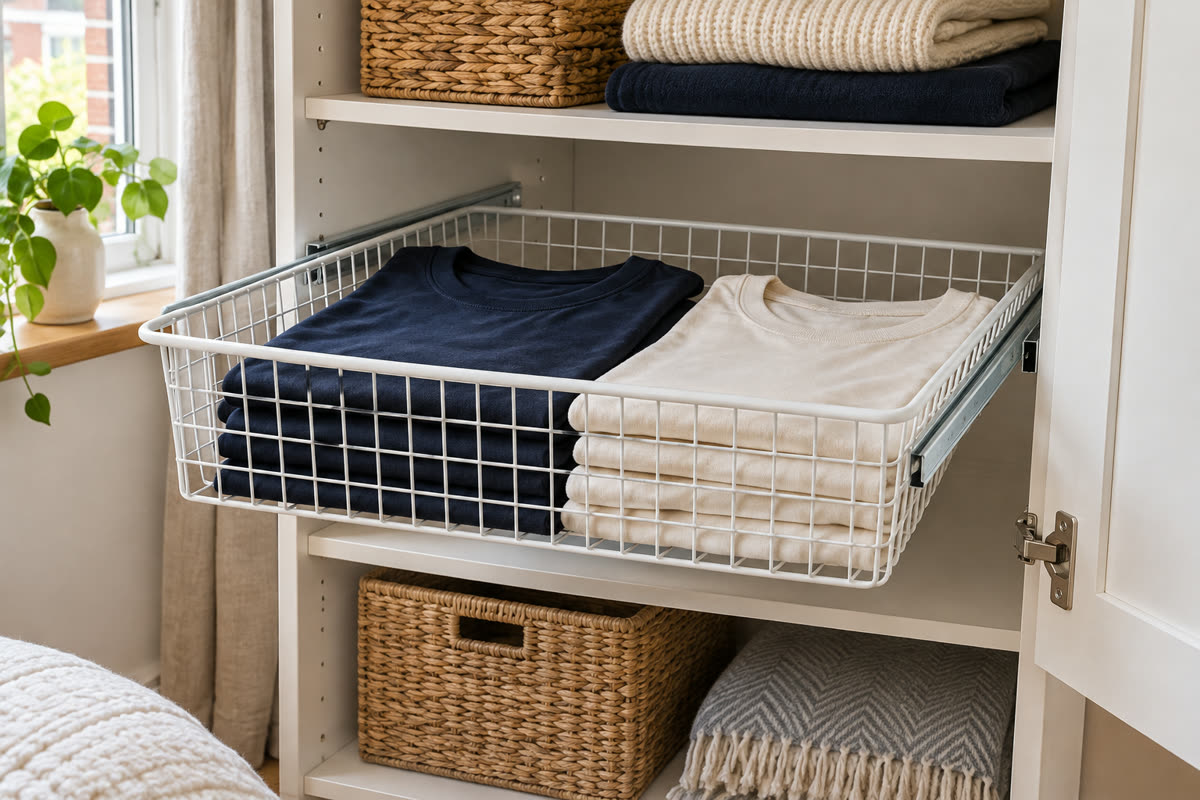
Two retrofit baskets with different mounting methods
The base-mount example is designed for suitable base cabinetry. Use it in a wardrobe only if the base, opening and installation meet its instructions. The wider Solmer listing includes built-in wardrobe use.
Narrow screw-fixed base mount
ClosetMaid 3051 narrow base-mounted basket
A sliding wire basket on a carriage designed to screw into a compatible cabinet base.
- Assembled width and depth
- Approx. 28.3 cm wide × 50.8 cm deep
- Access
- Base-mounted pull-out carriage
- In the pack
- One basket and installation hardware
What to check Allow a clear opening at least 30.5 cm wide. Confirm the assembly height, front setback and base suitability in the exact instructions.
View on Amazon — ClosetMaid 3051 narrow base-mounted basketWider side-mounted pull-out
Solmer soft-close wire basket for nominal 600 mm cabinet
A wire basket with paired full-extension soft-close runners and fixing screws.
- Basket body only
- 50 cm wide × 45 cm deep
- Access
- Side-mounted full-extension runners
- In the pack
- One basket with runners and screws
What to check The listing specifies 16–20 mm cabinet boards and a 25 kg maximum for the basket. Check the full runner span, assembly height and the wardrobe's own mounting limits.
View on Amazon — Solmer soft-close wire basket for nominal 600 mm cabinetSide-by-side dimensions
Scroll sideways to see all columns.
| Basket | Width and depth | Mounting | Check first |
|---|---|---|---|
| ClosetMaid 3051 | Approx. 28.3 × 50.8 cm assembled | Screws into a suitable cabinet base | Clear opening at least 30.5 cm; check installed height and front setback |
| Solmer nominal 600 mm | 50 × 45 cm basket body | Side-mounted full-extension runners | 16–20 mm cabinet boards and exact runner span |
Check the cabinet first
Find the wardrobe model and instructions before measuring for a runner. Frame-specific systems may offer fittings designed around the original holes and doors. For example, an accessory sold for a particular frame width and depth can rely on the spacing of its side panels and the position of its hinges. Look up the exact compatible frame and door combination. Keep the existing panels and fittings in their specified positions.
For a retrofit, decide which surface can carry the load. A side-mounted unit needs appropriate material and enough width to fit the two runners parallel. A base-mounted unit needs a suitable level base and room for the carriage and fasteners. A loose adjustable shelf or thin decorative lining may be unsuitable as a mounting surface. Confirm with the furniture and basket instructions before fixing anything into place.
Measure the clear inside width at the height where you plan to mount the runners. Take it near the front and again at the back. Measure the depth to the back panel and note any vertical lip that reduces what you can actually use. Check the frame when installed and secured as directed. Our wardrobe measuring guide separates these figures from the outside dimensions of the furniture.
Map the complete pull-out path
Open the doors as far as you normally can. Measure the narrowest part of the opening at basket height. On hinged doors, include the hinge arms and the inside edge of the open door. On sliding doors, put the basket behind one clear opening and account for the door overlap. Test the left and right edges separately. The difference between two widths on paper tells you little about an offset basket.
Trace the assembly on cardboard and move it forward from the planned position. Check the entire basket including the rim and handle. Some baskets sit deeper inside because a frame or door projects. Follow the fitting instructions for the starting position and use the full travel specified by the maker. A basket that extends across a bed frame may become unusable before you reach the items at the back.
Choose a base or side mounting
For a narrow compatible base, the ClosetMaid 3051 sits on a screwed-in carriage. The listing calls for an opening at least 12 inches wide, about 30.5 cm. Allow around 50.8 cm of assembled depth plus any front setback the instructions specify. Measure the space above the loaded basket to the next shelf. This type works only where the wardrobe can take the installation meant for suitable base cabinets.
For a wider compatible bay, the Solmer nominal 600 mm basket includes two full-extension soft-close runners and a basket body measuring about 50 cm across by 45 cm deep. The listing specifies 16–20 mm cabinet boards. Ask for the exact runner span and assembly height if either is close. Use the mounting instructions for the cabinet, runners and fasteners. Its stated basket limit does not establish how much an existing wardrobe can support.
Where the instructions rule out both styles, a handled lift-out wardrobe bin can provide a usable group with no runners. Check the shelf supports, lift height and handle position so you can remove it smoothly.
Check reach and loaded fit
Put the frequently used clothes at the front and keep stacks low enough to clear the next shelf when the basket closes. Take out the biggest folded item first and try putting it back without dragging it along the wire. For small items, check whether the mesh supports them or use an appropriate contained group within the basket where it stays clear of the runners.
Use the permitted load for the complete installation, including the furniture panels and hardware. A drawer extended in front of the cabinet puts its load in a different position from a stationary shelf. Use all prescribed wardrobe fixings and confirm installation questions with the maker or a competent fitter. After fitting, open and close the basket gently before adding clothes. If the front scrapes or the runners bind, stop and check the alignment and clearances. For planning a deep bay without runners, see the deep shelf guide.
If the bay has enough room for a separate unit, compare freestanding wardrobe drawers by their full drawer travel and installation instructions.
Questions before you choose
Can a pull-out basket fit any wardrobe?
Use it only where the frame, panels, mounting hardware and door arrangement meet the basket instructions. A similar cabinet width alone cannot establish compatibility.
Does nominal 600 mm mean a basket is 60 cm wide?
No. Nominal measurements can describe the cabinet size. Check the actual basket dimensions, the full span between runners and the minimum opening.
Can I put a side-mounted basket behind a hinge?
Measure the projection of the hinge and the basket's full travel. Use a spacer only if the exact maker specifies a compatible setup.
What depth should I measure?
Measure inside the wardrobe at runner height. Include any required setback from the closed door and the full length of the moving assembly.
Do I need full-extension runners?
They help reach the back if the room has space for the complete extension. Try the open position with any bed or furniture opposite.
What if I cannot use the supplied fixings?
Use a compatible fitting or a removable storage bin. Follow the stated mounting instructions for any fitted basket.
How this shortlist was assembled
We checked two exact Amazon UK variants and the corresponding fitting information. ClosetMaid dimensions are approximate and Solmer basket-body width excludes the runners. Compatibility and load depend on the documented installation.