
Best cutlery trays for shallow drawers
Compare flat, expandable and narrow tiered cutlery trays. Check the real closing height, compartment length and the clearance needed to lift cutlery.
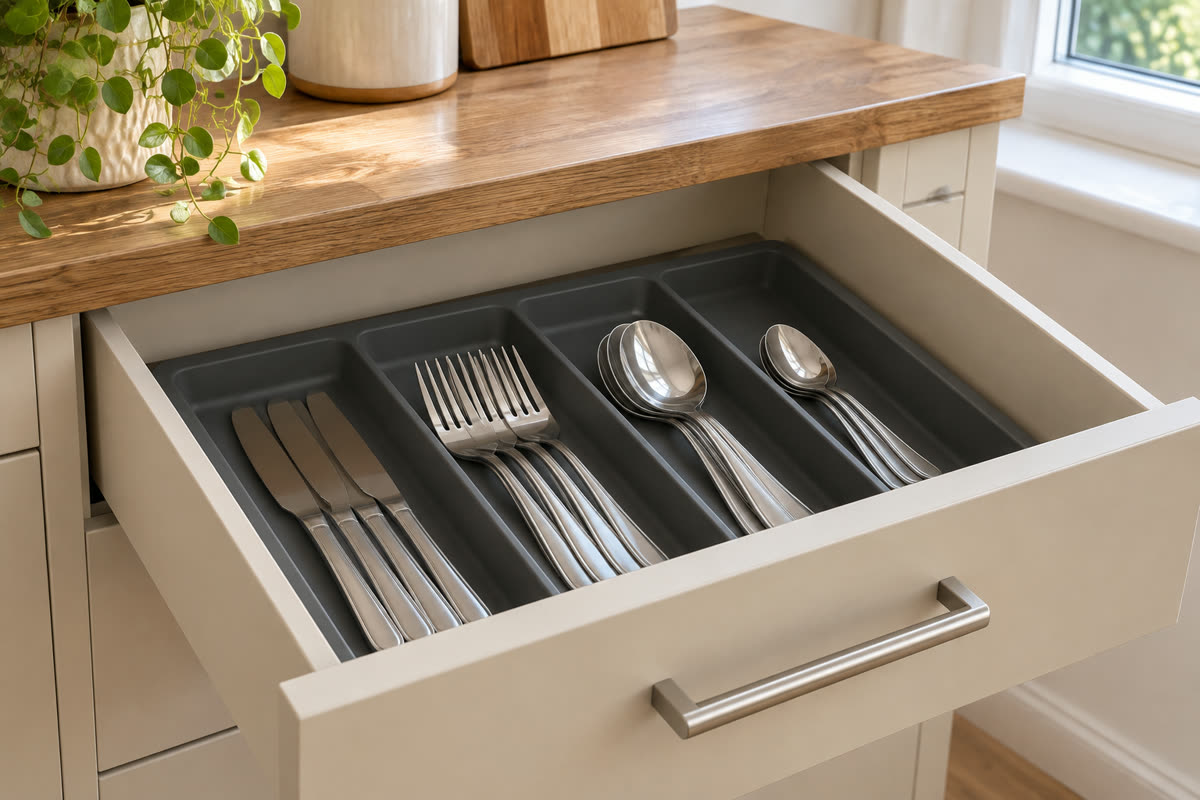
Four trays for different width and height limits
Outside height describes the empty tray. Check your loaded height and any separate minimum specified by the manufacturer.
Lowest flat cutlery tray in the shortlist
Space Home wooden four-compartment cutlery tray
A low wooden tray with four fixed compartments for a compact group of utensils.
- Outside footprint × height · cm
- 32 × 22 × 3.5
- Access
- Four flat compartments
- In the pack
- One tray
What to check Check the longest usable section and loaded height. The listing notes that the backing colour can vary and advises against dishwasher cleaning.
View on Amazon — Space Home wooden four-compartment cutlery trayCompact grip-lined flat tray
madesmart Classic Mini cutlery tray
Five flat sections with grip lining for smaller groups of daily cutlery.
- Approx. W × D × H cm
- 22.9 × 32.4 × 4.8
- Access
- Five flat compartments
- In the pack
- One tray
What to check Outside figures are approximate. Measure your longest knife and spoon against the usable compartments, then check the full loaded height.
View on Amazon — madesmart Classic Mini cutlery trayAdjusts to a wider drawer
Joseph Joseph expandable cutlery tray
A flat cutlery insert with a side section that expands to suit the usable width.
- Outside · W × D × H
- 29–48 × 38 × 5.3 cm
- Access
- Width-adjustable flat tray
- In the pack
- One expanding tray
What to check Check the 38 cm depth and the selected width at the narrowest part of the base. Leave room to grasp the longest pieces.
View on Amazon — Joseph Joseph expandable cutlery trayVery narrow drawer with 8 cm height
Joseph Joseph DrawerStore Compact
Staggered pockets save width by arranging cutlery at different levels.
- Outside · W × D × H cm
- 11 × 39.5 × 5.7
- Access
- Staggered cutlery pockets
- In the pack
- One tray
What to check Joseph Joseph requires at least 8 cm of internal drawer height. Check loaded clearance and reach to the rear pocket.
View on Amazon — Joseph Joseph DrawerStore CompactSide-by-side dimensions
Scroll sideways to see all columns.
| Tray | Footprint | Empty height | Use it for |
|---|---|---|---|
| Space Home four-compartment | 32 × 22 cm | 3.5 cm | Low flat storage and short cutlery groups |
| madesmart Classic Mini | 22.9 × 32.4 cm | 4.8 cm approx. | Compact flat sections with grip lining |
| Joseph Joseph 85042 | 29–48 × 38 cm | 5.3 cm | Adjusting to a wider drawer |
| Joseph Joseph 85119 | 11 × 39.5 cm | 5.7 cm | Narrow tiered format, requires 8 cm internal height |
Measure the lowest point along the closing route
Open the empty drawer and look for a rail, fixing or underside of a worktop that it passes beneath. Measure from the surface the tray will sit on to the lowest obstruction in that path. Take readings at the intended position of the tray, including where the tallest handles will sit. The height of the drawer front can be larger than the space you can actually use inside.
Add the tray's raised base or feet and any liner to the height you measure. A 3.5 cm tray with an item sitting above its rim can take more room than its outside dimension suggests. Measure the tallest group with all its pieces stacked as you usually return them. If you have mixed handle shapes, try the widest or thickest one first. The drawer measuring guide explains how to check the base and closing height separately.
Check the longest pieces and the way you take them out
Lay the longest table knife, fork and spoon on a flat surface. Measure the longest point and the widest part of each piece. Compare those with the compartment opening and its narrower base. A tray with rounded ends can have less usable length than its overall depth. Leave enough room to get a finger under the handle and lift it free.
Try the compartment arrangement with a full set of dry cutlery. When spoon bowls nest, their handles can sit at different heights. Thick handles take more space when several pieces sit together. Keep bulky serving spoons and tongs in a separate utensil organiser if they reduce the space for daily cutlery.
Choose a shape for the drawer you have
For the lowest empty tray here, the Space Home wooden tray has a 32 × 22 cm footprint, 3.5 cm outside height and four fixed compartments. Check the usable length of the longest section and leave space for hands around the rim. Follow the maker's care directions and keep it out of the dishwasher.
For a compact flat tray with grip lining, the madesmart Classic Mini uses five compartments in a footprint of about 22.9 × 32.4 cm. Check whether the small size suits your longest cutlery and the complete group you need to keep nearby. Its lining can help keep pieces separated as the drawer moves.
For a wider drawer, the Joseph Joseph DrawerStore 85042 expands from 29 to 48 cm wide. The stated depth is 38 cm. Set the width against the smallest usable base and see whether the expanded section still leaves the grip space you need. Check the fit with the drawer in its usual open position, especially if the rear is partly covered.
For very limited width with adequate height, the Joseph Joseph Compact 85119 uses staggered pockets in an 11 cm-wide tray. Joseph Joseph specifies 8 cm of minimum internal drawer height. Check the way a handle sits when inserted and whether the drawer opens far enough to reach the far pocket. Keep to a flat tray if closing height is the tighter limit.
Test the loaded tray before filling the rest of the drawer
Place the empty tray at the intended spot and move the drawer gently through its closing path. Load one group at a time, beginning with the tallest or thickest handles. Try retrieving the piece at the rear while the drawer is normally open. If the tray needs to sit farther forward, check that the front rail and handle remain clear at that new position.
Give everyday cutlery the easiest reach and move pieces used for serving elsewhere if they obstruct it. Use the paper layout guide to test the footprint alongside other inserts. If the empty tray moves across the base, check how to stop an organiser sliding before adding a liner that changes its height.
Questions before you choose
What is the shallowest tray here?
The Space Home four-compartment tray has a listed outside height of 3.5 cm. Measure it with your longest and tallest pieces in place.
Can the Joseph Joseph Compact fit a 6 cm drawer?
The maker specifies at least 8 cm of internal drawer height for model 85119. Choose a lower flat format if you cannot meet that requirement.
How do I tell whether table knives fit a tray?
Measure your longest knife and compare it with the clear length of the intended compartment. Check the grip and lift movement as well.
Is an expandable tray deeper when opened?
Check the exact design. The Joseph Joseph 85042 expands in width from 29 to 48 cm and lists a 38 cm depth.
Can I put a liner below a cutlery tray?
Use a compatible liner that lies flat and include it in the loaded height. Check whether the tray already has feet.
How much cutlery can a shallow tray hold?
Count the pieces you need in each section and test their height when returned as a full group. Stack shape and handle thickness change the result.
How this shortlist was assembled
We compared four exact Amazon UK variants with their published dimensions and format. We give the manufacturer’s separate height requirement for the tiered tray and leave usable compartment length to be checked against your pieces.