
Best utensil drawer organisers for long kitchen tools
Compare long individual trays, fixed compartments and expandable utensil organisers. Check the longest tool, widest head and thickest handle before buying.
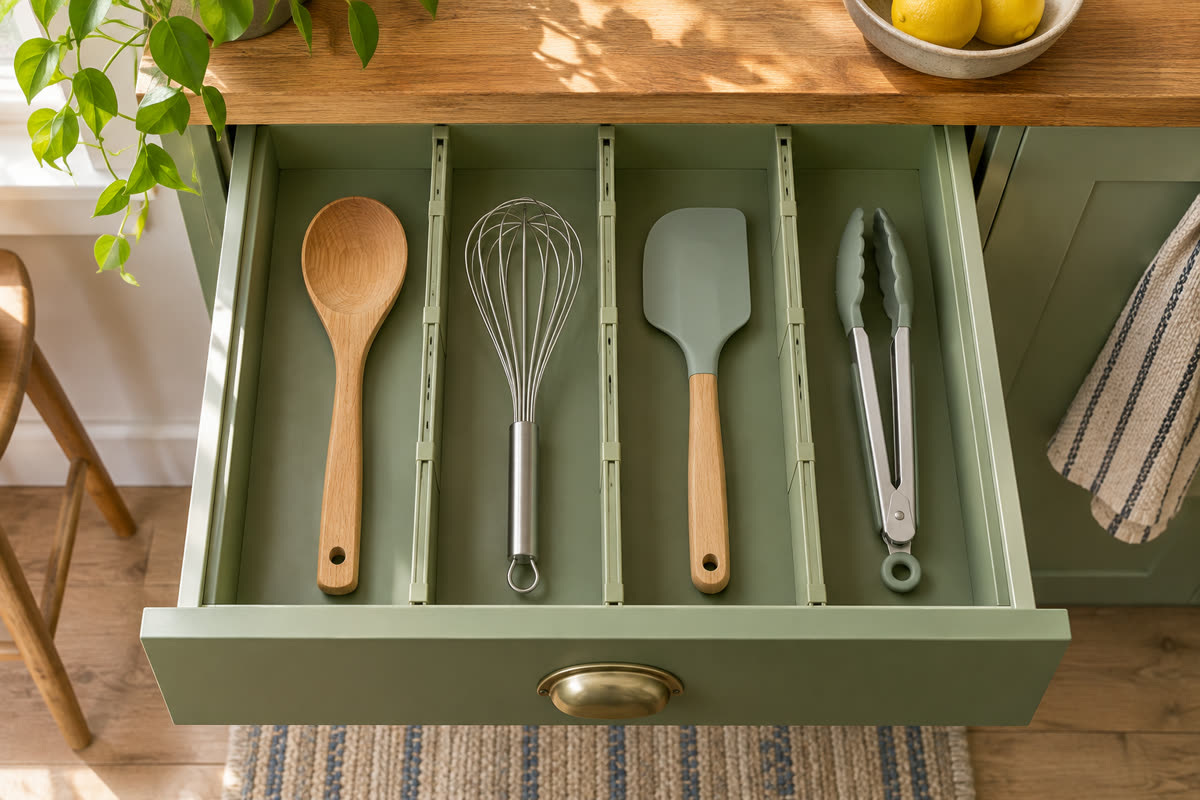
Four layouts for kitchen tools of different shapes
The dimensions describe the organiser's outside size. Compare the actual channel length and head room with the tools you plan to store.
One long tray and two smaller groups
Addis Drawer Tidy triple pack
Three loose trays let you put the long tools on one side and move the shorter pieces separately.
- Individual outside sizes
- 17 cm wide; 40.5, 24.5 and 17 cm deep; 5 cm high
- Access
- Three independent trays
- In the pack
- Three trays
What to check Use the maker's individual dimensions. Check the actual inside length and whether the longest tool can lift out when the drawer is open.
View on Amazon — Addis Drawer Tidy triple packFixed sections for similar tools
Addis three-compartment utensil tray
A fixed-size tray with three sections, grip lining and feet.
- Outside · W × D × H cm
- 33 × 41 × 5
- Access
- Three fixed sections
- In the pack
- One tray
What to check Check the inside length of the longest section and leave room around the widest tool head. Measure the loaded clearance.
View on Amazon — Addis three-compartment utensil trayBulky tool heads and mixed widths
OXO large expandable kitchen tool organiser
An expandable organiser with movable dividers and a removable cup for small pieces.
- Outside · W × D × H
- Approx. 25–45.9 × 41.5 × 6.3 cm
- Access
- Expandable with removable cup
- In the pack
- One organiser with partitions and cup
What to check Check the narrowest base width and the drawer's lowest closing point. Measure the highest utensil, especially a whisk or ladle.
View on Amazon — OXO large expandable kitchen tool organiserCutlery and utensils in one drawer
Joseph Joseph cutlery and utensil organiser
A combination tray with staggered cutlery pockets, utensil compartments and a smaller gadget section.
- Outside · W × D × H cm
- 38.4 × 39.7 × 5.3
- Access
- Tiered pockets and fixed channels
- In the pack
- One tray
What to check Joseph Joseph specifies at least 8 cm of internal drawer height. Check the largest tool in each intended compartment.
View on Amazon — Joseph Joseph cutlery and utensil organiserSide-by-side dimensions
Scroll sideways to see all columns.
| Organiser | Outside size | Format | Good starting point |
|---|---|---|---|
| Addis 506985 triple pack | 17 cm wide; 40.5, 24.5 and 17 cm deep; 5 cm high | Three loose trays | One long run with smaller trays elsewhere |
| Addis 518896 | 33 × 41 × 5 cm | Three fixed sections | A group of utensils of similar lengths |
| OXO 13322100 large | Approx. 25–45.9 × 41.5 × 6.3 cm | Expandable with adjustable partitions | Wider heads and mixed tools |
| Joseph Joseph 85127 | 38.4 × 39.7 × 5.3 cm | Combination with tiered cutlery pockets | One shared drawer, at least 8 cm internal height |
Measure the long tools and the bulky heads
Take out the tools you reach for each week. Measure the longest wooden spoon, turner or pair of closed tongs. Then measure the width and thickness of the biggest head. The tool that needs the longest compartment may be different from the tool that sets the closing height. Check a whisk across its widest point and a ladle at the deepest point of its bowl.
Lay tools in the orientation you expect to use. Keep tongs closed as directed where the design has a lock. Check that a deep ladle bowl can sit in the space without rolling and that a silicone head has enough room to lie flat. Try removing one tool with a hand while the rest stay in place. If the handle cannot lift without hitting another utensil, adjust the orientation or give it a separate section.
Keep sharp kitchen items in storage suited to them. Place long blunt tools where they can be picked up by the handle. Group things by when you reach for them rather than sorting by length alone. For daily forks and spoons, compare shallow cutlery trays.
Plan usable channels in the actual opening
Measure the base in the direction the longest tool needs to sit. Check both sides of the drawer and the corners. Look at where the back of the open drawer sits under the worktop. A long tray may fit the base and still leave the end of a spatula hard to lift. Try the retrieval motion and keep the handles within reach.
Use the paper layout guide to place your longest channel before adding smaller sections. Put the shortest tray in the leftover space only if you can still pick it up when the long tools are in place.
Compare four ways to group tools
For one long run beside other storage, the Addis Drawer Tidy triple pack uses three loose trays, each 17 cm wide and 5 cm high. Their depths are 40.5, 24.5 and 17 cm. Put the longest one where you can lift your tools and position the other two for smaller items. Check the usable interior separately and allow room to lift the trays individually.
For a single tray with fixed sections, the Addis 518896 is 33 cm wide, 41 cm deep and 5 cm high. Its grip-lined sections suit a group that already fits the layout. Compare each compartment with the biggest tool assigned to it, and check whether the drawer exposes the full tray.
For bulky heads or different widths of tool, the OXO 13322100 has an expandable format with adjustable partitions and a removable cup. Check the approximate 25–45.9 cm width range, 41.5 cm depth and 6.3 cm height against your base. Place the wide tools where there is room for their heads and keep the cup for small pieces that stay below the closing route.
For sharing with everyday cutlery, the Joseph Joseph 85127 combines staggered cutlery pockets with longer utensil sections and a small gadget space. The tray is 5.3 cm high empty and the maker calls for 8 cm minimum internal drawer height. Check the height of your ladle and whisk separately, especially if they sit across another item.
Check retrieval and closure together
Start with the drawer empty and test the organiser as you move it through the closing route. Then load the tallest tool in its normal position, add the pieces that share its channel and check again. Measure the thickest stack with any feet or liner underneath. Refer to the drawer measuring guide for a low cabinet rail or a hidden fixing.
Try removing the farthest tool without pulling another one out first. Move a rarely used piece to the back or to a separate suitable place if it crowds the daily tools. If your widest piece cannot lie comfortably in a moulded compartment, compare a divider layout that uses the existing base or a long removable tray.
Questions before you choose
What length should a utensil tray be?
Measure the longest tool you keep there and compare it with the usable compartment, allowing room to grip and lift. The organiser's outside length will be larger.
Can a whisk lie in a shallow drawer?
Check the diameter of the whisk head and its orientation. Include the tray floor or liner in the height you measure.
What is the difference between cutlery and utensil trays?
Utensil trays often have longer or wider sections for tools such as turners and ladles. Choose compartments around your own pieces.
Can I use an expandable insert in a tapering drawer?
Set the width within the maker's range and check the smallest base reading along the entire insert. Rounded corners and fixings can reduce the usable span.
What if the drawer only opens partway?
Keep frequently used utensils where you can lift them. Check that long tools at the rear can clear the cabinet without turning into another section.
Does the Joseph Joseph combination tray need more room than its 5.3 cm height?
Yes. Joseph Joseph specifies at least 8 cm of internal drawer height for model 85127, and the loaded tools still need to clear the closing route.
How this shortlist was assembled
We compared four exact Amazon UK variants with maker information and exact model dimensions. The OXO size is approximate. The dimensions describe the outside of each tray or layout, so the longest usable compartment needs its own check.