
Shoe storage without wall fixings
Find low shoe storage options that suit a hallway where you cannot drill. Compare a compact rack, rolling tray and boot tray by usable space.
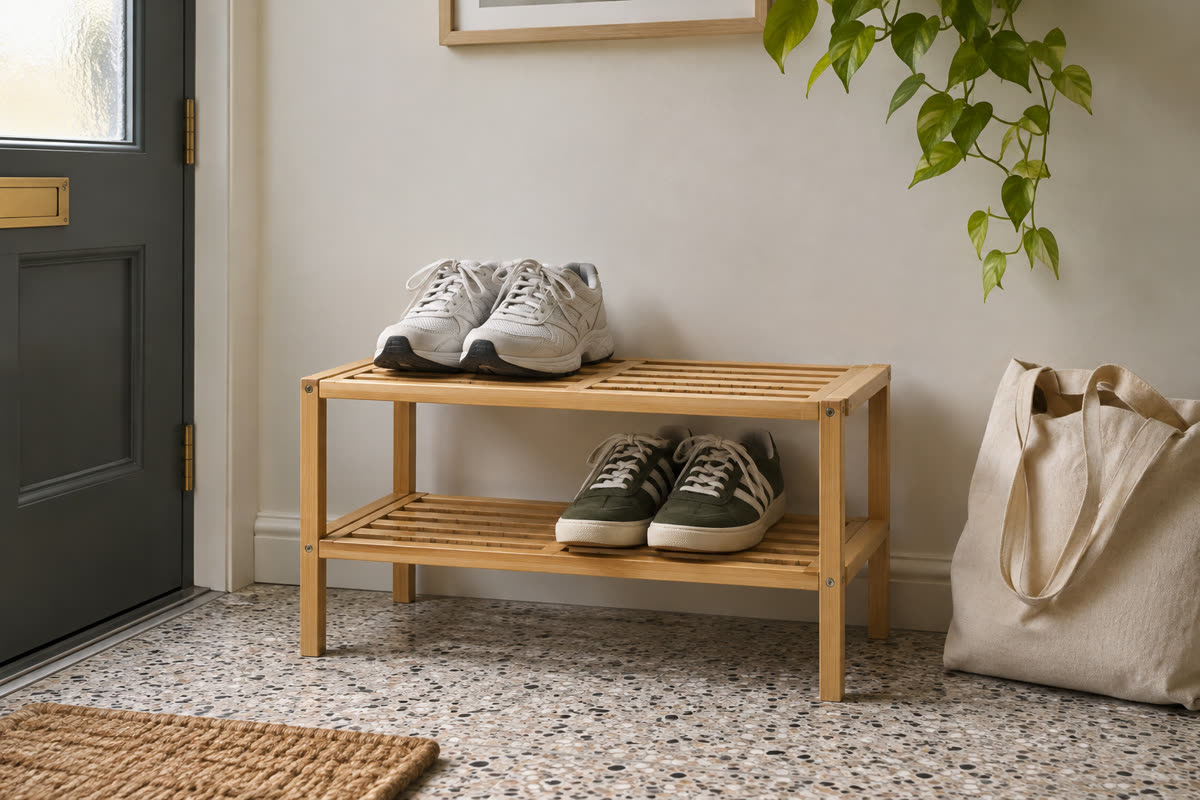
Three low options for halls where you cannot drill
These work in different floor spaces. Keep them out of door movement and follow the maker's directions for placement and loading.
Low rack for a short recess
Joseph Joseph Shoe-In compact rack
A compact two-level rack that places one pair above another within a short wall span.
- Outside · W × D × H cm
- 23.5 × 35 × 15
- Access
- Open shoe platforms
- In the pack
- One rack
What to check Set it against a wall or cupboard back as the maker directs. Check the real projection of the shoes and space to lift them out.
View on Amazon — Joseph Joseph Shoe-In compact rackPull-out rack for a low recess
Yamazaki Tower rolling shoe rack
A low wheeled tray with stoppers and 80 cm of usable inside width. It can pull out of a suitable recess.
- Outside · W × D × H cm
- 83.5 × 27.5 × 14.5
- Access
- Open rolling tray
- In the pack
- One rack
What to check The 14.5 cm outside height includes castors. Measure the loaded height and pull-out route. The maker lists a 4 kg static load.
View on Amazon — Yamazaki Tower rolling shoe rackFlat landing for muddy shoes
Nicoman plain black boot tray
A rigid floor tray with a raised lip for wet soles and grit. Lift it out to rinse and dry it.
- Outside · W × D × H cm
- 75 × 38 × 3
- Access
- Open tray
- In the pack
- One tray
What to check The outside size includes the rim. Check the inner flat space and place the tray clear of door movement and the walking route.
View on Amazon — Nicoman plain black boot traySide-by-side dimensions
Scroll sideways to see all columns.
| Product | W × D × H | Format | Check |
|---|---|---|---|
| Joseph Joseph Shoe-In | 23.5 × 35 × 15 cm | Two levels | Place against a wall or cupboard back as directed |
| Yamazaki Tower 1623 | 83.5 × 27.5 × 14.5 cm | Rolling tray | Loaded height, pull-out room and castor clearance |
| Nicoman plain black tray | 75 × 38 × 3 cm | Stationary tray | Flat interior and floor space for the rim |
Start with the installation instructions
If you cannot drill, start by ruling out furniture whose assembly instructions require wall anchoring. A listing that says freestanding may describe where the weight rests. The assembly instructions can still require an anti-tip fixing. This matters for tilting shoe cabinets and tall racks, especially when shoes sit in the upper part or the contents move as a drawer opens.
Look up the exact model code and check the manual before committing. Similar models can use a different mounting method, and a single rack may have different requirements from a stack. If the seller cannot confirm how a planned configuration must be secured, choose a format with clear instructions. If you are renting and want a model that needs wall attachment, resolve any permission and fixing questions before ordering.
A low option can make a smaller but more useful daily storage zone. Set a realistic target based on pairs used between morning and evening. Keep occasional footwear in a separate cupboard or wardrobe and rotate it as your needs change. If you have permission to mount a cabinet and want to reclaim floor space, see the slim cabinet guide for options with documented fixing requirements.
Plan the loaded footprint
Measure floor space from the most prominent point of the skirting or other rear obstruction. Lay out the widest and longest pair you use. Mark the maximum projection from the wall, taking into account the way the shoes sit on the product. If the rack goes inside furniture, measure between the supports at floor height and at the height of the highest loaded shoe. Use the shortest measurement where the walls or sides taper.
Test access with shoes in place. For a low rack, someone needs room to crouch or reach down. For a rolling tray, the entire tray can occupy the route while it is pulled out. Check whether you can roll it out in the direction you expect, and whether a floor lip, thick rug or threshold obstructs the castors. Put a piece of card the size of the tray in the recess and pull it towards you. Mark the area where the tray and your feet will be while you reach the back.
Behind the door, allow for the handle and stop as well as the bottom corner. An empty tray might clear the door while a pair of trainers catches it. Use the front door sweep test with your tallest pair in the normal position.
Choose by floor space
For a narrow strip beside a wall, the Joseph Joseph Shoe-In uses 23.5 cm of width and has two levels. Check the 35 cm depth before assuming it is the shallowest solution. Place it against a wall or the back of a cupboard as directed. Check that the upper shoes stay supported and you can lift them without disturbing the other pair. If wide shoes occupy more space than the platform, allow for their edges before placing a second unit alongside.
For a low, wide recess, the Yamazaki Tower rolling tray is 83.5 cm wide outside with 80 cm of usable width. Its frame stands 14.5 cm high including the castors. Measure how high it becomes with the tallest pair on board and compare that to the lowest support above it. Check the route out and the 4 kg static load limit. An under-bench recess with a crossbar across the front can be wide enough inside yet impossible to use.
For muddy shoes without a shelf, use the Nicoman tray on a suitable floor. Work from the flat space inside the rim and leave a reachable edge for lifting. Place it so people can step out of wet shoes without stepping across the tray. Keep it out of the door sweep and empty it when water collects. If the tray takes too much depth, move the wet pairs to a deeper recess and use a smaller low rack for dry shoes near the entrance.
Make limited capacity work
Try out the routine for a week using the smallest safe footprint you can create with existing storage. Count the pairs still on the floor at the end of each day and note why they missed the rack. A pair may need more height, a child may need an easier place to put shoes, or there may be nowhere for damp footwear. Fix the cause before adding another unit.
Assign the nearest spots to shoes that leave the house most often. Split wet and dry pairs if the same spot gets muddy. For boots that need vertical space, the hallway boot guide compares upright and inverted formats. If your constraint is a wide trainer or work shoe, use the large shoe measuring guide to see which positions will work before buying a rack.
Questions before you choose
Can a freestanding cabinet still need a wall fixing?
Yes. Some cabinets stand on the floor but require an anti-tip fixing. Check the assembly instructions before buying.
Can adhesive strips replace a wall fixing?
Use the fixing method specified for the product. An adhesive strip is suitable only if the manufacturer explicitly approves it for that installation.
What works in a tiny recess?
A low compact rack can work if you can reach it and the loaded shoes stay inside the recess. Compare the full depth with the doors and skirting.
Can I leave a rolling tray under a bench?
Use it there only if the loaded tray fits between and under the supports. Check the pull-out route and the operation of the castors and stoppers.
Can I put one low rack on another?
Use stacking only when the instructions permit it for that exact model and you can meet the fixing and load requirements.
What if all the shoes won't fit?
Keep daily pairs on the hall rack and rotate occasional pairs into another storage area. Try two low zones if both sit outside the walking route.
How this shortlist was assembled
We selected three floor-level formats from exact Amazon UK listings and checked the makers' published dimensions and intended use. This shortlist excludes furniture that requires wall attachment for its intended configuration.