
How to organise large shoes in a narrow hall
Measure long trainers and bulky boots, calculate the loaded rack depth and use shelf space without crowding the hallway.
The main decision
Measure where the longest pair ends up
Measure the longest sole, the widest pair and the highest boot separately. Position each on a supported shelf and check its full depth in use. Keep only the pairs that can sit securely without projecting into the route.
Make a short list of the awkward pairs
Long shoes are one problem. Wide soles, high tongues and boot shafts are separate problems. Start with the pairs your household wears most often and select the longest, widest and tallest examples. There is no need to measure every pair if these representative shoes already show what the shelf must handle.
Measure the outer length of the longest sole, from heel to toe. Include a heel that flares beyond the upper. Place each pair side by side and measure the occupied width. Measure a boot standing as you intend to store it, with the shaft supported in its normal shape. Then note the clearance needed to lift it into position.
A wide shelf with a low opening can still be awkward for high-top trainers. Check the smallest gap between the shelf surface and the underside of the shelf above, including any front crossbar. If a shelf adjusts, check how a taller opening changes the space left for the next level.
Test the direction the shoes sit
Start with the shoes facing out, because that is easy to repeat when you arrive home. Place the pair on a supported surface and see how far the toes or heels project. Then try a supported sideways orientation. It can use a shallower front-to-back area and still take more of the available shelf length. Some wide shoes also need more space to turn before they are fully in place.
If you angle the pair, measure it in that position. The usable shelf surface matters more than the diagonal length of the bare frame. Crossbars, uprights and the heel shape can restrict the angle. Avoid balancing shoes on a single rail or forcing the heel against the wall to make them fit.
Check the result at the pinch point beside the rack. Include a door handle or other obstruction opposite it. Our hallway measuring guide explains why a wide spot elsewhere in the hall is less useful than the narrowest point beside the furniture.
Compare a wide rack with a narrow vertical unit
The SONGMICS three-tier example has a 92 cm outside width and 30 cm depth. A longer shelf gives room to try different arrangements, including placing a large pair across more of the shelf. Its outside width includes the frame. Measure usable space between the supports before working out how many pairs will fit.
For an open stretch of wall
SONGMICS 3-tier shoe rack
Three open tiers keep everyday shoes within reach. The 30 cm frame depth is useful where a deep cabinet would crowd the hall.
- Outside · cm
- 92 × 30 × 55
- Access
- Open shelves
- In the pack
- One rack
What to check Allow 92 cm of wall width and check how far your shoes project past the rails. Follow the supplied instructions for assembly and securing the rack.
View on Amazon — SONGMICS 3-tier shoe rackThe Joseph Joseph Level Ecru uses just 26 cm of wall width and extends 35 cm front to back. It puts individual pairs in a vertical arrangement. That may help in a short recess if there is enough depth in the direction the shoes face. Check the adjustable shelf positions and the maker's load limit. If you build a stack, each rack needs to be secured as the maker specifies.
Short wall span
Joseph Joseph Level adjustable shoe rack
This narrow floor footprint holds shoes vertically on adjustable shelves. It can be configured as part of the same system.
- Outside · W × D × H cm
- 26 × 35 × 51.2
- Access
- Adjustable open shelves
- In the pack
- One rack
What to check Allow 35 cm frame depth before shoe projection. The maker lists 1 kg per shelf and requires every rack in a stack to be fixed to the wall.
View on Amazon — Joseph Joseph Level adjustable shoe rackThese formats address different constraints. A wide rack is useful where a long stretch of wall is available. A narrow vertical footprint saves wall length but can still project farther into the room. Compare the actual footwear on each and leave enough space to retrieve it. The narrow rack comparison has more footprint examples.
Use a pair count you can maintain
Line the pairs up in their planned arrangement and add their actual widths. For example, a usable shelf span of 78 cm can accommodate three pairs each occupying 24 cm in arithmetic, leaving 6 cm between them and the ends. Check that the spacing still lets you grasp a pair and that each shoe sits fully on the support. Large winter shoes could make that same shelf a two-pair shelf.
Assign the tallest everyday pair to a suitable open position. Set aside another place for wet boots, where they can drain or air as their maker directs. A low boot tray can catch drips if there is enough usable floor outside the route. Seasonal pairs can go in another room once dry, freeing the hallway for what you use now.
If you would prefer a closed unit, work through the flip-down compartment fit check before buying. A bulky sole can need clearance throughout the movement even if it enters an open compartment. Try your biggest pair first and choose a workable number of pairs for the location.
Questions before you choose
Can large shoes overhang a rack?
Only where the shoe remains properly supported and the overhang does not obstruct the route. Include every projecting toe or heel in the installed depth.
Does turning shoes sideways save space?
It can reduce front-to-back projection, but it uses more shelf width. Try one pair in its intended position and measure both dimensions before counting capacity.
How do I measure shelf height for high-top trainers?
Measure to the shoe's highest point and compare with the narrowest opening under the shelf above. Allow room to pick it up without compressing the upper.
How many size 12 shoes fit a rack?
Measure your particular pairs and the rack's usable shelf span. Shoe shape and outside sole dimensions vary by maker, so the size number does not establish capacity.
Is a slim cabinet suitable for large trainers?
Check actual internal length, height and the full flap movement. Try the thickest pair as well as the longest one.
Where should I put tall wellies?
Use an upright position that supports them without crushing the shaft, or a compatible boot stand. Leave enough room to place and lift them, and manage drips while they dry.
How we put this guide together
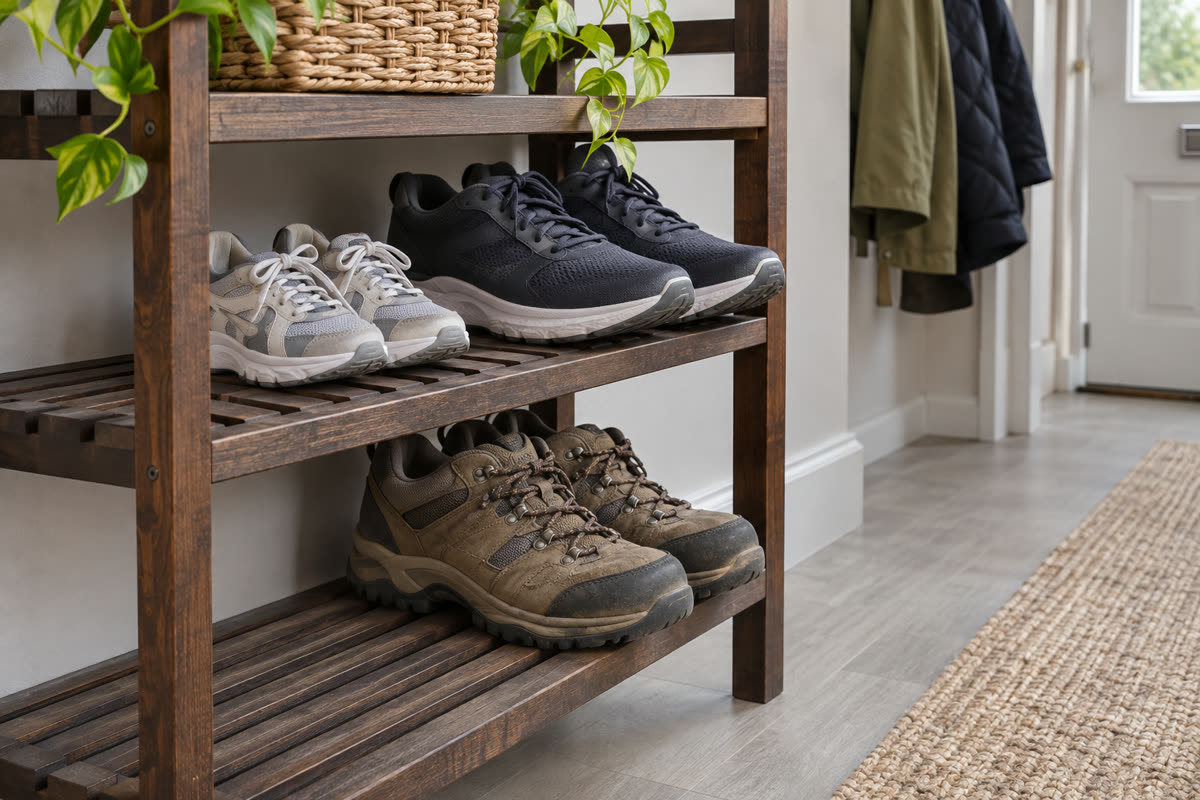
Dimensions refer to the exact SONGMICS LSA303B02 and Joseph Joseph Level Ecru variants. The shoe measurements and capacity calculations are worked examples. The room photo illustrates shoe overhang.