
Drawer dividers vs trays: which fits your drawer?
Compare adjustable drawer dividers and lift-out trays by usable base, closing height and access. See how to combine rows with removable groups.
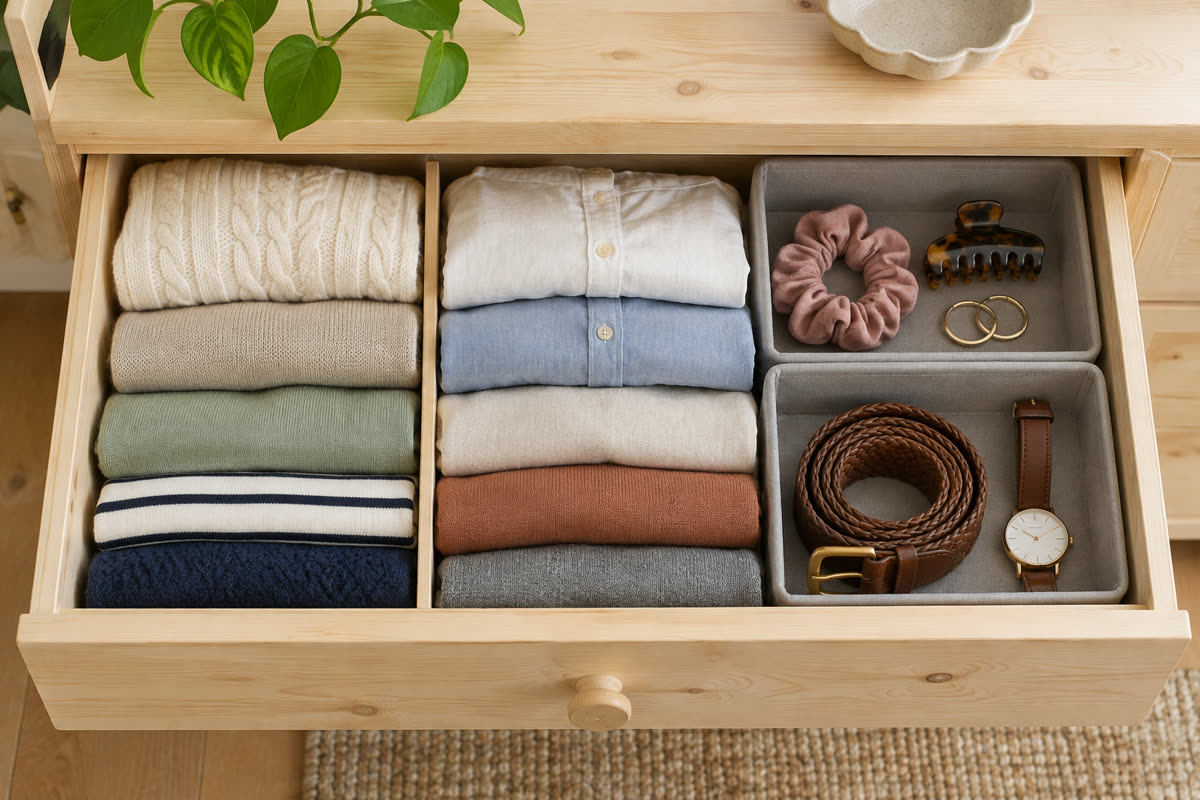
The main decision
Choose rows for folded items and trays for loose groups
Use dividers when you want clothes or long items to sit in rows on the drawer base. Use trays when small pieces need their own compartments or you want to lift out a group. Check the end surfaces for dividers and the usable footprint and loaded height for trays.
Compare what each format does in use
Start with the items you actually use. Folded T-shirts can sit in a row and stay visible if the row width supports them. A jumble of hair ties or spare fasteners benefits from side walls that keep the smallest pieces separate. An organiser works when each group is easy to find, remove and put back on a normal day.
A divider leaves the contents on the original base. It can split a wide drawer into rows without adding a floor beneath the clothes. A tray adds a floor and walls, so you can move the group together. Count the space used by both features. The divider may have pads or tabs at each end, while the tray can have thick sides or a rim wider than the base.
If you clean frequently, decide which groups you would like to remove as a unit. A tray of hair accessories can come out for cleaning or for use at a mirror. A row of T-shirts can stay in place while you take one out. Avoid adding individual cells to an item you need to pull from a long flat row.
Check the divider against the surfaces at both ends
Choose whether the rows run front to back or side to side. Take the clear measurement at the height and position where the end fittings sit. A taper or an angled drawer front can make the gap different at the base and the top. Measure both sides of the proposed divider and check the range and pad shape for the exact model.
A tension or locking divider needs ends that can support the fitting as directed. Check that pads sit flat and the divider clears screw heads and the front rail. If the panel is thin or the fitting would press on a curved surface, try a removable tray instead. Compare the choices in the adjustable divider guide.
Check the contents around the divider too. Place the widest fold in the row and see whether you can pick it up without pulling its neighbour loose. The lowest rail still needs to clear the fold and any raised end fitting. Use the drawer measuring guide to check the closing route.
The short SpaceAid kit below gives you the option to break part of a row into pockets. Measure the 33.7–43.2 cm span where the main dividers will press. Leave the row continuous where long items need it.
Rows with smaller pockets
SpaceAid short bamboo divider kit
Four padded spring dividers and nine cross inserts let you separate some parts of a row into shorter pockets.
- Per main divider
- 33.7–43.2 cm long; panel about 6 cm high
- Access
- Spring ends and cross inserts
- In the pack
- Four dividers and nine inserts
What to check The listing also gives a 6.4 cm overall height. Check installed height for a close fit and leave enough room to reach around the cross inserts.
View on Amazon — SpaceAid short bamboo divider kitCheck the tray, its contents and the lift path
Measure the outside shape, including a rim, feet and connectors. Compare the usable inside compartment with your longest item and the place where you grip it. A long tray that fits a brush can still be too narrow for the handle to turn out. Measure the highest point of the loaded tray from the drawer base, including any liner beneath it.
The Blox seven-piece set below is one example of trays you can clip into a mixed arrangement. The maker's example measures 43.9 × 26.5 × 5 cm. If you change the positions, measure the complete arrangement again. Keep one or more trays removable if you want to take a group to another room.
For loose everyday essentials
Joseph Joseph Blox 7-piece organiser
Seven trays clip together in different arrangements, so you can group small accessories without committing to one large fixed insert.
- Example layout · cm
- 43.9 × 26.5 × 5
- Access
- Lift-out trays
- In the pack
- Seven trays
What to check The maker’s example arrangement is 43.9 × 26.5 × 5 cm. Check your chosen layout and the clearance under the drawer’s front rail.
View on Amazon — Joseph Joseph Blox 7-piece organiserIf the drawer opens partway, test a tray at the back before relying on its full storage. Check whether it can slide forward and be lifted without striking the cabinet. For more ways to arrange different sizes, see the modular tray guide.
Try a mixed layout with the things you use
Start with one divided row and one loose tray. Put a complete load of clean clothes or everyday items back in the drawer. Reach for one from each group and return them. If you frequently lift the tray, leave a usable grip gap around it. If you rarely lift it and the sides waste room, a divider or a single longer tray might work better.
Use the paper layout guide if you need to work around a rounded corner. For soft inserts and fabric cells, the clothes drawer organiser guide compares ways to separate folded clothes and small pairs.
Questions before you choose
Do dividers use less space than trays?
A thin divider often leaves more of the drawer base open. Its end fittings still need usable surfaces. A tray adds walls and a base but can keep loose items together when removed.
Are trays better for shallow drawers?
A low tray can work well for small items. Include its base, rim and loaded contents in the closing measurement. A low divider can preserve more vertical space if its fitting suits the drawer.
What works for socks and underwear?
Use dividers for folded rows or fabric cells for individual groups. Compare the size of your normal folds and the way you reach them.
Do dividers and trays work together?
Yes, if they both fit independently. Keep the tray clear of the divider end and leave space to grip it.
Which is easier to clean?
Lift-out trays let you remove one group before cleaning. Dividers give an open base when the contents are taken out. Follow the materials' care instructions.
Will linking trays stop them shifting?
Linking compatible trays can keep them together. The complete arrangement can still move, so check its fit and any supplied grip feet.
How we put this guide together
We used the exact SpaceAid short kit listing and Joseph Joseph's published Blox configuration. The dimensions in the mixed layout are illustrative. We compare usable base, closure and retrieval for each format.