
Best wardrobe door organisers for hinged doors
Compare open hooks, fabric pockets and adjustable baskets by bracket fit, loaded depth, door sweep and how the organiser carries weight.
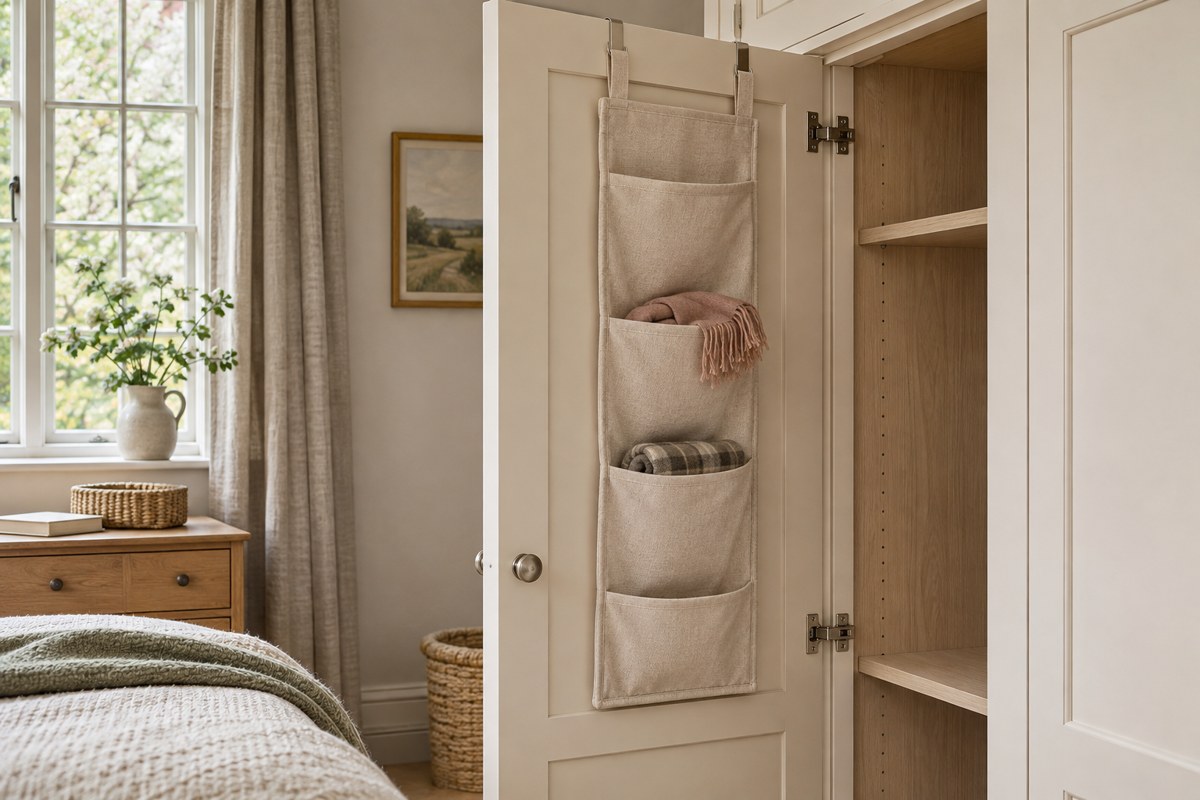
Three door organisers for different contents
The dimensions describe each empty frame. Measure how far the contents extend as the door opens and closes.
Small loose accessories
Umbra Estique five-hook door organiser
Five open hooks with rounded wooden ends. The frame provides a single short row for accessories where the door has enough clearance.
- Frame · W × D × H
- Approx. 39 × 10 × 30 cm
- Access
- Five open hooks
- In the pack
- One organiser
What to check Measure the installed bracket and the loaded accessories. Check the top gap and follow the door and organiser fitting instructions.
View on Amazon — Umbra Estique five-hook door organiserLight folded groups
SONGMICS TINA four-pocket door organiser
Four open fabric pockets with two over-door hooks. The maker drawing gives a 4.5 cm maximum door thickness.
- Frame · W × D × H
- 33.5 × 12 × 100 cm
- Access
- Four fabric pockets
- In the pack
- One organiser
What to check Check the gap above the door and allow for the loaded pockets. The drawing gives 5 kg total static and 1.25 kg per pocket. The door must also allow the load.
View on Amazon — SONGMICS TINA four-pocket door organiserAdjustable basket positions
VyGrow five-tier over-door basket organiser
Five adjustable metal baskets in a tall frame. The maker drawing gives a door width of at least about 51 cm and a bracket opening of about 5 cm.
- Frame · W × D × H
- 33 × 11.5 × 128 cm
- Access
- Five open baskets
- In the pack
- One five-basket organiser
What to check The bracket opening is only one measurement. Check the closed top gap, loaded basket projection and hinge-side sweep before use.
View on Amazon — VyGrow five-tier over-door basket organiserSide-by-side dimensions
Scroll sideways to see all columns.
| Organiser | W × D × H | Storage | Door fit check |
|---|---|---|---|
| Umbra Estique | Approx. 39 × 10 × 30 cm | Five hooks | Check bracket and top gap |
| SONGMICS TINA | 33.5 × 12 × 100 cm | Four pockets | Drawing shows up to 4.5 cm thick |
| VyGrow | 33 × 11.5 × 128 cm | Five baskets | At least about 51 cm door width |
Check the door and the gap above it
Start with a hinged door that opens far enough to reach its inside face. Measure its thickness at the top where the hooks will sit. Take the measurement over any trim or bevel the bracket will pass. Then look at the gap between the door and the wardrobe when it closes. A hook can fit the thickness of the door and still catch at the top because its metal needs room of its own. Try an unweighted position before relying on the arrangement.
Check the wardrobe maker’s instructions and the door’s condition. The weight of the organiser and its contents sits on the door and its hinges. Use a suitable door and check that the proposed loading is allowed. Keep heavy contents on a supported shelf or in a drawer. Sliding doors and doors that pass directly behind a second panel need clear space along the entire track. Use an organiser on them only if that system permits the fitting and its travel remains clear.
Allow for the contents and the hinge-side sweep
Measure from the inside face of the door to the furthest point of the loaded organiser. With a fabric pocket, include a corner or rolled scarf that pushes forward. With a hook rack, include the thickest accessory and how it swings. Check where that point passes the edge of a shelf, hanging clothes or a pull-out. An organiser can fit a door open and then hit a shelf just before the latch engages.
Mark the proposed positions on the inside with removable tape and use a light template to check the footprint. Open the door fully, then close it slowly without forcing it. Check access to the organiser as well. A row near the hinge side can be awkward to use with another door open. Try the busiest nearby shelf or drawer with the door in the normal open position. See the wardrobe measuring guide for checking hinge intrusion and usable access.
Choose hooks, pockets or open baskets
The Umbra Estique five-hook rail is a short row of rounded hooks. It suits light accessories that can hang by a loop and that you reach individually. The maker lists a frame about 39 cm wide and 10 cm deep. Compare the bracket against the door and measure the contents hanging freely. Keep a loose item away from the hinge where it could swing into a shelf.
The SONGMICS TINA gives four fabric pockets in a 100 cm-high organiser. Use it for light folded groups that sit below the lip. The maker drawing shows up to 4.5 cm door thickness and specifies a 5 kg static total with 1.25 kg per pocket. Use the door’s permitted load as well. Fill a single pocket lightly and check how its depth changes before adding the rest.
The VyGrow five-basket set takes a taller door and provides different basket positions. Its fitting drawing specifies at least about 51 cm of door width and a bracket opening of about 5 cm. Use the exact installation instructions and check the fitted top gap. Choose basket positions so each can be reached without striking a shelf or the opposite door.
Load one light group and try the door again
Fit the organiser and any supplied pads as directed. Check that the hooks sit fully in position and the door closes and opens normally before adding contents. Start with a light group, move the door through its normal range and listen for contact. If the frame shifts or an item catches, adjust the placement where the instructions allow or use a different position. Check again when a taller item replaces a shorter one.
Review the door after the first few days of use. If a pocket gets bulkier as accessories are added, take the extra pieces out and repeat the closure test. Check any pads or brackets periodically according to the fitting instructions, especially if the door starts to rub or the organiser moves when opened.
Give the easiest hook or pocket to the accessories you reach for first. Keep the lower positions for light groups you can see. If most of the door face is opposite shelves, see the accessory hanger guide or use a shallow shelf layout. The extra storage is useful when the whole wardrobe remains easy to close, open and reach.
Questions before you choose
Will an over-door hook stop my wardrobe door closing?
It can if the hook is thicker than the top gap. Check the bracket against the door and test closure gently before loading.
Can I use these on sliding doors?
Use an organiser only if the door system allows it and the complete loaded fitting clears the tracks and other panels.
How much can a wardrobe door hold?
Check the door and hinge maker’s permitted load and the organiser’s own limits. Include the weight of the organiser itself.
What should go in the pockets?
Choose light folded groups that fit below the lip. Measure their depth when loaded and keep the door and shelves clear.
How do I stop a basket catching on a shelf?
Measure its loaded depth through the hinge-side sweep. Move it to a permitted position or use a shallower group if it interferes.
How this shortlist was assembled
We checked three Amazon UK variants against maker specifications and fitting drawings. We give VyGrow’s bracket opening separately from the top gap and omit Umbra’s maximum door thickness because the published figures differ.