
How to organise a shallow wardrobe
Measure usable closed depth, check hanger orientation and find shallow bins and folds that clear the doors and hinges.
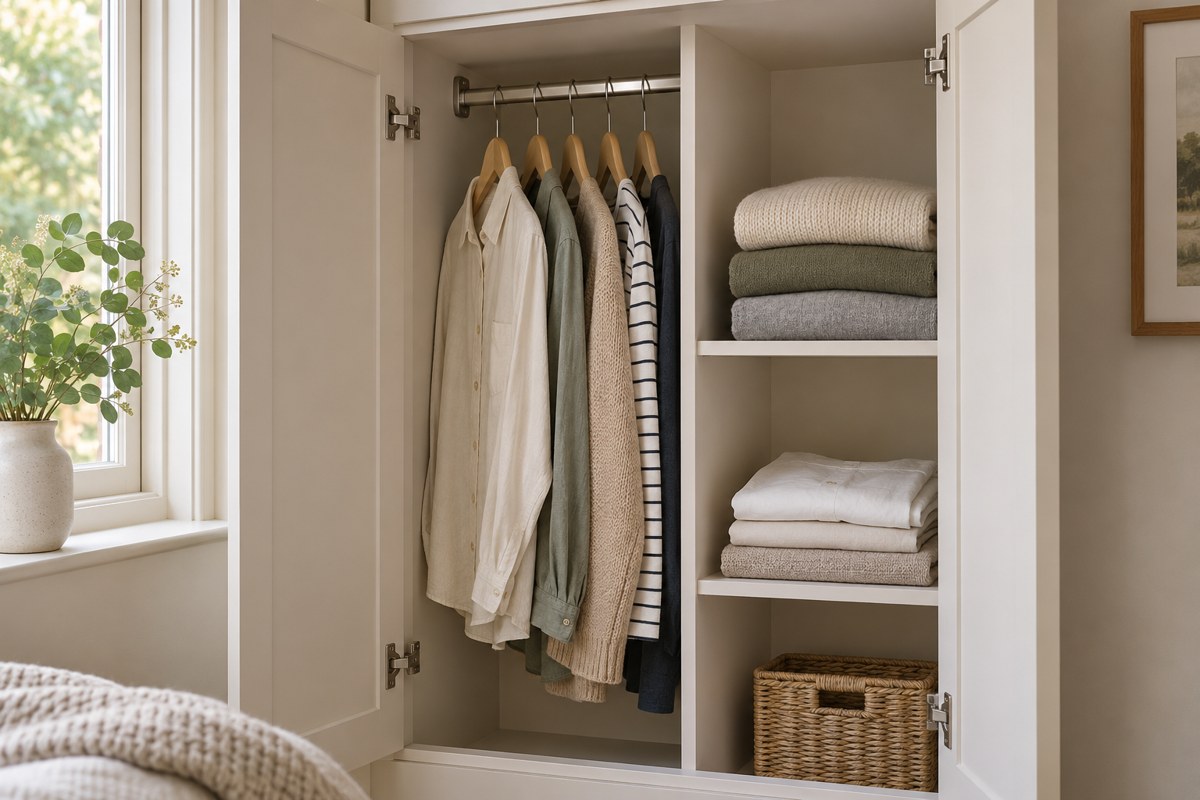
The main decision
Use the depth behind the closed door
Check the biggest loaded hanger and the narrowest point. Keep the existing rail if clothes clear the door, or check a compatible front-to-back rail and use shallow folded groups.
Measure the space behind the closed door
Measure from the inside back to the inside face of the closed door at the height of the rail, each shelf and the bottom of the bay. A projecting hinge, handle screw or sliding track can take away depth at one edge. Take a separate reading at that point and check how much of the opening is usable when the door is open. The advertised depth of a wardrobe normally describes its outer cabinet. The space available to a loaded hanger or folded stack is smaller.
Try a representative hanger with the broadest garment you want to keep there. Include the shoulders, sleeves and any thicker fabric that rolls over the ends. Hold it on the existing rail and ease the door towards its closed position. Stop if anything catches. An empty hanger can clear a door while the loaded one catches at one shoulder. Repeat near both ends of the rail, where a hinge may change the available depth.
Check access with the doors in their normal positions. A shelf or hanging rail might fit the interior while the hinges block the hand space to reach it. In a wardrobe with sliding doors, see the sliding-door wardrobe guide to check which section opens fully. Use the wardrobe measuring guide to record separate figures for the opening, rail and shelves.
Choose a hanging direction that lets the doors close
If the existing side-to-side rail works with the garments you need, make the simplest change first. Use hangers that suit those garments and hang broad pieces where there is the most clearance. Thin hanger bodies can create more width along a rail. The shoulder span and clothing shape determine whether the hanger clears the door. Measure the shoulders of a bulky coat before buying thinner hangers to solve a depth problem.
A front-to-back rail puts the hangers facing you. This uses the bay width for the shoulders and the available depth for a row of hangers. IKEA’s shallow PAX system is one example of a wardrobe designed to support this arrangement. Check the exact rail and frame compatibility, mount it as directed and allow room to slide or lift hangers off. Put the most-used garments at the front. A short front-facing row can become frustrating if all the clothes need to move whenever you reach the back.
Fold for the supported shelf depth
Measure from the back to the part of the shelf that supports the contents. Keep the front edge of folded clothes or a bin behind that line. Try one fold with a favourite jumper and one with your largest T-shirt. Compare them at their thickest points and check that you can lift a single piece without bringing the whole pile forward. Shallow groups or short rows can make better use of the shelf than a tall stack against the door.
A shallow bin can work for small items that you use together. Check its full outside depth, including the lip or handle. Try pulling it through the opening with a hand on the grip. The hinge might let one side pass while blocking the other. Compare the wardrobe bin guide for different shapes, and use the knitwear guide for folds that retain their shape.
The SmartStore Compact Clear L gives one example of orienting a bin to a shallow shelf. Run its 41 cm side along the shelf and its roughly 29 cm side front to back. A shelf with 31 cm of usable depth leaves about 2 cm to account for any stand-off and handling. Check the inside depth separately if a folded garment already measures 27 cm. The inside short dimension is 24.7 cm, so that fold needs to turn or change.
Low clear bin with known interior
SmartStore Compact Clear L bin
A rigid open-top container for a low stack or a group of smaller items you want to see at a glance.
- Outside · W × D × H cm
- 41 × 29 × 15.5
- Inside · cm
- 35.3 × 24.7 × 15.1
- Capacity
- 15.4 litres
- Access
- Open top
- In the pack
- One bin without lid
What to check Compare the inner base with the widest fold. Use the compatible lid if stacking as the manufacturer directs. It is sold separately.
View on Amazon — SmartStore Compact Clear L binTry one full bay before reorganising the rest
Set up one section with the usual number of clothes. Close and reopen the doors gently and check whether a sleeve or handle shifts forward. Try taking out a broad hanger from the back, then lift a folded stack or bin with the other door in its normal position. Keep the pieces you handle often in the easiest part of the opening. Use another suitable spot for a bulky garment that repeatedly catches.
Check the change during a normal week before buying more fittings. If you cannot see what sits behind the first row, try a shorter group or put occasionally worn pieces elsewhere. Measure again when thick winter clothing replaces lighter garments. A layout that suits thin shirts may need a different balance between hanging and folded storage once the bulky clothes are back.
Questions before you choose
How deep does a wardrobe need to be for normal hangers?
Measure the actual hanger and its broadest loaded garment. Compare that width with usable closed depth, including the hinge and track.
Can a front-to-back rail help?
It can turn the hangers to face you. Check the wardrobe and rail compatibility, usable bay width and access to the rear pieces.
Will slim hangers make the doors close?
They save space along the rail. Check the shoulder span with the garment on the hanger to judge door clearance.
How shallow should a wardrobe bin be?
Compare the complete outside depth with the supported shelf, and check the interior against the largest fold. Leave room for your hand at the front.
Do sliding doors change the measurements?
Yes. Include the tracks and door overlap, and test the opening where you will reach each bay.
How we put this guide together
We reviewed front-facing rail specifications for shallow IKEA wardrobe frames and Orthex’s outside and inside bin dimensions. The wardrobe example shows the checks for a bay you already own.