
Best wardrobe accessory hangers for belts and scarves
Compare a narrow vertical hook hanger, a wide steel hook hanger and a wooden loop hanger. Check rail fit and loaded width before buying.
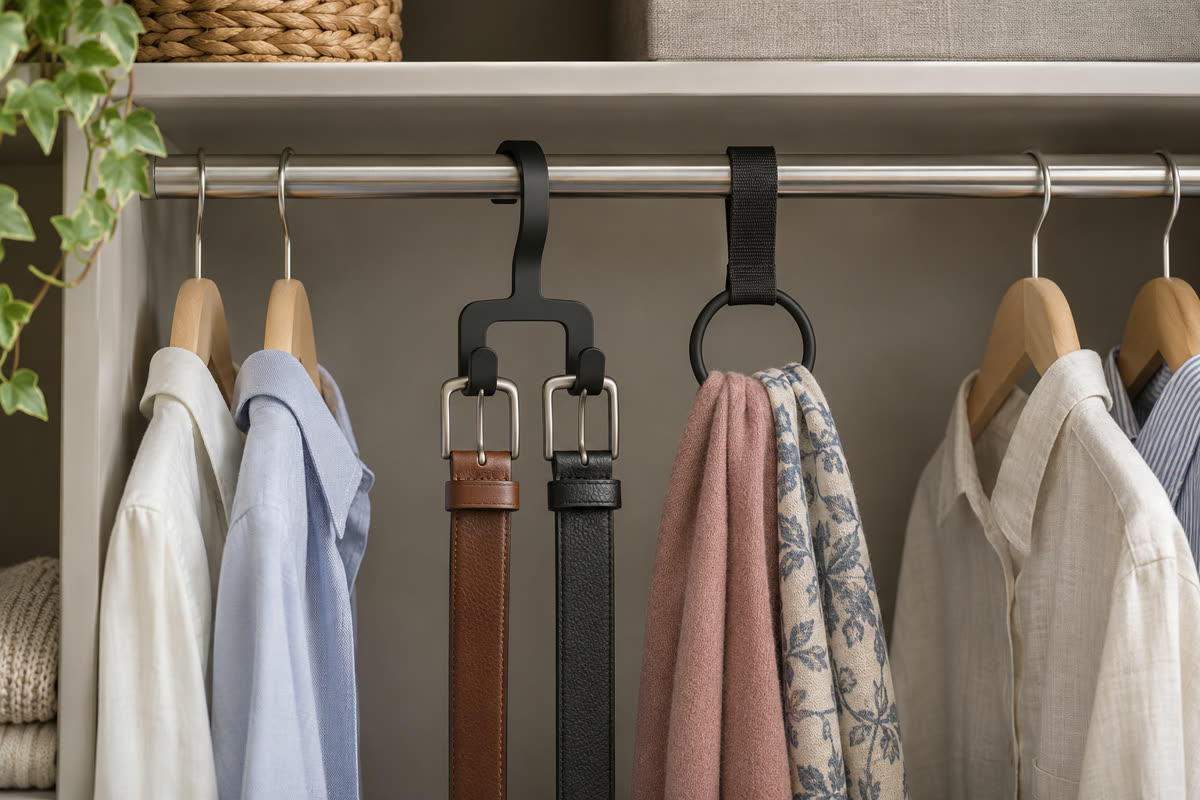
Three accessory hangers for different rail spaces
Empty dimensions are a starting point. Buckles, folded scarves and hanging straps change the space each hanger needs in use.
Narrow gap with room below
Yamazaki Smart vertical closet hooks
Eight hooks run down a vertical steel frame. Hang belts and other items with suitable loops or buckles.
- Outside · W × D × H cm
- 6 × 5 × 54
- Access
- Vertical hooks
- In the pack
- One hanger
What to check The maker lists up to 4.45 cm rail diameter and 1 kg per hook. Check the loaded drop and use the supplied screws to assemble the hanger itself.
View on Amazon — Yamazaki Smart vertical closet hooksSeveral belts across a short drop
iDesign Classico 14-hook hanger
Fourteen chrome-finish steel hooks spread out across a compact frame that hangs over the rail.
- Outside · W × D × H cm
- 26 × 9.5 × 17.1
- Access
- Open hooks
- In the pack
- One hanger
What to check Measure the space for wide buckles and your hand around the outer hooks. Check the rail and the longest belt in position.
View on Amazon — iDesign Classico 14-hook hangerSeparate loops on both sides
Hangerworld wooden 12-loop hanger
Six loops on each face and a swivelling top hook. Use separate loops for pieces you want to keep apart.
- Published width and height
- 41 cm wide × 15 cm high
- Access
- Two-sided loops
- In the pack
- One hanger
What to check Check the size of the loop against the fabric and allow the hanger to turn with its contents in place.
View on Amazon — Hangerworld wooden 12-loop hangerSide-by-side dimensions
Scroll sideways to see all columns.
| Hanger | Published size | Format | Check first |
|---|---|---|---|
| Yamazaki Smart 7647 | 6 × 5 × 54 cm | Eight vertical hooks | Rail diameter and loaded drop |
| iDesign Classico | 26 × 9.5 × 17.1 cm | Fourteen hooks | Space for the side hooks and buckles |
| Hangerworld wooden loop hanger | 41 cm wide × 15 cm high | Twelve loops across two sides | Loop opening, usable swing and access to both faces |
Sort accessories by how they attach
Lay out the accessories you reach for most. For each belt, look at the buckle and its opening. A hook can hold a belt securely when the buckle shape gives it a stable place to sit. A wide buckle or thick fabric belt may need a wider hook opening or a different way to store it. Avoid hanging several pieces from one point if taking one out brings the rest with it.
For scarves, check the thickness of the fabric when you fold it through a loop. A narrow ring might suit a light scarf but catch a bulky knit. Use an attachment with a smooth finish suitable for the fabric. If an accessory creases or snags when threaded through, keep it in a small wardrobe bin instead. Test one of your longest pieces before planning to use every hook or loop.
Sort long pieces from small ones. Belts and straps need the full length beneath the hanger, and small items can sit higher where you can see them. A holder used for several types may be harder to search if long fabric covers the hooks below. Put the longest accessories on a separate group if that makes the daily pieces easier to reach.
Measure the hanger with everything on it
Measure the rail diameter or profile and the space between the nearest hangers. Check the maker's maximum rail size and allow room above to fit the hook. A shelf above the rail can get in the way even when the holder can hang below it. Measure to the door and the rear panel, then test the space the loaded holder occupies when you remove an accessory from its side.
Measure the drop from the rail to the lowest point of the longest fitted belt or scarf. Consider where the hook sits along the frame. A long belt fitted at the bottom of a vertical hanger can reach much farther down than one fitted at the top. Check the shelf, bins or drawers below it. If you have sliding doors, keep the straps clear of the tracks and the moving panel.
Choose a hanger shape that fits the rail
For a narrow rail gap with room below, the Yamazaki Smart puts eight hooks in a vertical strip. It measures 6 × 5 × 54 cm before loading and the maker lists a maximum rail diameter of 4.45 cm and a 1 kg limit per hook. Check the assembly instructions and the loaded drop. The small footprint is helpful when most of the rail needs to stay available for clothes.
For a wider group of belts, the iDesign Classico has fourteen open hooks in a shorter, wider steel frame. Check the 26 cm width and space around the sides to take buckles off cleanly. If you use the hooks close together, place wider buckles apart so you can lift them without disturbing the next belt.
For scarves or other pieces that suit closed loops, the Hangerworld wooden hanger has six loops on each face and a swivelling hook. Check the loop size and space needed to turn the loaded hanger. It occupies a wider space across the rail than the narrow vertical model. Use fewer than all the loops if that makes it easier to see and take out the right item.
Keep the things you use together within reach
Place the accessory hanger beside the clothes you wear with it. Take out a belt with the wardrobe in its normal open position and see whether you need to push another hanger aside first. Keep bulky pieces towards a less busy side of the wardrobe if they make the front hooks harder to reach. Avoid letting long straps drape over a pull-out or catch a door hinge.
Move occasional pieces into a separate group before buying another hanger. If the rail is crowded, take the measurements in the wardrobe organiser guide and compare a lift-out tray or bin. In a wardrobe with no shelves, leave space for the clothes that need the full drop and decide where smaller accessories are easiest to see.
Questions before you choose
Are hooks or loops better for belts?
A hook suits a belt that hangs securely by the buckle or its loop. A closed ring can keep a belt grouped, but try how easily it threads through.
Can I hang scarves on a belt hanger?
Check that the contact points suit the fabric. Smooth loops can give soft accessories their own space. Avoid forcing thick fabric through a small opening.
Will a narrow vertical hanger save rail space?
It uses little width when empty, but the accessories can hang into nearby clothes. Check both the loaded width and the full drop.
Can I hang handbags from an accessory hanger?
Check the model's intended use and the hook and rail load limits. Use another suitable place for heavy bags and keep straps clear of the door.
Do swivel hangers need extra room?
Yes. Allow the width and depth needed to turn with accessories in place. A swivel hook is most useful where both faces remain reachable.
Where should a belt hanger go in a sliding wardrobe?
Place it behind the opening you use, beside the clothes it goes with. Check that the full loaded hanger is clear of the moving doors.
How this shortlist was assembled
We compared three exact Amazon UK listings by attachment, overall dimensions and their usable access. We give load limits only where documented for the model, and check the assembled and loaded footprint separately.