
Best wardrobe shelf dividers for folded clothes and bags
Compare clip-on acrylic shelf dividers with a freestanding adjustable separator. Check shelf thickness, panel depth and folded stack width.
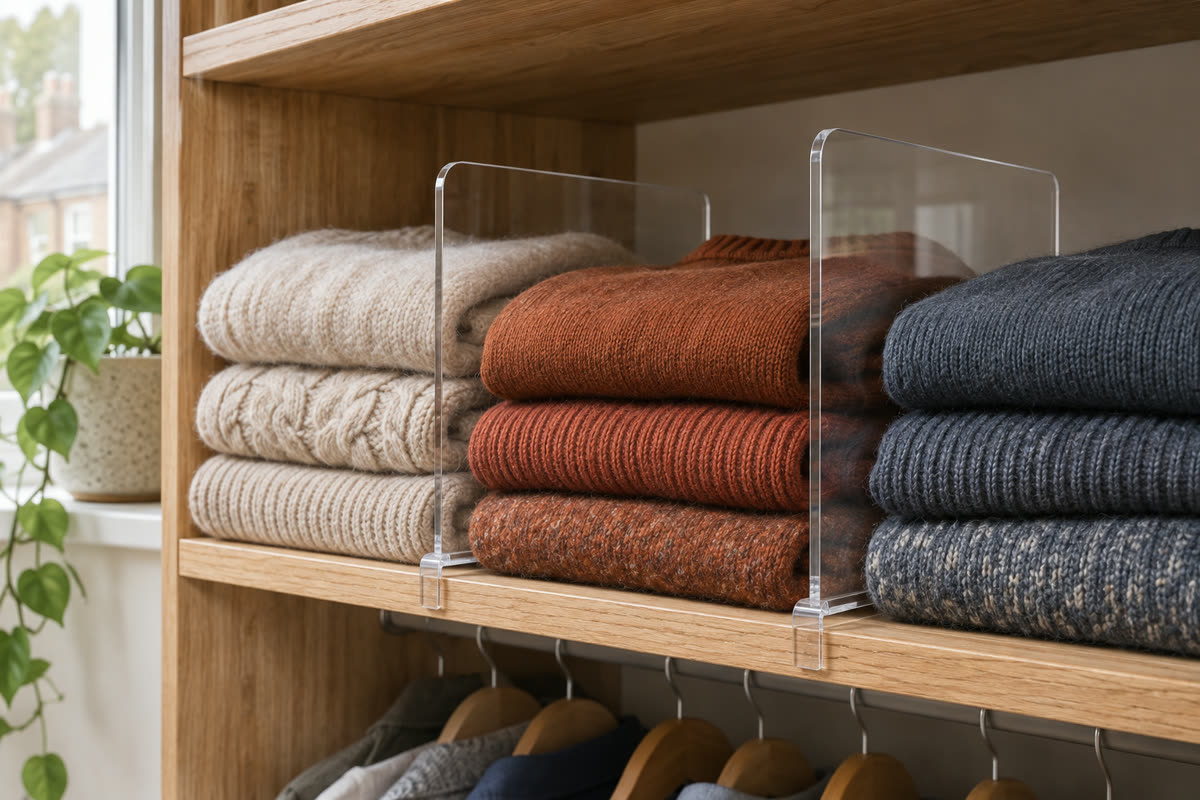
Two attachment types for different shelves
A slip-on panel and a freestanding system solve different problems. Start with the shelf construction and the width of what you want to separate.
Clip-on for a solid shelf
Jucoan clear acrylic shelf dividers
Clear upright panels separate stacks of clothes on a suitable solid wooden shelf.
- Per panel
- 30.5 cm deep × 20 cm high
- Access
- Slip-on clip
- In the pack
- Four panels
What to check The clip is for a shelf edge up to 2 cm thick. Measure the finished front edge and check the clearance below it before fitting.
View on Amazon — Jucoan clear acrylic shelf dividersAdjustable spaces for bags
Ronlap clear freestanding shelf dividers
Clear panels slot into modular bases to create upright spaces for bags and other items that stand on their own.
- Listed assembly · W × D × H cm
- 66.5 × 24.2 × 17.5
- Access
- Slot-in panels on freestanding bases
- In the pack
- Eight panels
What to check The outside dimensions describe the listed assembled arrangement. Use a flat shelf that supports the base completely and check the usable slot widths.
View on Amazon — Ronlap clear freestanding shelf dividersSide-by-side dimensions
Scroll sideways to see all columns.
| Divider | Size | Attachment | Check first |
|---|---|---|---|
| Jucoan four-pack | 30.5 cm deep × 20 cm high per panel | Clip on a suitable solid wood shelf | Shelf thickness up to 2 cm and a clear front edge |
| Ronlap RLSD01CR | 66.5 × 24.2 × 17.5 cm listed assembled | Panels slot into freestanding bases | Usable shelf width and support under the entire base |
Measure the shelf at the front edge
Open the wardrobe to the position you normally use. Measure the thickness where the clip will sit, including any trim or raised lip. A shelf can have a thin main board and a thicker edge. Compare the actual edge with the fitting instructions for the divider. A rounded, bevelled or recessed edge may also make it hard for a clip to sit properly even when the nominal thickness is within range.
Check that the space immediately under the shelf is clear where the lower part of the clip needs to go. Look for a drawer, a shelf support or a strip fixed to the front. Then measure depth from the edge to the back panel and height to the lowest obstruction above. A 30.5 cm-deep panel needs enough room to settle in the intended position. Test the door closure around the clip and the front corner of the panel.
A freestanding system avoids the need for a suitable edge. It still needs a flat, level surface with enough width and depth to support the base fully. Work from the usable shelf and its door opening as described in the wardrobe measuring guide. Check the floor or shelf support before adding weight.
Plan the width of each slot with real clothes
Fold your usual stack and record its widest point. A chunky jumper can flare out at the folded edge and use more width than its centre suggests. Plan a gap that lets you lift a piece without scraping it past a panel. Make groups by what you reach for together and keep the busiest pile close to the opening. A tight slot that holds a pile neatly while full can be awkward when you need the bottom layer.
For handbags, measure the body in its normal upright position and include the handle if it stands up. Keep long straps from trailing into the next slot. Put one heavier bag on the shelf to see whether its base sits flat and whether it wants to tip. Dividers can separate stable bags. A bag that leans heavily into a light panel needs another way to stand.
Choose clip-on or freestanding
For a clear solid shelf edge, the Jucoan four-pack uses clear acrylic panels 30.5 cm deep and 20 cm tall. The fitting slips over a suitable solid wood shelf up to 2 cm thick. Confirm the edge and material are compatible before fitting. Try one panel first and make sure it sits square. Clear panels can be easy to see through in a narrow wardrobe, but a packed shelf still needs space to reach behind them.
For an adjustable line of bags, the Ronlap system uses separate panels that slot into modular freestanding bases. Check the product instructions for the base arrangement and choose slots for the actual width of each item. Its overall assembled dimensions describe the listed configuration. Leave room for the base at the front, and keep the pull direction clear of hinges or the door. This can also work for light folded groups whose width matches the available slots.
Neither shape gives you another level for tall bays. If the piles collapse because they are too tall, divide each into shorter piles or use a shelf riser to make a second supported level. If each group needs to come out as a unit, compare wardrobe storage bins.
Test what happens when you remove an item
Start with a few daily items and try lifting them with the doors in their usual position. Reach for a garment at the bottom of a pile and put it back. Check that the divider stays upright and that the adjacent group remains accessible. Keep stiff seams, buckles and handles clear of the attachment. If the panel shifts when you take one item, reduce the load pressing sideways or widen the slot.
On a deep shelf, keep the divider where you can still reach the farthest item you plan to use. Some partitions create a long, narrow slot that is hard to retrieve from. Our deep shelf layout guide shows how to assign front and back space separately. On sliding doors, keep each slot aligned with a clear opening.
For folded jumpers, the knitwear storage guide shows how to measure a fold and check how easily it lifts out.
Questions before you choose
How thick can a shelf be for clip-on dividers?
Check the exact divider's fitting range. The Jucoan example is specified for suitable solid wood shelves up to 2 cm thick.
Can clip-on dividers go on glass shelves?
Use a clip-on fitting only on the material and thickness the instructions allow. Choose a suitable freestanding divider if the clip is designed for wood.
How tall should a divider be for jumpers?
Measure your usual pile and check how it moves when you take an item out. Keep unstable stacks low enough that the divider can support them.
Will a divider support a heavy bag?
Check the exact model's intended use and any loading limits. Empty heavy bags or store them upright elsewhere if they push the panel out of position.
Do shelf dividers take up usable width?
Yes. The panel, clip or base takes up some space. Allow that width as well as the space needed to grip each pile or bag.
When is a riser a better option?
Use a riser if you want another supported level in a tall bay. A divider is most useful when adjacent groups need side support at the same height.
How this shortlist was assembled
The shortlist covers one clip-on design and one freestanding design. Dimensions and fit conditions refer to the exact Amazon UK variants. The number of clothes or bags depends on how they are folded and how the slots are set.