
Best drawer organisers for cables
Compare a divided cable box, open trays and a slim removable pouch for disconnected spare leads. Check coil size, plug pins and packed height.
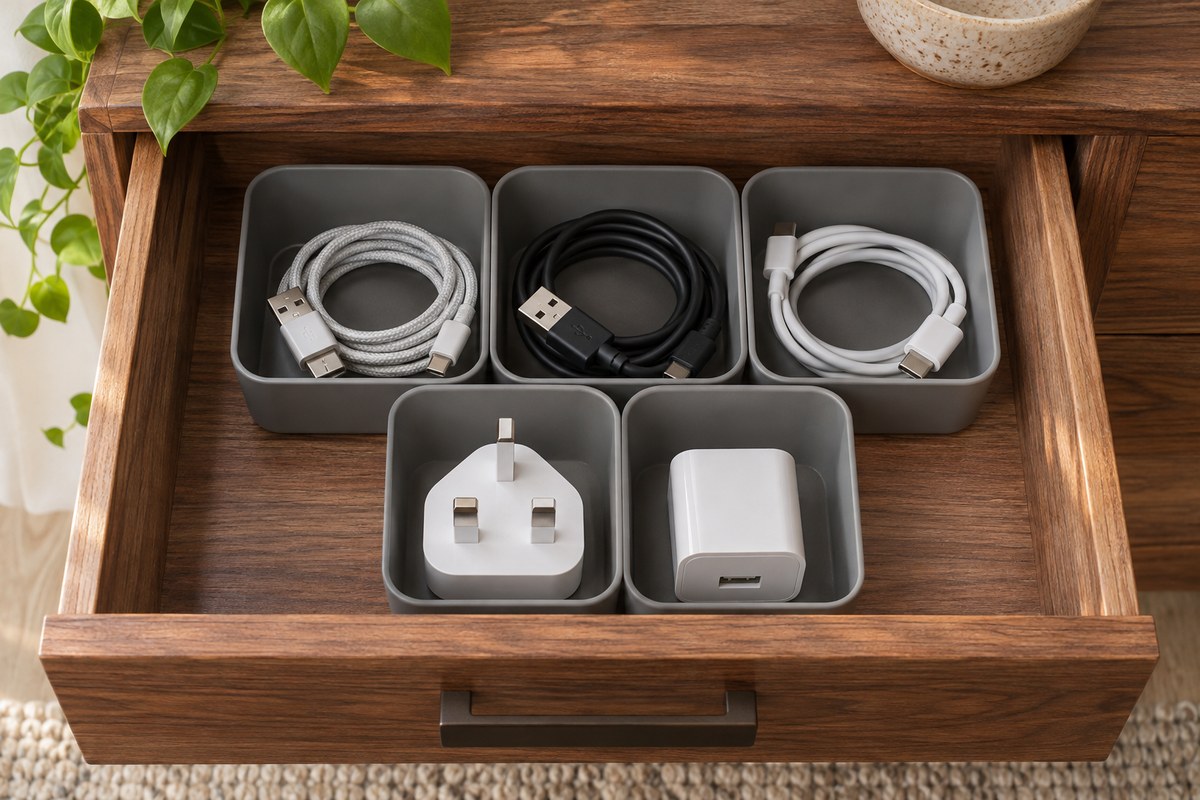
Three ways to separate and lift out spare cables
Measure the lead or adapter in the shape you will store it. Include connectors, pins, the liner and the space for your hand.
Small leads in separate compartments
PAVSTINE divided cable storage box
A lidded clear organiser with removable dividers for separating stored cables and small accessories.
- Maker drawing · L × W × H
- Approx. 30 × 10 × 7 cm
- Access
- Removable dividers and lid
- In the pack
- One divided box
What to check Check the supplied size: listing text says 30.3 × 10.7 × 7.5 cm while the drawing shows 30 × 10 × 7 cm. Include lid movement and the loaded coil.
View on Amazon — PAVSTINE divided cable storage boxOne long tray and two smaller groups
Addis Drawer Tidy triple pack
Three loose trays let you put the long tools on one side and move the shorter pieces separately.
- Individual outside sizes
- 17 cm wide; 40.5, 24.5 and 17 cm deep; 5 cm high
- Access
- Three independent trays
- In the pack
- Three trays
What to check Use the maker's individual dimensions. Check the actual inside length and whether the longest tool can lift out when the drawer is open.
View on Amazon — Addis Drawer Tidy triple packSmall leads to lift out together
BAGSMART slim cable organiser pouch
A slim zipped pouch with elastic loops and mesh pockets for a small group of disconnected spare leads.
- Empty outside · L × W × H
- 24 × 17 × 3.5 cm
- Access
- Zip and internal loops
- In the pack
- One pouch
What to check Check the packed thickness. A bulky moulded UK plug may need an open tray instead of this slim pouch.
View on Amazon — BAGSMART slim cable organiser pouchSide-by-side dimensions
Scroll sideways to see all columns.
| Organiser | L × W × H | Format | Main check |
|---|---|---|---|
| PAVSTINE clear box | Approx. 30 × 10 × 7 cm | Removable divisions and lid | Compartment and lid movement |
| Addis triple pack | 40.5, 24.5 and 17 × 17 × 5 cm | Three open trays | Plug height and coil footprint |
| BAGSMART slim pouch | 24 × 17 × 3.5 cm | Zip, loops and mesh pockets | Packed thickness |
Sort the spare leads by the job they belong to
Start with disconnected spare leads, plugs and adapters you actually need to keep. Group them by the appliance or household task they serve. A short charging lead, a large three-pin adapter and a bundle of replacement cables need different compartment sizes. Keep an identifiable set together if you normally take it out as one group. A simple label can tell you which item it fits without unwinding every lead.
Follow the cable or appliance maker’s storage guidance. Coil each lead gently in its natural curve and leave the connector clear of tight bends. Measure that loose coil and the largest plug in its stored position. A cable that fits only when wrapped tightly around an adapter can be awkward to remove and put back. Try the storage shape you can repeat comfortably.
Measure the plug, coil and loaded tray height
Measure the inside drawer at the base and through its closing path. Include any liner or tray feet. Put the largest disconnected UK plug on the surface in its intended orientation and check its pins against the sidewall and the lid. For a small divided box, measure the usable compartment between partitions. Thick walls and rounded corners can reduce the space for a connector even when the box outline fits.
Check the lift path if the drawer stops before the back is exposed. A tall plug can pass below the cabinet while lying flat, then strike it when the tray tilts. Keep the frequent group in the exposed section and use a smaller rear case you can move forward. The partial-opening drawer guide shows how to check that movement.
Choose divided compartments, open trays or a pouch
The PAVSTINE divided box gives smaller leads their own compartments, with removable dividers for changing the group size. Measure the coil with both connectors inside. A clear lid helps you identify the contents once the box is out, but leave enough room above and beside it to open the lid or lift the box onto a suitable surface.
The Addis Drawer Tidy triple pack offers three open trays, all 17 cm wide and 5 cm high outside. Their lengths are 40.5, 24.5 and 17 cm. Use the longer tray for a loosely coiled cable or a disconnected adapter that needs its own clear space. Check its usable base and the loaded plug height. The larger footprint can extend into the hidden rear area of a short-opening drawer, so try the lift path before filling it.
The BAGSMART slim pouch is useful for a small set of spare leads you take to another room. Its empty outside size is 24 × 17 × 3.5 cm, with elastic loops and mesh pockets inside. Measure it packed and zipped. A bulky moulded UK plug can make it too thick or press against the fabric; give that item an open tray if the pouch cannot close comfortably.
Keep the item you need easiest to remove
Put the regular spare group at the front and give occasional cables their own tray or case. If one lead is needed on its own, leave it accessible without pulling a bulky adapter out over the rest. Arrange plugs so their pins have their own space and do not press into a cable. Keep connectors visible where possible and use removable labels to identify confusing leads.
Test putting the lead back after normal use. If the coil expands into the next compartment, enlarge its space or shorten the group. If a zipped case becomes difficult to close, remove one item and check its packed shape again. The modular tray guide compares low open pieces where your drawer has less headroom, while the layout guide shows how to reserve room for your hand between groups.
Before assigning a compartment to an adapter, check how often you need its cable separately. A pouch works when the whole set travels together, while a tray makes one loose component easier to reach. Keep a short written inventory for obscure spares so you can identify the intended appliance without repeatedly unpacking the group. Review the set when replacing a device, and remove items you no longer need through a suitable local electrical reuse or recycling route.
Questions before you choose
Can I store spare leads in a drawer?
Store disconnected items as their makers advise, with gentle coils and space around connectors. This guide covers storage rather than running equipment inside a drawer.
How do I measure a UK plug for a tray?
Measure its complete stored shape, including the pins and the cable exit. Check both the usable compartment and the height above the tray base.
Will a slim cable pouch hold a three-pin adapter?
Check the packed thickness and the adapter shape. Use an open tray if a bulky plug strains the pouch or presses into nearby cables.
Should each cable have its own compartment?
Give separate compartments to items you remove independently. Keep a complete appliance set together if you normally use and return it as one group.
How do I stop a cable drawer becoming tangled?
Use loose repeatable coils, identify unfamiliar leads and leave room to return each group. Recheck the layout when a device or adapter changes.
How this shortlist was assembled
We checked three Amazon UK variants and the selected dimension drawings. The PAVSTINE drawing differs slightly from its text, so its size is approximate. Addis provides three consistently specified open trays; the pouch size describes its empty closed shape.