
Best spice racks for drawers
Compare separate spice rows, an expandable tray and a compatible drawer-system holder. Check jar size, loaded height, drawer depth and rear-row access.
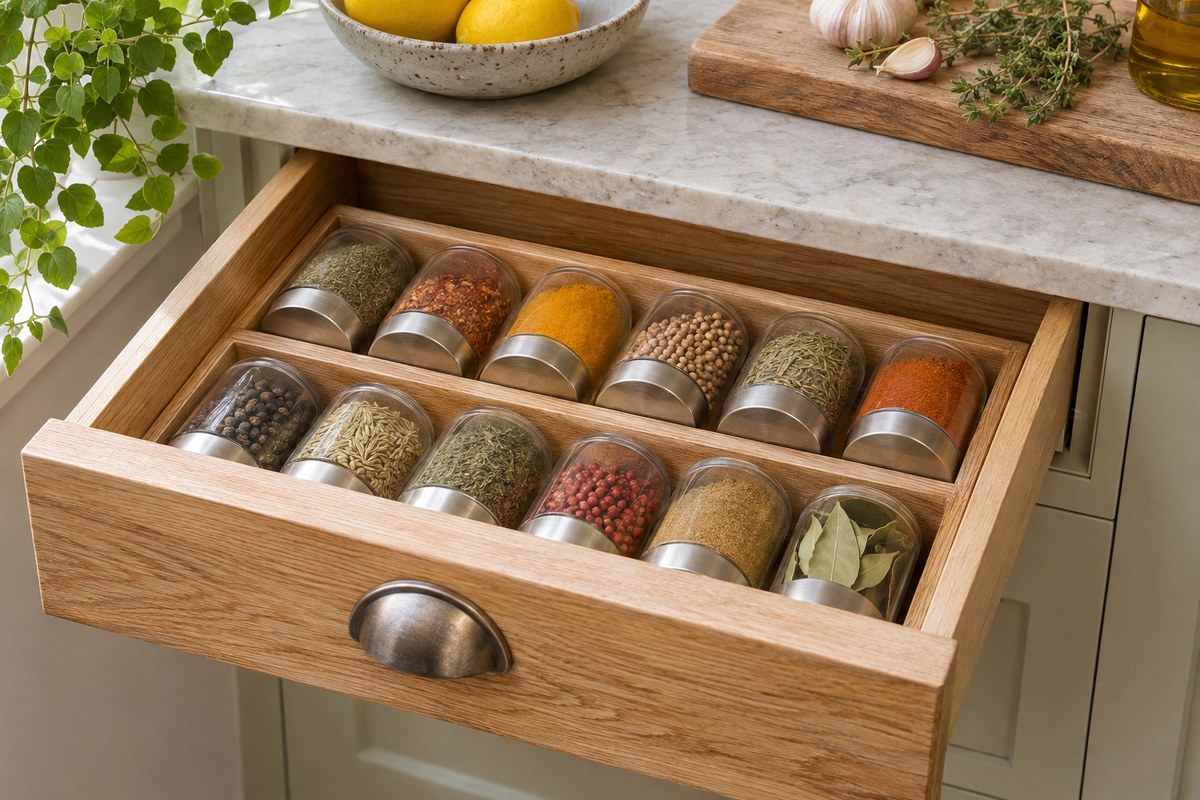
Three formats for different drawer layouts
Dimensions describe the empty pieces or assembled footprint. Allow separately for your jars and the drawer’s closing path.
Separate sloped rows for wider drawers
Lifewit clear spice drawer trays
Eight separate clear sloping pieces can make shorter rows or the maker’s shown two-column arrangement.
- W × D × H; layout W × D
- 33 × 11.5 × 3.9 cm each; shown layout 66 × 48.4 cm
- Access
- Sloped open rows
- In the pack
- Eight trays
What to check The maker requires more than 8.5 cm drawer clearance and bottles no larger than 10.4 cm tall × 4.6 cm diameter. Selected clear variant has a stale Black title.
View on Amazon — Lifewit clear spice drawer traysOne width-adjustable three-tier tray
mDesign expandable spice drawer tray
A clear three-tier insert with a sliding width adjustment for a single drawer bay.
- Outside · W × D × H
- Approx. 20–37 × 42 × 4 cm
- Access
- Three angled tiers
- In the pack
- One expandable tray
What to check The selected drawing shows about 20–37 cm width; a conflicting bullet says 42 cm. Measure the loaded jars, since the empty tray is about 4 cm high.
View on Amazon — mDesign expandable spice drawer trayFor a matching AMBIA-LINE frame
Blum AMBIA-LINE spice holder
A specialist spice holder that drops into the correct 218 mm AMBIA-LINE frame in supported drawer systems.
- Width × depth
- 20.5 × 35.6 cm footprint
- Access
- Compatible frame required
- In the pack
- One holder; confirm frame separately
What to check Confirm LEGRABOX C/F or MERIVOBOX E compatibility, the matching frame and its inclusion separately. Check loaded height with the actual jars.
View on Amazon — Blum AMBIA-LINE spice holderSide-by-side dimensions
Scroll sideways to see all columns.
| Rack | Width × depth | Empty height | Fit requirement |
|---|---|---|---|
| Lifewit, each piece | 33 × 11.5 cm | 3.9 cm | Above 8.5 cm drawer clearance |
| Lifewit, shown layout | 66 × 48.4 cm | 3.9 cm | Check all eight pieces assembled |
| mDesign 1880MDKEU | Approx. 20–37 × 42 cm | Approx. 4 cm | Measure loaded jars |
| Blum ZC7G0P0I | 20.5 × 35.6 cm | Check loaded fit | Matching 218 mm frame and drawer system |
Measure the jars you actually want to store
Lay out the spice jars you use and separate the unusually tall mills, broad refill tubs and small packets. An angled drawer insert works best when the supported bottles stay within its intended size. Measure each large jar from base to cap and across its widest part. Include the shoulder if it is broader than the cylindrical body. A drawer rack bought around a common-looking jar can leave your larger bottles loose at the side.
Decide which labels you want to read when you open the drawer. If your jars have front labels, an angled row can expose those faces. Labels on the caps may suit a different standing arrangement if the drawer has enough height. Keep the existing packaging and care instructions where needed. There is no need to decant every spice into a matching bottle before planning the space.
Check the loaded slope and the exposed opening
Measure the drawer’s inside base width and depth, then the lowest clearance along the closing route. A sloping rack raises one end of each jar. Its empty rim height therefore cannot tell you whether the loaded drawer will close. Use the maker’s bottle limits and clearance requirement, and check your largest jar in the actual tilted position. Include any drawer liner beneath the insert.
Also measure how much of the drawer opens. A rear spice row can sit inside the cabinet when the drawer reaches its stop. Check whether you can see the label and lift a jar without knocking the cap against the underside above. Move the everyday row forward or use fewer rows if the rear position is awkward. The partial-opening drawer guide explains this reach check in more detail.
Choose separate rows, an expanding tray or a system holder
The Lifewit eight-piece set lets you arrange separate sloping pieces rather than committing to one fixed block. Each piece measures 33 × 11.5 × 3.9 cm. The maker’s complete four-row, two-column arrangement occupies 66 × 48.4 cm; use that assembled footprint when trying all eight. Do not simply multiply four piece depths, since the laid-out geometry is different. The stated drawer clearance is above 8.5 cm, and bottles must be no larger than 10.4 cm tall and 4.6 cm across. Check the selected clear colour against the photos because its listing title contains a conflicting colour word.
The mDesign 1880MDKEU keeps three tiers in one width-adjustable insert. Its selected dimension drawing shows approximately 20–37 cm width, about 42 cm depth and 4 cm empty height. Use that drawing when checking the width; a listing bullet gives a conflicting expansion figure. Allow enough drawer depth for the complete insert, then check the tilted jar height separately. Expansion gives you a width adjustment, but it does not shorten the tray or make a wide jar narrower.
The Blum AMBIA-LINE holder is a system-specific option. The official catalogue lists it for LEGRABOX C/F or MERIVOBOX E with the correct 218 mm AMBIA-LINE frame. Its holder footprint is 20.5 × 35.6 cm. Confirm the matching frame and whether it is supplied before ordering. The fitting drawing shows the holder dropping into that frame. An empty wooden drawer of a similar width does not establish compatibility.
Arrange for cooking and easy returns
Group the spices around how you cook. Put the frequent jars in the exposed front rows, with clear space to lift one and return it. Occasional bottles can sit farther back if you can still remove them comfortably. Leave an intentional place for a new jar or a partly used refill rather than filling every possible slot on the first day.
Try the layout with the fullest and widest jars before filling the remaining rows. Open and close the drawer slowly and watch for cap contact, jars rolling sideways and pieces shifting under the load. Keep each bottle supported in the orientation the rack is designed for. If the insert moves, follow the maker’s grip advice and recheck the headroom after adding any permitted liner.
Use the drawer measuring guide to record the base and closing clearance, and the layout guide to mark the footprints before buying. For long utensils that share the drawer, compare the utensil organiser formats and keep handles out of the spice jar lift path.
Questions before you choose
How deep does a spice drawer need to be?
Compare the complete rack footprint with the inside base. The selected mDesign tray is about 42 cm deep; other row arrangements need their own assembled measurement.
Is the rack height the clearance I need?
No. The sloping tray raises the loaded jars. Check the largest bottle in position and any minimum drawer clearance given by the maker.
Will the Lifewit trays fit a narrow drawer?
Each selected piece is 33 cm wide. Try the number of rows you need on paper; the shown eight-piece layout occupies 66 × 48.4 cm.
Can the Blum holder sit in any wooden drawer?
Confirm the exact supported drawer and matching 218 mm AMBIA-LINE frame. Its similar footprint alone does not establish compatibility.
What if the back row is hard to reach?
Keep frequent jars in the exposed opening and use fewer rows or an independently removable rear group. Check the actual jar lift path.
How this shortlist was assembled
We checked three Amazon UK variants, their selected dimension drawings and Blum’s fitting guidance. We distinguish empty tray size from loaded clearance and record conflicting listing measurements rather than treating them as a fit guarantee.