
Best vertical shoe racks for tight floor spaces
Compare narrow shoe towers by frame width, usable shelf height, shoe projection and fixing requirements. Find a rack for a short wall or tall recess.
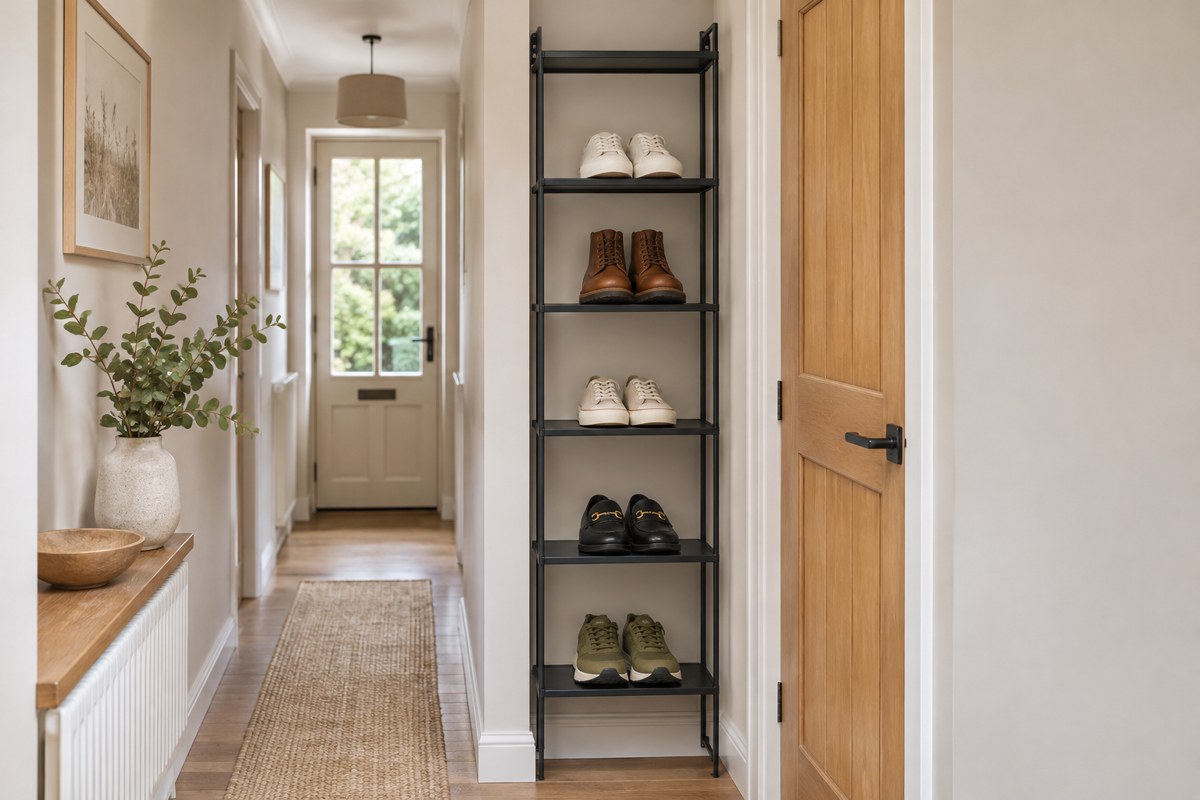
Four ways to use a short stretch of wall
The dimensions describe the frame. Allow extra room for shoes, hooks, access and the exact fixings.
Short wall span
Joseph Joseph Level adjustable shoe rack
This narrow floor footprint holds shoes vertically on adjustable shelves. It can be configured as part of the same system.
- Outside · W × D × H cm
- 26 × 35 × 51.2
- Access
- Adjustable open shelves
- In the pack
- One rack
What to check Allow 35 cm frame depth before shoe projection. The maker lists 1 kg per shelf and requires every rack in a stack to be fixed to the wall.
View on Amazon — Joseph Joseph Level adjustable shoe rackEvenly spaced solid shelves
VASAGLE seven-tier slim shoe rack
A slim fixed tower with seven levels and a published 17 cm between tiers. The shelf surfaces support small soles without rail gaps.
- Outside · W × D × H
- 26.4 × 30 × 110.4 cm
- Access
- Seven open tiers
- In the pack
- One rack
What to check Check room above the shoes to lift them out and fit the supplied anti-tip hardware as instructed.
View on Amazon — VASAGLE seven-tier slim shoe rackTaller lower compartments
COSTWAY seven-tier vertical shoe rack
A narrow solid-shelf tower with two taller lower spaces. The published shelf spacing includes approximately 13 cm and 19 cm openings.
- Outside · W × D × H
- 27 × 26 × 110 cm
- Access
- Seven open tiers
- In the pack
- One rack
What to check Compare the larger shoes with the lower openings and confirm the fitting and loading instructions for the exact rack.
View on Amazon — COSTWAY seven-tier vertical shoe rackNine levels in a tall recess
VASAGLE nine-tier slim shoe rack
A taller solid-shelf tower with side hooks and nine levels. The listed frame width is about 26.5 cm.
- Outside · W × D × H
- Approx. 26.5 × 30 × 147 cm
- Access
- Nine open tiers
- In the pack
- One rack
What to check Allow for the hooks and anything you hang on them. Use the supplied anti-tip hardware and check the installation and reaching height.
View on Amazon — VASAGLE nine-tier slim shoe rackSide-by-side dimensions
Scroll sideways to see all columns.
| Rack | W × D × H | Format | Shelf arrangement |
|---|---|---|---|
| Joseph Joseph Level | 26 × 35 × 51.2 | Short unit | Adjustable shelves |
| VASAGLE seven-tier | 26.4 × 30 × 110.4 | Seven tiers | 17 cm between tiers |
| COSTWAY seven-tier | 27 × 26 × 110 | Seven tiers | Two taller lower bays |
| VASAGLE nine-tier | Approx. 26.5 × 30 × 147 | Nine tiers | Solid shelves and side hooks |
Measure the whole recess from floor to top
A vertical shoe rack can use a short stretch of wall beside a doorway or at the end of a cupboard. Measure the available width at the bottom, middle and proposed top. Check both the back and front edges of the footprint. Skirting can push a rack forward and a door frame can narrow the upper space. Add any side hooks and keep the door handle, switches and other fittings easy to reach.
Check where the weight sits once the rack is loaded. Use a level floor position and follow the manufacturer’s securing instructions. If it needs a wall restraint, check where the exact fitting sits relative to the skirting and whether it can be installed as directed on that wall. Ask the maker or a competent installer if the wall or hardware is unclear. Look for another location if the rack cannot be secured as specified. The hallway measuring guide covers the open door and the route past the widest point.
Check actual pairs against usable shelf space
Measure the largest shoes in the orientation you plan to use. On a narrow shelf, a single pair side by side may already occupy most of the width. Look at the distance between the side panels rather than the whole outside frame. For depth, measure the shoe’s supported position and how far it projects in front. Use that loaded projection when judging the route past the rack.
Measure the gap from the shelf surface to the underside of the next level. Leave space to lift a toe or heel over a lip. If several pairs have high collars, they may need more tall openings than a seven-level rack provides. A shelf with more uniform spacing is useful for similarly shaped pairs. Where shelves adjust, use the approved settings and try the largest pair before planning the remaining levels.
A solid deck can support small soles that would drop between widely spaced rails. A backboard may limit the direction a shoe can sit, so check the heel and toe together before ordering. Keep tall boots in a dedicated suitable position if they need more vertical clearance. The boot storage guide compares several layouts for upright pairs.
Choose the height and openings you will use
The Joseph Joseph Level is the shortest comparison at 51.2 cm high and 26 cm wide. Its adjustable shelves can help when footwear heights vary. Allow for its 35 cm frame depth and any extra shoe projection. The maker lists 1 kg per shelf. Use the individual unit as directed and check the manufacturer’s instructions for any other configuration.
The black VASAGLE seven-tier rack uses solid shelves with a published 17 cm gap between levels. It is a practical shape to compare when you need several similar spaces and can install the supplied anti-tip kit. The COSTWAY seven-tier rack has two taller lower openings and a shallower frame. Check your tallest pair against the approximately 19 cm lower space and leave room for the shoe to pass the shelf edge.
The VASAGLE nine-tier rack reaches 147 cm high. Check the upper reach and fixings before buying it. Extra shelf count helps only if the people who use the rack can reach the pairs they need. Check how far the side hooks project and whether a shoe brush or accessory on them would take room away from the door or route.
Set up the rack for easy reach
Use an easy middle level for the pairs removed most often. Follow the model’s load guidance and keep heavier footwear in a suitably supported low position. If the shelf is shared, put each person’s everyday shoes at a height they can comfortably use. Keep a separate suitable place for footwear that is still wet. This makes it easier to keep the dry rack clear of grit and drips.
Test the narrowest area with the rack loaded and the door open. Stand where you normally will and pull out the widest pair. If you have to twist or step into the doorway, move the pair to a more reachable level or reconsider the location. A short open rack for a narrow hallway can suit a low wall, while a wall-mounted rack leaves floor space underneath where the wall can take the required fixings.
Questions before you choose
How narrow can a vertical shoe rack be?
The racks in this comparison are around 26–27 cm wide. Measure the narrowest part of your recess, including trim and any hooks.
Does a narrow rack also have a shallow depth?
Check the depth separately and include stand-off and shoe projection. A narrow tower can still extend a long way into the passage.
Can one shelf take a pair of large trainers?
Compare your pair side by side with the usable width and check how the soles rest. Leave a hand gap to lift the pair.
Can tall boots go on the lower shelves?
Measure from the support to the underside of the next shelf and check the lift path. Use a suitable separate spot if the upper cannot sit naturally.
Will I need to secure a tall tower to the wall?
Follow the exact instructions. Both tall VASAGLE models shown include anti-tip hardware and should be secured as instructed.
How high should the daily pairs go?
Choose a height that the regular user can reach comfortably and leave the hardest-to-reach shelves for occasional lightweight pairs within the maker’s limits.
How this shortlist was assembled
We checked four exact Amazon UK variants and their listed dimensions and shelf layouts. The COSTWAY width and depth follow the product drawing. The two VASAGLE towers have their own securing instructions. We compared each as a single unit.