
Best folding shoe racks for visitors
Compare two-, three- and four-tier folding shoe racks by open footprint, shelf access and the space you need to put them away.
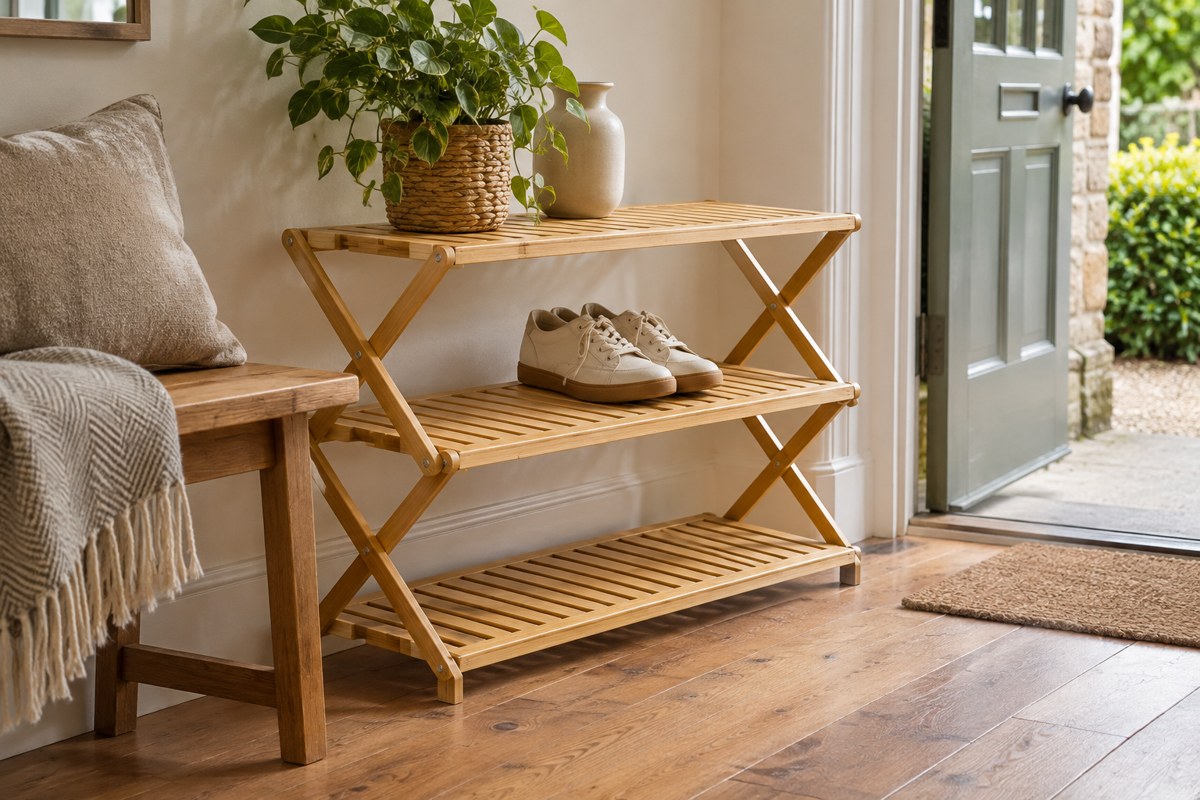
Three sizes for temporary shoe storage
These are open sizes. Ask for or measure the folded footprint if the storage gap is close.
Low two-tier option
Ashwood & Rye two-tier folding shoe rack
Two open bamboo shelves in a low folding frame. The selected listing describes tool-free setup.
- Open · W × D × H
- Approx. 45 × 27 × 25 cm
- Access
- Two open shelves
- In the pack
- One rack
What to check Check the depth with adult shoes on it and confirm the folded size against your cupboard. Leave enough room to unfold it fully.
View on Amazon — Ashwood & Rye two-tier folding shoe rackA middle height with three tiers
Glsety three-tier folding bamboo shoe rack
A compact folding frame with three slatted tiers and cross-braced sides. The listing describes unfolding it into position without assembly.
- Open · W × D × H
- Approx. 50 × 26 × 46 cm
- Access
- Three slatted tiers
- In the pack
- One rack
What to check Check that the frame is fully opened as directed and the slots support your smallest soles. Verify folded clearance before buying.
View on Amazon — Glsety three-tier folding bamboo shoe rackMore tiers on a longer wall
HOMCOM four-tier folding bamboo shoe rack
Four slatted tiers in a 60 cm-wide folding frame. The selected variant opens to 67 cm high.
- Open · W × D × H
- 60 × 29 × 67 cm
- Access
- Four slatted tiers
- In the pack
- One rack
What to check Check the loaded footprint and access at every level. Measure where you will put the whole rack after folding it.
View on Amazon — HOMCOM four-tier folding bamboo shoe rackSide-by-side dimensions
Scroll sideways to see all columns.
| Rack | Open W × D × H | Tiers | Where to start |
|---|---|---|---|
| Ashwood & Rye | Approx. 45 × 27 × 25 cm | Two | A low spot by a bench |
| Glsety | Approx. 50 × 26 × 46 cm | Three | A short stretch of wall |
| HOMCOM | 60 × 29 × 67 cm | Four | A wider wall and more shelf space |
Choose the temporary spot before counting shelves
Watch where visitors take off their shoes and where the next person stands. Open the door fully, then mark a possible rack position beyond its sweep and outside the main route. Keep room for the longest pair that will sit on the front edge. If the entrance is tight, try a nearby wall in a suitable room and keep the exit clear. A temporary rack needs the same floor and door checks as a rack that stays out every day.
Use a full-size outline of the open rack. Measure its full width at the feet and note how far the outermost part of the frame stands from the wall. Include skirting and any foot that sits farther out than the shelves. Hold a representative pair in its intended position. Add any toe or heel projection to the frame depth before comparing the route. See the hallway measuring guide for a practical check of the door and remaining floor.
Find where the whole rack will go after use
Measure the opening into the storage spot as well as its depth and height. A rack that folds thin may keep nearly all of its width. A folded frame can also need extra space for protruding feet, hinges or catches. Look for a dimensioned folded drawing or ask the seller for its outside measurements in the intended stowed orientation. Use the stated open dimensions to plan the visitor layout. Measure the real folded rack before relying on an exact fit in a narrow cupboard.
Decide how the rack will get from storage to the entrance. Leave space to lift it out without moving a stack of shoes or reaching around a cupboard door. Store it in a position where it cannot slip into the route or lean onto other items. If the storage spot is awkward and you use the rack often, see whether a fixed narrow open rack or a spare shelf would be easier.
Choose the number of shelves you can use
The Ashwood & Rye two-tier rack is the lowest option in the comparison. Its roughly 45 cm width can suit a small group beside an existing bench where the shoes and the bench still leave enough room to sit and stand. Its 25 cm overall height gives limited room between tiers. Check any tall shoe against the shelf opening or place it separately.
The Glsety three-tier rack adds a third level while keeping the width around 50 cm. The slatted shelves and cross-braced frame suit a compact spot where several pairs will fit within the loaded footprint. Try the smallest soles against the slat gaps, and use the maker’s setup instructions to check the frame and each shelf are fully open.
The HOMCOM four-tier rack provides more levels in a 60 cm-wide frame. Use it where there is enough wall span and height and where feet, door and loaded shoes all clear the route. Compare the usable gap between tiers with real shoes. Keep large wellies and muddy boots on a suitable separate boot tray or stand if they need more height or a place to drain.
Set it up empty and check the frame before loading
Open the rack on a suitable level surface. Follow the instructions for folding, clips or shelf supports and keep fingers clear of the moving joints. Check that the legs are fully open, that each shelf is supported and that the rack sits flat. Put one pair on each useful level first and try removing it before you fill the remaining space. Observe the maker’s load guidance and leave the top clear of bags if the shelves are for shoes.
After the visit, take all the shoes off and check the rack is clean and dry. Fold it as directed, keeping hold of the frame so the shelves move in a controlled way. Put the empty rack away using the route you measured. If visitors arrive often, compare the shared hallway layout to see whether keeping a spare position on an existing rack would simplify the routine.
Questions before you choose
How big should a folding shoe rack be for visitors?
Count the pairs you expect at the same time, measure them side by side and allow a hand gap. Check the resulting width and depth against the available floor.
Does a folding rack keep its full width when folded?
Many designs reduce depth while keeping much of the width. Check the folded drawing or measure the actual unit, including projecting hinges and feet.
Can I fold the rack with shoes on it?
Remove the shoes and follow the manufacturer’s folding instructions. Keep fingers clear of moving joints and store the rack empty.
Will a folding rack hold boots?
Check the shelf support, usable height and model’s loading instructions. Use a separate suitable spot for tall or dripping boots if they are awkward on the rack.
Can I use a folding rack on a rug?
Use a suitable level surface and follow the product guidance. Check whether the feet rock or catch at the rug edge once open.
Where can I use one if the hall is too narrow?
Choose a suitable spot in an adjoining room or use an existing shelf. Keep the doorway and escape route clear.
How this shortlist was assembled
We checked three exact Amazon UK offers and compared the listed open sizes and folding designs. Small differences in the rounded Glsety width are shown as approximate. We use open dimensions here because the selected listings did not provide comparable folded measurements for all three.