
Best opaque storage boxes for open shelves
Compare fabric cubes, a labelled hardboard box and solid plastic storage. Check handles, lid access, packed shape and how you will identify concealed contents.
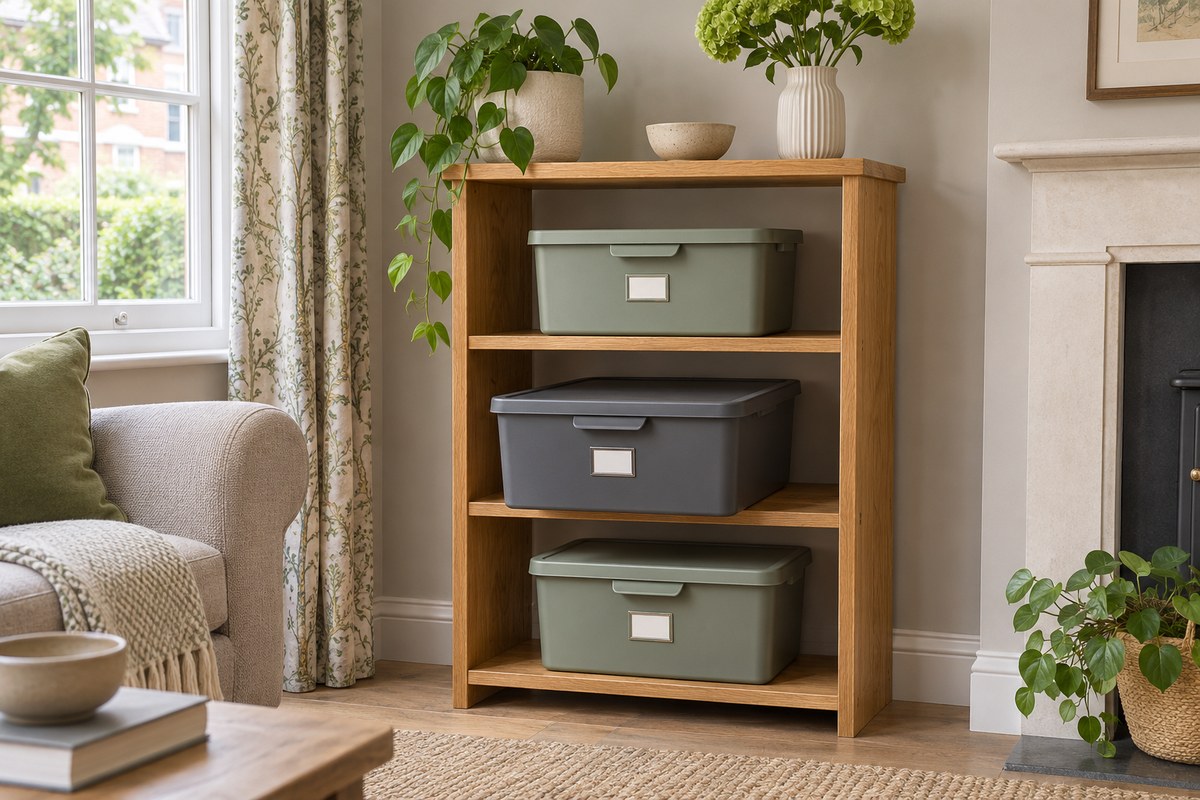
Three materials for concealed shelf storage
These are the selected colours and packs. Check the complete outside shape and the room needed for each top lid.
Lids and room around the insert
Febzoce light grey and white lidded cubes
Three foldable fabric boxes with lids and cutout grips. Each has 30 cm outside sides.
- Outside per box · W × D × H cm
- 30 × 30 × 30
- Access
- Lift-out lidded box
- In the pack
- Three boxes
What to check Check the lid movement and plan to withdraw the box if there is little room above it.
View on Amazon — Febzoce light grey and white lidded cubesLabel holder and fold-flat storage
Leitz Click & Store medium white box
A lidded laminated-hardboard box with metal carrying handles and a front label holder. It folds flat when empty.
- Outside · W × D × H
- 28.1 × 37 × 20 cm
- Access
- Top lid and front label holder
- In the pack
- One box with lid
What to check Use the maker’s width, depth and height: Amazon fields swap the last two. Leave room for the handles and remove the box to lift its top lid if needed.
View on Amazon — Leitz Click & Store medium white boxSolid sides with a removable lid
Curver Infinity plain white 17L box
A rigid opaque box with cutout handles and its matching removable lid, for concealed groups on an open shelf.
- Published outside size
- 36.3 × 27 × 22.2 cm
- Access
- Cutout grips and top lid
- In the pack
- One box with lid
What to check Check the complete footprint and the grip space. The maker rounds dimensions to 36 × 27 × 22 cm; the selected listing gives 36.3 × 27 × 22.2 cm.
View on Amazon — Curver Infinity plain white 17L boxSide-by-side dimensions
Scroll sideways to see all columns.
| Box | Outside size | Material / pack | Identification |
|---|---|---|---|
| Febzoce cubes | 30 × 30 × 30 cm each | Fabric; three | Suitable separate tag |
| Leitz medium | 28.1 W × 37 D × 20 H cm | Laminated hardboard; one | Built-in label holder |
| Curver Infinity plain 17L | 36.3 × 27 × 22.2 cm | Rigid plastic; one | Suitable removable label |
Choose concealment around the things you need to find
Opaque boxes can give an open shelf a calmer appearance while keeping mixed household groups out of view. Begin with the contents you need to retrieve together. A cube of spare textiles, a small archive group and a rigid container for everyday supplies need different interiors and handling. Measure the widest and tallest items before choosing a box around the shelf’s appearance alone.
Decide how you will identify each group once it is concealed. A built-in label holder works where its front faces the room. A removable contents label or suitable tie-on tag can work on a fabric grip where the maker permits it. Use a short description that another household member can understand. Do not fill three visually identical boxes and rely on remembering which one contains the spare cables.
Keep the container material in mind. A fold-flat fabric cube, laminated-hardboard archive box and rigid plastic tub have different cleaning and storage instructions. Choose the material around the contents and the room conditions. A lid provides coverage as designed by its maker; it does not establish that an ordinary shelf box is sealed or suitable for every material stored inside it.
Measure the closed box and the movement of its lid
Measure the clear shelf opening between uprights, at the front and behind any frame. Record supported depth and the height to the underside of the next shelf. Compare the complete closed box, including grips and lid overhang. Check whether you can take hold of the handle before committing to a snug fit. The space left above an empty box may disappear when soft contents push its lid upwards.
Check the complete removal route, including nearby furniture and doors. A box may slide out straight but need space to turn once it leaves the shelf. Use a paper footprint or empty carton to try the movement. The shelf measuring guide explains how outer fit and usable inside space differ, while the cube guide compares inserts against the actual bay opening.
Compare fabric, hardboard and solid plastic formats
The Febzoce three-pack provides light grey and white fabric cubes, each 30 × 30 × 30 cm outside, with lids and metal-edged grip holes. It is useful where a square group suits the shelf and you can withdraw the cube to open it. The boxes fold flat when empty. That is a different storage method from nesting rigid tubs. No dedicated label holder is established for this exact offer, so plan a suitable separate identification method.
The Leitz Click & Store medium box is one white laminated-hardboard box with a top lid, carrying handles and a label holder. The manufacturer specifies 28.1 cm width, 37 cm depth and 20 cm height. Some Amazon fields swap depth and height, so use the maker’s orientation for the shelf plan. It folds flat when empty. Check the broad front grip and the place where you will set the box down to remove its lid.
The Curver Infinity plain 17L box is rigid solid-sided white plastic with cutout handles and a supplied removable lid. The selected listing gives 36.3 × 27 × 22.2 cm outside; Curver’s catalogue rounds the dimensions to 36 × 27 × 22 cm. Use the complete selected footprint and check the handle position. This is the plain version, so the storage comparison does not rely on the ventilation holes of a different Infinity variation.
Make the concealed contents easy to return
Put the frequent group where its label and grip remain visible. Keep the heaviest suitable group low and check the exact shelf load limit with the packed boxes. A concealed collection can become denser over time because its contents are less obvious. Review the label and weight when a box changes purpose, particularly when replacing textiles with books or tools.
Try taking one item out and putting it back in its normal place. If you have to empty the box to find a small piece, divide the group or use an appropriate inner tray. If the lid stops closing flat, reduce the contents or choose a taller supported bay. Keep room for the return rather than filling every gap at the first tidy-up.
For occasional boxes that need less space when empty, compare nesting storage boxes. For a utility location, follow the cupboard planning guide before allocating space around controls, service access or household products.
Questions before you choose
Are opaque boxes better for open shelves?
They conceal mixed contents. Choose them where you can identify each group and still remove the box comfortably; visibility may be more useful for other supplies.
Will a 30 cm cube fit every cube shelf?
Measure the clear opening and lid overhang. You also need room to grip and withdraw the box, so matching nominal dimensions alone are insufficient.
Which selected box has a label holder?
The white Leitz Click & Store medium box includes one. The exact Febzoce and plain Curver offers have no established dedicated label holder.
Can I open the lid while the box stays on the shelf?
Check the lid movement and headroom. Withdraw it to a suitable surface if the shelf above prevents normal opening.
Do these boxes all fold flat?
Febzoce’s fabric cubes and the selected Leitz hardboard box collapse as instructed. The rigid Curver plain box uses a different construction.
How this shortlist was assembled
We checked the selected Amazon UK pack, colour and included lid for each box. Leitz’s maker specification resolves reversed marketplace depth and height fields; Curver’s catalogue rounds its dimensions. Material and access comparisons use the exact variants.