
How to set up shoe storage by the back door
Plan where to take off muddy shoes, measure a tray against the actual soles and keep wet footwear separate from dry pairs.
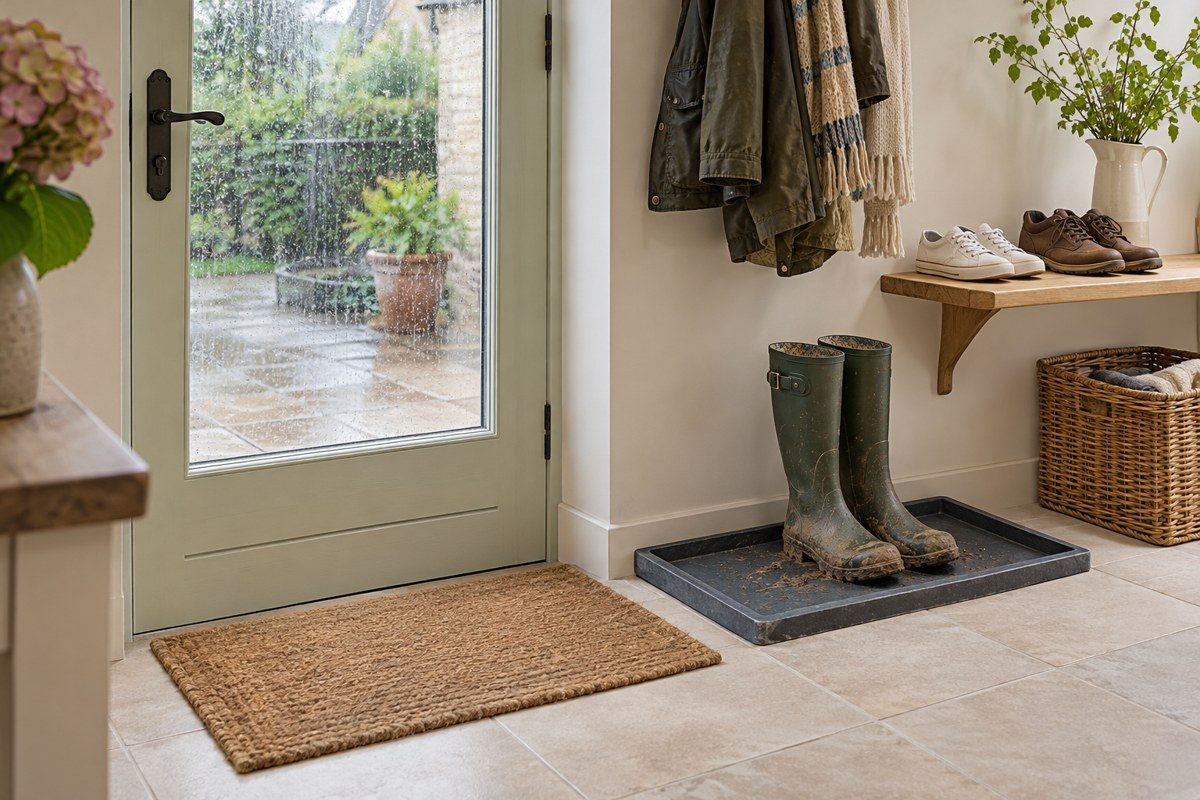
The main decision
Give muddy footwear a place to drain out of the way
Keep the threshold and door swing clear. Put a suitable tray where you can step out of wet shoes, then give dry pairs their own accessible shelf or cupboard.
Map where you step in and take your shoes off
Open the back door fully and mark its swing on the floor. Include the lower edge over the mat, any threshold and the handle where it passes the wall. If the door opens outward, check the space needed to enter and close it from inside as well. Keep that movement clear, along with the route people use to get through the room. Measure with everyday fixtures in use, such as an adjacent cupboard door or an appliance that opens into the same area.
Decide where you naturally stop when taking off muddy shoes. If that spot blocks the door, choose an area to one side or a nearby utility space. Put the wet footwear tray close enough that muddy soles can reach it in one step. Avoid putting the tray where everyone has to cross it to reach the next room. Check whether you can lift the tray for cleaning without passing it over a pile of shoes.
The location of the mat matters too. Use a suitable mat that lies flat and stays clear of the door’s lower edge. A tray and mat side by side can work where you have spare width. Where you have depth instead, put the tray beyond the edge of the mat and beside the walking route. Walk the arrangement with the door in normal use and with anything you regularly carry through it.
Size the wet zone for the soles you actually use
Stand the wet-weather pairs together on a sheet of paper. Trace their outline as they naturally sit and measure the width and depth of the group. Measure a candidate tray across the flat inner base. The lip can flare out or curve inwards, so the outside dimensions alone will not show whether boots can stand flat. Leave room to lift a boot clear of its neighbour without knocking it over.
Three compact trays can be easier to position than one long tray when there are separate places to change shoes. The Relaxdays trays have an inside base about 34.5 × 24.5 cm each. Trace the wet pair first, especially for adults’ walking boots. Leave enough room for the raised edge and a hand to lift the tray.
Separate small wet-shoe spots
Relaxdays compact boot trays, three-pack
Three shallow rimmed trays. Each has a published flat inside area of about 34.5 × 24.5 cm.
- Outside · W × D × H
- 35 × 27 × 3 cm each
- Access
- Open raised-edge trays
- In the pack
- Three trays
What to check Lay out the actual soles before choosing a position. Check that the rim sits outside the door swing and walking route.
View on Amazon — Relaxdays compact boot trays, three-packKeep tall uppers upright where their maker directs, with space above to lift the boots out. If there is a low shelf above, measure from the tray base, including the tray lip and the movement needed to get a boot free. For several pairs of walking boots or wellies, the boot storage guide compares open racks, trays and stands by how they support different shapes.
Dry footwear before moving it to a clean shelf
Remove dirt and dry the footwear as the maker directs. Different materials need different care. Some walking boot makers advise airing wet boots at room temperature and keeping them away from direct heat. Check the instructions before removing an insole or applying anything to the upper. A tray protects the floor from ordinary drips while a pair is airing. Take the tray out and empty or clean it when needed, and dry the floor below it before putting it back.
Keep dry shoes where they are easy to pick up without standing in the wet area. If there is room, use a short shelf for the pairs you need to leave the house again. A closed cupboard can hold clean dry shoes when it is suitable for them. If the back door is the route to a garden or dog walk, keep ready-to-wear pairs with the things you take out at that door, as long as the rest of the route remains clear.
Keep the system usable on a wet day
Set up the space and bring a representative group of shoes back through the entrance. Check the door closes fully and that the wet pairs can all be placed with their soles flat. Watch where the next person stands while the first changes shoes. If the tray has to move each time, use a different wall or reduce the number of pairs stored at the entrance. A damp spare pair is often better moved to a suitable drying spot elsewhere.
If boots come in from a garden path, put any outdoor scraper where it can be used without obstructing the threshold or making the indoor mat bunch. Bring footwear inside to the tray when it is ready to drain or dry as directed. Keep the tray and the clean shelf separate so that a quick change into dry shoes does not track grit across the room.
Keep only the regular wet-weather footwear in the wet zone. Clean the mat and tray on the schedule that suits how they are used, and move dry pairs out as the group changes. Use the shared hallway guide if household allocation is the main issue, or the children’s shoe layout if smaller pairs need their own reachable spot.
Questions before you choose
Where should the boot tray go?
Put it beside the changing spot, outside the door swing and walking route. Check that you can lift it out to clean it.
Do I measure the outside of a boot tray?
Measure the outside for the floor position and the flat inside base for the soles. The raised rim can reduce usable width and depth.
Can I put a tray over a doormat?
Check that both sit flat and stay in place on the floor as intended. Moving them apart is usually easier if the mat bunches, the tray rocks or the door catches.
How do I dry wet walking boots?
Follow the maker’s care instructions. AKU advises drying its footwear in a ventilated place away from direct heat.
Can damp shoes go into a cabinet?
Let them dry fully as directed before putting them in a suitable closed unit. Keep the drying area easy to clean.
What if the back door opens straight into the kitchen?
Use an adjacent spot with a clear route for people and the door. If it is too tight, choose a suitable utility or drying area nearby.
How we put this guide together
We used manufacturer care instructions for walking boots and wet school shoes, and compared outside tray size with the flat base in the worked example.