
How to store wrapping paper under the bed
Compare complete roll length with usable case dimensions, then calculate orientation and withdrawal space for under-bed wrapping-paper storage.
The main decision
Fit the longest roll along the usable base
Measure the cardboard tube end to end and check the usable inside length of the case. Then test the whole case under the bed, including the space to pull it clear and lift out a roll.
Measure across the roll, including the core
Put your longest rolls on a clear surface and measure each one from end to end along the cardboard core. Check any tube that extends beyond the paper and any protective end cap you want to keep. The length of paper advertised on the label describes how much unrolls. For example, a 70 cm wide, 3 m roll usually needs space close to 70 cm along the core, plus whatever extends at the ends. Measure the roll you have before buying a case.
Measure the thickest roll as well, including crumpled outer layers if you want to keep them. Set your intended number of rolls next to each other and check the width across the group. A single layer keeps the rolls visible and the case shallow. If you have to stack them, measure the loaded height over the largest two rolls and check that it leaves room to close the cover without pressing on the paper.
Use the internal base length when you compare cases. A rigid box can taper towards the floor, and a soft case can have rounded ends or padded dividers. A quoted external length can therefore overstate the length available to a straight roll. Check the zip opening too. A long case with a short opening may take the roll only when you angle it, which takes more room and can crease the edge. Look for a top that opens far enough to let you lift a roll out flat.
Plan how a long case moves under the bed
The case needs a straight path in and out, or enough room to turn. Measure between the legs and any centre support, then measure the depth behind that opening. A case that spans two short bays can be impossible to withdraw sideways even if you can push it lengthwise from the foot. Use a cardboard footprint the size of the closed case and try it from the side or end that you can usually reach.
Check the part that lifts as you pull. For a soft case, the handles and filled seam can rise when the end reaches a rug or carpet edge. For a rigid case, include clips, a lid rim and any wheels. The under-bed measuring guide shows how to mark the narrowest opening, the inside bay and the space in the room that you need to use the case.
Check the complete roll against the inside length
We compared four complete roll lengths with the Really Useful 22L’s 75 cm minimum inside length. The maker’s 80 cm outside length includes the lid and handles; it describes the case’s footprint, not the available space for paper. A 30-inch complete roll converts to 76.2 cm and exceeds the straight inside length by 1.2 cm, even though the outside length appears to leave 3.8 cm.
Swipe to compare each straight-length result.
| Complete roll length | Inside-length difference | What the subtraction establishes |
|---|---|---|
| 70 | 5 | 5 left before end access and shape checks |
| 75 | 0 | Equal length; no numerical end clearance |
| 76.2 (30 inches) | -1.2 | Exceeds straight length by 1.2 |
| 100 | -25 | Exceeds straight length by 25 |
Length gauges · one case
Outside length and usable length answer different questions
The bars share one starting reference to compare lengths. The complete roll extends 1.2 cm beyond the minimum inside length; the larger outer bar cannot make that missing interior space usable.
These are one-dimensional gauges, not a drawing of the box’s wall thickness, taper or exact position of its cavity.
Why the empty corner-to-corner diagonal is insufficient
The 75 × 21 cm minimum rectangular interior has a calculated corner-to-corner diagonal of 77.88 cm. That describes a line with no thickness. It cannot establish whether a real roll can lie diagonally, close beneath the lid or pass through the opening.
At one illustrative 12° angle, a 76.2 cm-long, 5 cm-diameter rectangular roll envelope needs 75.57 cm along the case and 20.73 cm across it. The width is within 21 cm, but the length still exceeds 75 cm. This one-angle check is not a solver for every possible angle; it shows why comparing a roll length only with the empty diagonal can mislead. Rounded corners, tapered walls and the way the roll enters add constraints.
Now compare the case’s outside withdrawal route
For a separate illustrative 90 × 85 × 18 cm bed bay, both orientations of the rigid box’s 80 × 25.5 × 15.5 cm exterior are within the static bounds. The opening is 85 cm wide and the clear straight withdrawal distance outside is 40 cm. The front of the case starts flush with the bed edge.
| Case orientation | Across × front-to-back | Opening-width difference | Full straight withdrawal | Withdrawal-distance difference |
|---|---|---|---|---|
| Long side across | 80 × 25.5 | 5 | 25.5 | 14.5 |
| Short side across | 25.5 × 80 | 59.5 | 80 | -40 |
Plan view · long side across
80 cm opening span, 25.5 cm withdrawal
The case sits inside the same 90 × 85 cm bay in either orientation. The usable opening spans 85 cm. The gold strip outside represents the illustrative 40 cm clear withdrawal distance.
The movement is 14.5 cm shorter than that clear distance; grip, support and lid access remain separate.
Plan view · short side across
25.5 cm opening span, 80 cm withdrawal
The case sits inside the same 90 × 85 cm bay in either orientation. The usable opening spans 85 cm. The gold strip outside represents the illustrative 40 cm clear withdrawal distance.
The required straight movement extends 40 cm beyond that clear distance.
Putting the long side across the opening needs 80 cm of opening and 25.5 cm of straight movement, leaving a 14.5 cm withdrawal-distance difference. Turning it reduces the opening width needed to 25.5 cm but increases full withdrawal to 80 cm: 40 cm more than this example provides. The orientation that is easiest to pass between bed legs can be the one that cannot come fully out into the aisle.
Neither route repairs a roll that is too long inside the case. Solve the inside-length question and the outside-route question separately. For the longer soft case below, keep its seller-stated roll limit separate from a minimum internal base measurement, and check its loaded outline rather than transferring these rigid-box results.
Choose a case for the floor and how often you wrap
A low rigid box helps protect paper edges against bumps from other boxes. Compare its inside shape with the longest roll, then check how much room you need to unclip and lift the lid. A half-opening lid can help in a tight aisle only if its opening lets you lift a roll without bending it. The rigid under-bed box guide shows how outside and inside dimensions differ.
The clear 22L boxes suit shorter rolls whose core and ends fit inside the 75 cm base. Choose a position where you can remove the clip lid and lift out the rolls without bending them.
Rigid storage for shorter rolls
Really Useful Box 22L Clear, two-pack
Two rigid clear boxes with removable lids. The maker publishes a 75 cm minimum inside length and an 80 cm outside length.
- Outside size
- 80 × 25.5 × 15.5 cm each
- Access
- Removable clip lids
- In the pack
- Two boxes with lids
What to check A true 30-inch roll measures 76.2 cm and exceeds the published inside length for a straight fit. Check the length including the core.
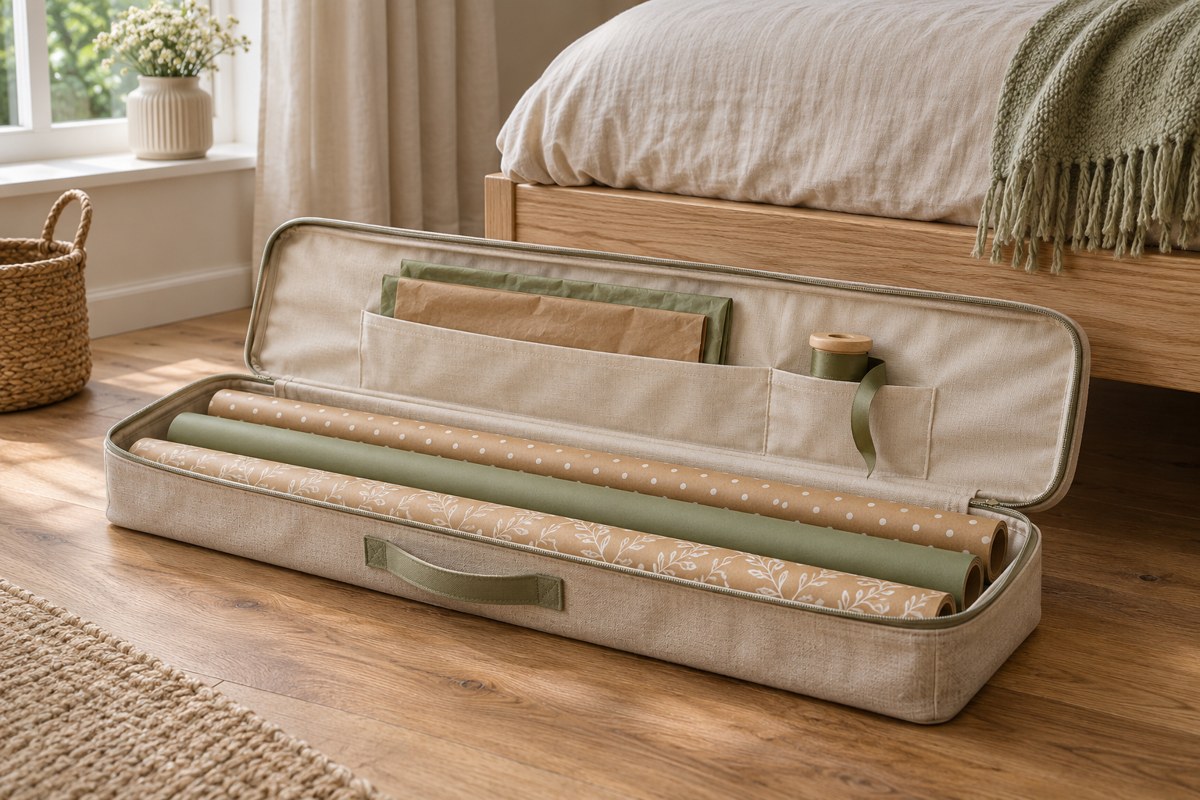
View on Amazon — Really Useful Box 22L Clear, two-packA long soft zip case is easier to carry empty and may fit under a lower bed. Check that the base supports the paper when you lift it and that the case keeps its shape once loaded. Lift it with the maker’s carry handles and support the ends if needed. If you take it out for just a few occasions each year, protect the roll ends and put frequently used wrapping supplies somewhere smaller and easier to reach.
The red BRANTMAKER zip case is sold as an option for rolls up to 101.6 cm long. Its outside footprint is about 103 × 36 cm, so use a floor template before buying if the route is narrow. The pockets keep small supplies separate from the paper.
Long rolls in a full-length zip case
BRANTMAKER wrapping-paper case
A long zip case with separate pockets and repositionable dividers. The listing states a maximum roll length of 101.6 cm.
- Nominal outside size
- Approx. 102.9 × 35.5 × 15.2 cm
- Access
- Zip opening and carry grips
- In the pack
- One case
What to check Treat that roll length as the seller’s stated limit. Check the actual roll and whether the long case can move past your bed supports.
View on Amazon — BRANTMAKER wrapping-paper caseKeep the rolls and the small supplies separate
Lay rolls in a single direction, with similar sizes grouped loosely. Put gift bags, tissue and flat tags in a separate shallow sleeve or pocket. Put tape, ribbon and tools in their own small pouch where they cannot press into the paper. Keep scissors in a suitable place if children can reach the case. If there is no pocket, use a flat pouch at the end only where the rolls leave a gap and the pouch cannot slide over them.
Use a dry location and let damp floor coverings dry fully before returning the case. Check the condition of exposed paper edges before putting part-used rolls away. When a seasonal case goes back under the bed, put the handle where you can reach it without moving another box. Mark the group with a simple description such as birthday wrap or seasonal rolls. The same retrieval check works for other long supplies: if the items have to be lifted out as a single bundle, leave enough hand space at both ends and enough room in the aisle to set the bundle down.
Questions before you choose
What length of case fits a 3 m roll of wrapping paper?
Measure the complete roll along its tube, including caps or protruding ends. The 3 m figure describes the paper that unrolls, not the length the case must hold. Compare the measured roll with usable inside length.
Can I use the box diagonal to fit a longer roll?
A corner-to-corner diagonal describes a line without thickness. A real roll needs length and diameter in its angled footprint, plus a route through the opening. One successful length comparison does not establish that route.
How much clearance should I leave at the roll ends?
Choose enough for the actual way you grip and lift it, including taper, padding and caps. Equal roll and inside lengths leave no numerical end clearance; there is no universal allowance for every case.
Is a zipped case or a rigid box better?
Compare usable length, loaded shape, access and the outside route. A rigid box has a defined footprint and lid movement. A soft case may be easier to carry, but its nominal outside length is not a minimum usable interior.
What if the case fits below the bed but cannot come out?
Compare both orientations against the opening width and full withdrawal distance. A shorter front-to-back orientation can need more opening width. Do not assume you can turn around a bed support; use a different suitable route or storage location.
How we put this guide together
We checked UK wrapping-paper dimensions from paper makers and compared published internal and external measurements for dedicated roll boxes. The worked example shows why a roll can exceed the usable length of a case.
Our comparison uses the inputs below and the stated formulas. Room dimensions and handling allowances are illustrative; named product dimensions are kept separate from them. Analysis prepared November 2026.
- Inches to centimetres = inches × 2.54.
- Straight length difference = minimum inside case length − complete roll length including tube and caps.
- At a chosen plan angle θ, rectangular bounds are L cos θ + D sin θ across and L sin θ + D cos θ front to back.
- Full straight withdrawal distance = complete outside case dimension front to back, with its front initially flush with the bed edge.
Calculations use unrounded inputs. Displayed results are rounded to two decimal places where necessary.
- Really Useful 22L dimensions: approximate outside maxima including lid and handles 80 × 25.5 × 15.5 cm; minimum inside dimensions 75 × 21 × 14 cm. Each pack contains two of that box.
- The 70, 75, 76.2 and 100 cm complete roll lengths are comparison inputs, not paper-maker product claims. Thirty inches converts exactly to 76.2 cm; any projecting tube or caps must be included.
- The 5 cm roll diameter and 12° plan angle are illustrative. This single-angle comparison does not prove or disprove every diagonal route. Rounded corners, taper and access are additional constraints.
- The 90 × 85 × 18 cm bed bay, 85 cm opening and 40 cm clear withdrawal distance are illustrative. The front starts flush and movement is straight, with no supports or changing height along the route.
- The BRANTMAKER catalogue gives approximately 102.9 × 35.5 × 15.2 cm outside and a seller-stated roll limit of 101.6 cm, not a verified minimum internal rectangular base. It is not substituted for the rigid box in the scenarios.
- Positive differences do not establish grip room, lid opening, loaded soft-case shape or a complete retrieval route.
Sources: Really Useful 22L internal and external dimensions; Existing exact BRANTMAKER red case Amazon UK listing.