
How to store down bedding without compression
Follow your duvet’s care instructions, choose a breathable case that allows a loose fold and find a dry shelf with room for the filling.
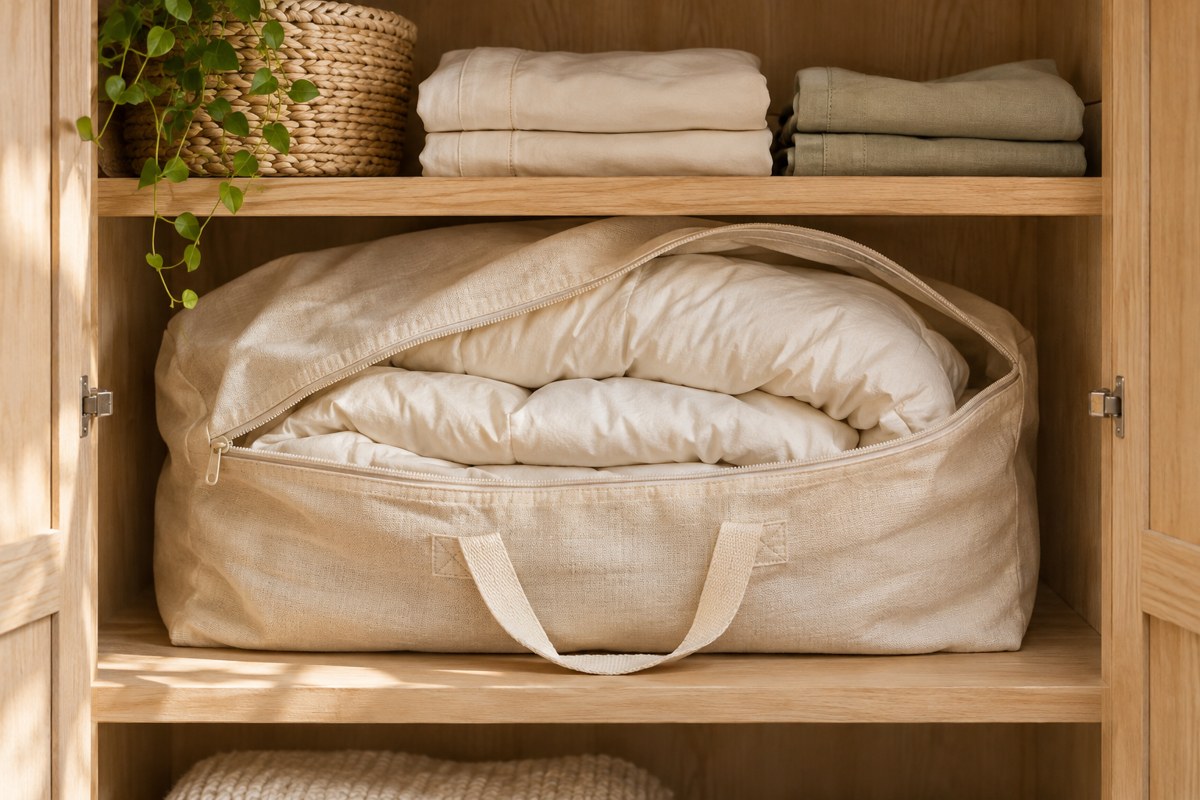
The main decision
Leave enough room for the filling to stay loose
Follow the duvet maker’s care guidance. Where it calls for uncompressed storage, use a clean, breathable case and a dry shelf with enough room for the relaxed fold. Store heavy groups elsewhere.
Read the guidance for your exact filling
Find the care label and, if possible, the maker’s instructions for storing the particular duvet or pillow. Scooms, for example, recommends a breathable storage bag for its down bedding. Downmark’s general care guidance also recommends a breathable bag in a dry location and leaving the filling uncrushed. Apply the directions for your own item, especially if the duvet includes other materials or has separate layers that can be stored individually.
If a vacuum bag advertises a bedding setting, check whether your duvet maker permits that storage method. When the duvet’s directions call for uncompressed storage, keep the filling loose. Temporary packing in the original shipping box does not establish a suitable way to store it between seasons. Save the original breathable storage case where the maker supplies one and it is still in good condition.
Decide whether the duvet needs cleaning before putting it away and follow the care directions for any permitted cleaning. If it has just been cleaned or dried, allow the filling to dry completely, including the middle of thick sections and around the seams. Spread it out in a suitable dry, aired room before packing. If it feels damp, smells musty or seems unusually clumped, leave it out and check the maker’s advice before putting it in a bag.
Choose a breathable case with enough room
Lay the duvet on a clean surface and bring it into a loose fold or roll as its maker recommends. Measure the widest and thickest points after you let go. Check the opening of the bag against that relaxed shape. You should be able to place the duvet inside and close the bag without pushing down on the filling or forcing the zip. If the bag only closes while you sit on it or hold it down, choose a larger case or another location.
If you need a replacement for the original bag, confirm the material is suitable for the bedding maker’s directions. A light fabric case of suitable size can keep dust off while allowing airflow. A windowed case with a zip does not necessarily provide the same airflow as the original. Where the maker permits it, a suitable clean cotton cover can be an option if it stays around the duvet without a tight tie. Keep the case itself dry and clean before packing.
Use a dry place that lets the filling sit loose
Look for a clean cupboard or wardrobe shelf with enough space around the bag and no heavy storage pressing on top. If you use under-bed space, check that the floor and the surrounding area stay dry, and that the bag will slide in without being flattened by a rail or pulled against a rough edge. A spare shelf is often easier to access than a low bed opening for this particular job. The under-bed bedding guide covers flat linen groups you can store separately.
Keep the case away from leaks and areas where you regularly see damp or condensation. A breathable case cannot correct a damp cupboard. If the location changes with the season, use a drier position that you can check without moving several heavy boxes. Give the bag a clear front grip and enough space to lift it out. For a two-part duvet, check whether storing the layers separately makes handling easier while leaving each layer loose.
If you store spare covers in the same cupboard, put them in their own light case beside the duvet. Avoid a tightly stacked pile where a dense cotton bundle flattens the down underneath. Use a removable label on the bag so you can see which tog or bed size it holds without opening every case.
Air and check the duvet before putting it back on the bed
Open the case in a clean, dry room. Spread the duvet out and allow it to air as directed, then gently shake it if the maker recommends it. Inspect the cover and seams and see that the filling has recovered an even distribution. A persistent smell, dampness or clumping warrants checking the maker’s cleaning and care guidance before use.
If you use the duvet seasonally, keep a note of how it sat in the bag and whether the shelf worked for lifting it down. For next time, adjust the location or the fold if the bag was hard to retrieve or the filling was pressed against the shelf above.
Once you have unpacked it, allow the storage bag to dry if necessary and keep it ready for the next seasonal change. If you are deciding which other bedding can be packed more tightly, see vacuum bags vs fabric cases. Treat each filled item separately from sheets and covers so a convenient storage method for one group does not dictate the care of the rest.
Questions before you choose
Can I use a vacuum bag for a down duvet?
Use the storage method specified by the duvet maker. If it recommends breathable storage without compression, use a suitable case and leave the filling loose.
Should I wash my duvet before storing it?
Follow its care label and the maker’s advice. Store it clean and completely dry throughout, including the filling, before closing the case.
Can I reuse the bag the duvet came in?
Reuse the original storage bag if the maker intended it for that purpose and it is clean and in good condition. Shipping packaging may have a different purpose.
Can I use a pillowcase or cotton sheet?
Check the bedding maker’s instructions. Where a loose cotton cover is suitable, use a clean one big enough to hold the relaxed fold without squeezing it.
Can down bedding go under the bed?
Only if the area stays clean and dry, and the loosely packed bag fits without catching or being flattened. A taller cupboard shelf may be easier to use.
What should I do when I take the duvet out?
Air it as directed, inspect the seams and filling and gently shake it if the maker recommends that. Check care guidance if dampness, mustiness or clumping persists.
How we put this guide together
We reviewed Scooms, Downmark and Norvegr care guidance for down bedding. The shelf example is illustrative. Follow the manufacturer’s instructions for your particular duvet or pillow.