
Vacuum bags vs fabric storage cases for clothes and bedding
Compare when to compress clothes and bedding, how each format opens, and what to measure once a bag is filled or sealed.
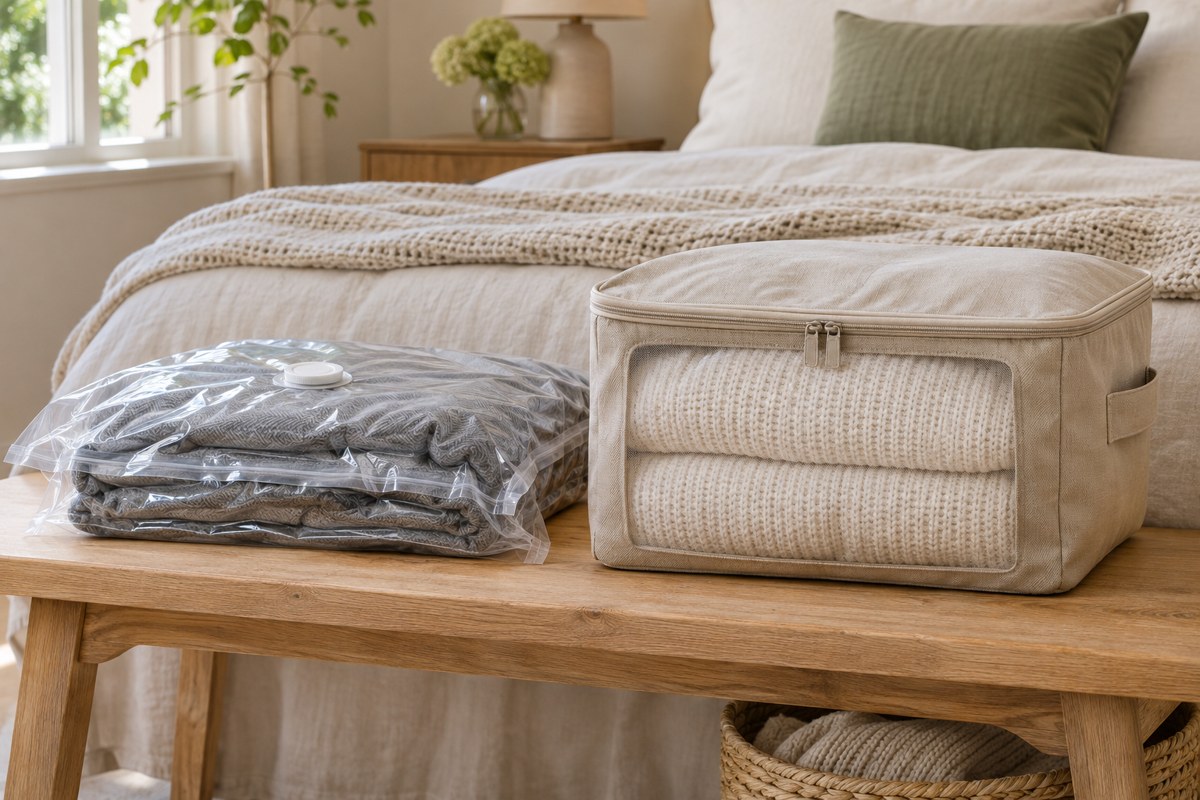
The main decision
Choose by textile care, access and the packed shape
Use a fabric case when the contents need loose storage or frequent access. Use a vacuum bag for suitable seasonal groups when the sealed bundle fits the actual shelf. Measure each option as you will store it.
Check whether the textiles can be compressed
Start with the individual textile’s care label and the maker’s storage instructions. Some down bedding makers specify a breathable case and advise against vacuum compression for their products. A vacuum bag manufacturer can tell you how to pack its bag. The textile maker determines whether that treatment suits the item. If the guidance calls for loose packing or airflow, choose a suitable breathable case in a dry location. Our down bedding storage guide covers what to do with a bulky duvet that needs that treatment.
Consider the contents of each group separately. Flat cotton bedding, a synthetic duvet and a wool coat may have different care needs. Separate any item that would otherwise dictate a less suitable packing method for the group. If you are unsure whether a shaped or delicate garment can be compressed, keep it in the care method the maker recommends and check with them before changing it. Store everything clean and completely dry whichever format you use.
Decide how often you will open the pack
A fabric case usually makes it easier to retrieve one item and close the case again. If you take a set of sheets out each week, put complete groups side by side and open the zip only as far as you need. Check that the lid or flap opens in the aisle where you use it. If the case can only open after it comes all the way out, keep its carry grips accessible.
A vacuum bag adds a resealing step. Once opened, a pack may expand and need folding and evacuating again before it fits on the shelf. Set aside seasonal groups in separate bags where that work is worthwhile. A single oversized bag can take several kinds of clothing, but you may then need to open and pack everything again to get one jumper. Use the sealing guide when you have chosen the contents and know that compression suits them.
The WENKO Balance example is a 105 cm long fabric bag with a three-sided zip. It illustrates a case that opens broadly for groups of flat linen, provided the bay has a long, clear run. Its window and nominal size do not establish that it meets a down duvet’s breathable storage instructions.
Single long fabric case
WENKO Balance under-bed bag
A single non-woven case with a wide zipped opening for arranging folded textiles. It avoids buying a multipack when you need only one long bag.
- Nominal bag size · cm
- 105 × 45 × 15
- Access
- Three-sided zip, large viewing window
- In the pack
- One bag
What to check The 105 cm length needs a long clear bay. Treat 15 cm as a nominal height and check the packed shape. Do not assume a machine-washable or waterproof construction.
View on Amazon — WENKO Balance under-bed bagIf you are choosing for a mix of weekly and seasonal items, try two groups with different jobs. A case for weekly changes and a smaller compression bag for suitable seasonal pieces can be easier to manage than a single large container. Put each one in the position where it can come out independently.
Measure the two formats in their usable shape
Use the same clean fold as your starting point. In a fabric case, measure the thickest part after zipping it normally. Include a raised seam, handle or padded edge. Look for a case with an opening wide enough to set the fold in without twisting it. A framed fabric case keeps its outside shape, while a softer bag may change width or height with its contents.
The Genie Space Small pack illustrates the other end of the comparison. The 60 × 40 cm size suits small groups where the fold fits the mouth and the clothing maker permits compression. It includes a manual pump, so plan where you can set the group down to reseal it each time.
For small, separate clothing groups
Genie Space Small vacuum bags with hand pump
Six same-size flat bags with a double zip, capped valve and supplied manual pump.
- Nominal empty bag size
- 60 × 40 cm each
- Access
- Double zip and capped valve
- In the pack
- Six bags and hand pump
What to check Measure the usable opening and leave room around the zip. Small dimensions suit compact folds, not every bulky jumper.
View on Amazon — Genie Space Small vacuum bags with hand pumpFor a vacuum bag, check the mouth, fill line and empty dimensions, then measure the sealed bundle. Include the valve, the thickest fold and any folded film at the end. Place the valve where it will stay clear of the edge as the bag slides into place. A flat bundle can need more width and depth than a loose case, even if it takes less height. The size printed on the empty bag does not give you the sealed footprint.
Allow for the shelf, surface and weight
Make room for the whole base and the way you grip the bundle. Avoid putting a sealed bag where the valve is pressed against the shelf above or the film catches a rough corner. A case with enough support and a grip at the front can be easier to remove from a deep shelf. For under-bed use, check the whole route past the rail, legs and floor coverings. The under-bed case comparison gives examples of different openings and packed shapes.
Compression changes the shape and bulk. You still have nearly the same weight of textiles to lift. A dense bag can be harder to handle on a high shelf than two smaller groups. Use an appropriate supported location and choose a group size you can lift easily. Compare the bedding bag formats for suitable bulky pieces or hand-pump packs for clothes if you need to reseal a smaller group without a vacuum cleaner.
Questions before you choose
Do vacuum bags always use less shelf space?
They can reduce thickness for suitable textiles. The bundle can also spread wider and a valve can project. Measure all sides and the cupboard opening after packing.
Which format suits clothes I use every week?
A fabric case often lets you take out one item and close the case again without resealing a whole bundle.
Can I use a vacuum bag for down bedding?
Follow the bedding maker’s instructions. If they call for loose breathable storage or rule out compression, use a suitable breathable case.
Does vacuum packing make a bundle lighter?
Removing air changes the shape and bulk. The textile weight remains nearly the same, so keep the group easy to lift.
Can I use a fabric case in a damp cupboard?
Use a suitable dry location for both formats. A breathable case or sealed bag does not correct a damp storage area.
What should I measure once I have packed the bag?
Check width, depth and height at the widest and highest points. Include handles, seams, valve and folded film, then check the route and grip space.
How we put this comparison together
We reviewed the bag makers’ closure and packing instructions alongside bedding care guidance from Scooms. The packed dimensions are illustrative. The two products show how access and nominal size differ between formats.